How to Read a Research Paper: A Non-Specialist’s Guide to Claims, Methods, and Limits
Read a research paper in three passes, reconstruct its claim and design, test its evidence, and state what the study does not establish.
Read a research paper in three passes. First decide whether it is relevant and identify its question. Second map the study design, measures, comparisons, and results. Third reconstruct the main inference and its limits. You do not need to decode every equation, but you do need to know what evidence would make the conclusion stronger, weaker, or inapplicable.
The reading problem this solves
A research paper is not a textbook chapter. It is a compressed argument addressed to a specialist community: a question was framed, a method selected, observations produced, and an inference defended. Reading from the first word to the last can therefore create an odd result. You understand many sentences but cannot say what the study established.
This guide is for a careful non-specialist—a policymaker, designer, founder, teacher, journalist, or independent researcher—who needs to use a paper without pretending to possess the authors’ expertise. It is not a shortcut to professional competence. It is a way to expose the paper’s load-bearing decisions so that you know what you understand and where to ask for help.
Start with four boxes
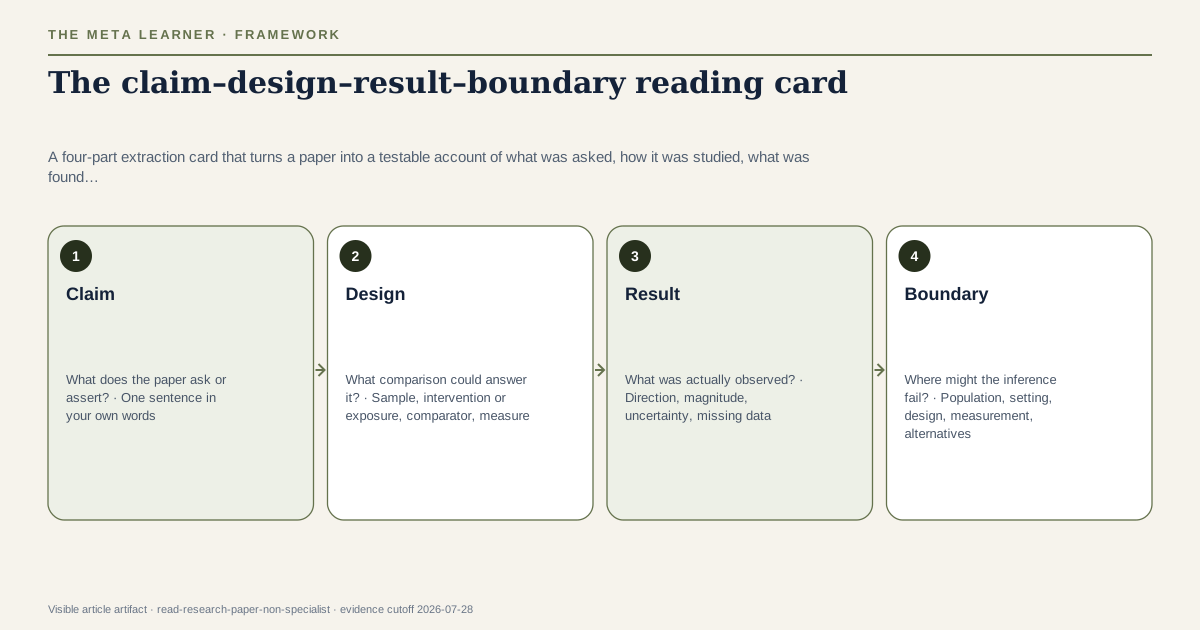
The original reading card has four fields:
| Field | Question | Evidence to capture | |---|---|---| | Claim | What does the paper ask or assert? | One sentence in your own words | | Design | What comparison could answer it? | Sample, intervention or exposure, comparator, measure | | Result | What was actually observed? | Direction, magnitude, uncertainty, missing data | | Boundary | Where might the inference fail? | Population, setting, design, measurement, alternatives |
Do not copy the abstract into the claim box. An abstract is the authors’ summary, not your reconstruction. If the title says “X improves Y,” determine whether the paper observed an association, randomized an intervention, modeled a scenario, or synthesized prior studies. Those are different evidential acts.
First pass: establish the paper’s job
Spend five to ten minutes on the title, abstract, introduction headings, figures, tables, discussion, and references. Keshav’s three-pass approach similarly begins with category, context, correctness, contributions, and clarity before close reading.keshav-paper, prisma-reporting, cochrane-bias
Write brief answers:
- What precise problem is being addressed?
- What kind of paper is this: experiment, observational study, model, qualitative inquiry, review, or argument?
- What would change if its conclusion were true?
- Which figure or table carries the central result?
- Is this a primary report or one account of a larger study?
Stop if the paper is irrelevant. Serious reading includes disciplined rejection; finishing is not a virtue when the source cannot answer your question.
Second pass: interrogate the design
Now read the methods and results together. For an experiment, trace allocation, comparison, attrition, outcomes, and analysis. For an observational study, identify selection, exposure, outcome, confounders, and temporal order. For qualitative work, inspect sampling, data collection, analytic procedure, positionality, and the relation between quotations and themes. For a review, inspect eligibility criteria, search coverage, selection, bias appraisal, and synthesis.
Ask “compared with what?” and “measured how?” A large sample cannot rescue a measure that does not represent the construct. Statistical significance does not tell you whether an effect is large, useful, or transferable. A polished causal verb cannot turn an observational association into an intervention result.
Structured reading and transparent reporting make the consequential parts of a study easier to inspect, while risk-of-bias frameworks show why design and conduct—not prestige or prose—must anchor confidence. These sources do not make appraisal mechanical: reviewers still make judgments that require context.
Claim sources: keshav-paper, prisma-reporting, cochrane-bias
Third pass: rebuild the inference
Close the paper and write its strongest defensible conclusion in this form:
In [population and setting], using [design and comparison], the researchers observed [result and uncertainty], which supports [bounded inference], provided that [important assumptions].
Reopen the paper and test every phrase. If “all adults” becomes “142 undergraduates at one institution,” you have found a scope correction. If “learning” was measured immediately after practice, do not silently upgrade it to long-term retention or transfer. If the result depends on a secondary analysis, label it.
Then write one plausible rival explanation. The rival need not defeat the study. Its purpose is to reveal what the design did and did not rule out.
Read the paper as part of a record
One paper is rarely the final unit of evidence. Follow its registered protocol when one exists, look for corrections or retractions, find related reports from the same study, and compare later replications or systematic reviews. PRISMA is a reporting guideline for systematic reviews, not a quality score, but its flow and checklist make missing steps easier to see.prisma-reporting
For consequential decisions, inspect whether independent reviewers have assessed bias. Cochrane’s guidance separates domains of possible bias and asks reviewers to justify judgments rather than collapse them into a single aura of “good” or “bad” research.cochrane-bias
A worked reading
Suppose a paper reports that an AI tutor “improves learning.” The abstract describes a positive difference. Your card reveals:
- Claim: an AI tutor improves learning outcomes.
- Design: volunteers used either the tutor or static materials for one session.
- Result: the tutor group scored higher on an immediate, researcher-made quiz.
- Boundary: self-selection, one short session, no delayed test, no transfer task, and an outcome aligned closely with the intervention.
The paper may support a useful conclusion: in this setting, the tutor improved immediate performance on this test. It does not yet show durable learning, general superiority to human teaching, or safety in other populations. The narrower sentence is not hostile; it is more informative.
Run the three-pass protocol
- Choose one paper tied to a real decision.
- Complete the four-box card without taking other notes.
- Mark each causal verb in the title, abstract, and discussion.
- Name the design feature that licenses—or fails to license—each verb.
- Write the bounded conclusion from memory.
- Check one protocol, correction, replication, or review.
- Record the decision the paper can inform and the decision it cannot.
Continue with How to Read a Difficult Book for textual architecture, Critical Thinking: A Practical System for Claims and Evidence for claim testing, and Turn Book Notes Into Reusable Knowledge for durable source records.
Failure modes that imitate understanding
- Reading the abstract as if it were the evidence.
- Treating peer review, journal rank, or sample size as a complete quality judgment.
- Reporting a p-value without effect size, uncertainty, or practical relevance.
- Confusing immediate performance with retention or transfer.
- Ignoring the comparator and imagining the result against “nothing.”
- Letting unfamiliar mathematics cause total deference—or total dismissal.
- Quoting limitations ritualistically without changing the conclusion.
Limits of non-specialist appraisal
This protocol cannot validate a statistical model, diagnose misconduct, or determine clinical, legal, engineering, or policy safety. Reporting checklists improve visibility but do not guarantee sound methods. When a decision carries material consequences, ask a qualified specialist to examine the design, analysis, domain assumptions, and applicability—and preserve the narrower conclusion until that review is complete.
The goal is not to sound like an expert after one paper. It is to become a better custodian of the distance between an observation and a claim.
Named sources
Evidence and further reading
Published July 29, 2026. No substantive revision has been recorded. Evidence last verified July 28, 2026.