How to Annotate for Argument, Not Highlighting
Annotate a source by mapping its problem, claims, evidence, warrants, objections, and implications instead of collecting attractive sentences.
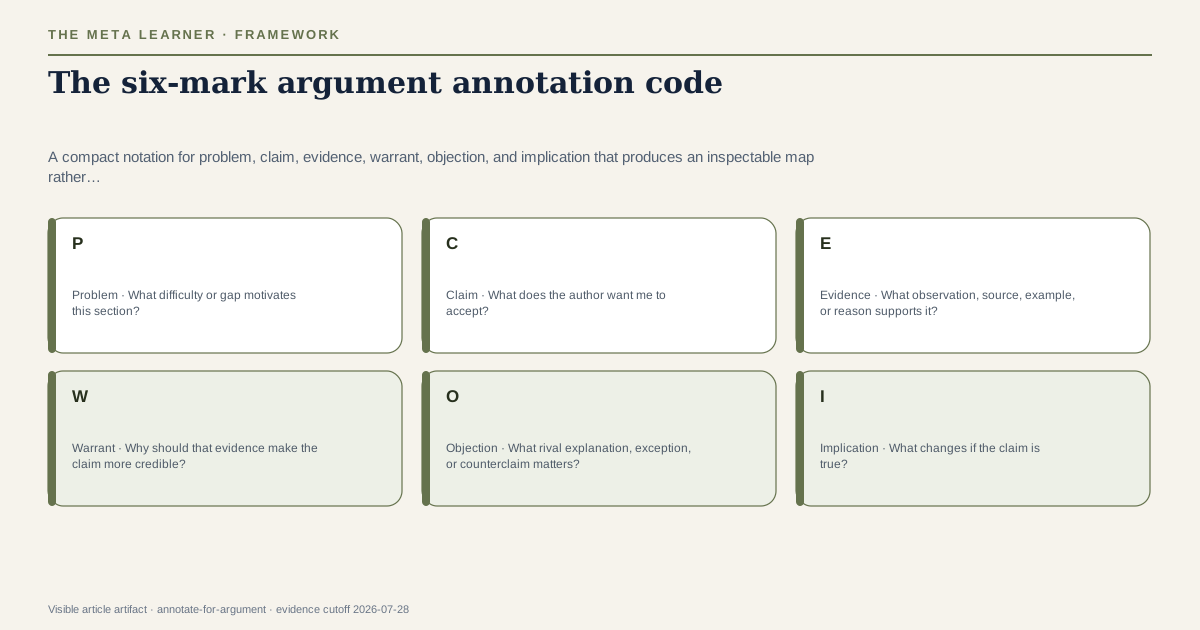
Annotate an argument with six marks: problem, claim, evidence, warrant, objection, and implication. After each major section, close the source and reconstruct those six elements in your own words. Highlight only the minimum text needed to relocate evidence. The purpose of annotation is not to preserve sentences; it is to make the source’s reasoning inspectable.
Why highlights become intellectual wallpaper
Highlighting feels productive because it leaves a visible trace. Weeks later, however, a page of fluorescent sentences often says only, “This seemed important once.” It does not preserve why the passage mattered, how it relates to the argument, whether you accepted it, or what evidence would challenge it.
Research reviews have rated highlighting and underlining as relatively low-utility learning techniques when used in the ordinary way.dunlosky-techniques, keshav-reading, acrl-framework That finding does not prove a highlighter is harmful. It means selection without generative processing, retrieval, or use is a weak learning design.
This method converts annotation from extraction into argument reconstruction.
The six-mark code
Use six symbols or margin labels:
| Mark | Function | Margin question | |---|---|---| | P | Problem | What difficulty or gap motivates this section? | | C | Claim | What does the author want me to accept? | | E | Evidence | What observation, source, example, or reason supports it? | | W | Warrant | Why should that evidence make the claim more credible? | | O | Objection | What rival explanation, exception, or counterclaim matters? | | I | Implication | What changes if the claim is true? |
The warrant is usually the hardest and most valuable mark. Authors often state evidence and conclusions while leaving the connecting assumption implicit. If a survey shows that workers use AI, the warrant might be that reported use reflects actual adoption; that assumption deserves inspection.
Annotate in layers
Layer one: architecture. Read title, abstract or introduction, headings, conclusion, figures, and references. Mark the governing P and provisional C.
Layer two: load-bearing passages. Read closely where definitions, methods, evidence, and transitions support the central claim. Add E and W.
Layer three: resistance. Mark the strongest O, whether supplied by the author or generated by you.
Layer four: use. Add I only in relation to your question. An implication for policy may not follow from an implication for theory.
Keshav’s staged approach to reading research likewise separates reconnaissance from deeper engagement and attempted reconstruction.keshav-reading The code adapts that logic to argumentative texts beyond research papers.
Evidence reviews do not support passive highlighting as a generally strong learning technique. Staged reading, active reconstruction, and inquiry-oriented source use provide a more defensible basis for annotation. The six-mark notation itself has not been tested as a standardized intervention.
Claim sources: dunlosky-techniques, keshav-reading, acrl-framework
Add a claim spine
At the end of each major section, write:
Because [evidence], and assuming [warrant], the author concludes [claim], despite [objection], which matters because [implication].
If you cannot complete the sentence, diagnose why:
- the passage is descriptive rather than argumentative;
- the author has not supplied evidence;
- a technical step is outside your competence;
- the claim depends on an earlier section;
- your attention drifted.
Do not invent coherence to make the note look complete. Mark the gap with a question.
Distinguish author, source, and reader
Use three voices:
- A: the author’s claim;
- S: what a cited source appears to establish;
- R: your interpretation, objection, or application.
This prevents a later note from turning your paraphrase into the author’s words or the author’s citation into independently verified evidence. The ACRL framework treats scholarship as conversation and information creation as a process, which makes provenance part of understanding rather than clerical detail.acrl-framework
A worked annotation
Text: “Organizations should automate routine knowledge work because generative AI increases productivity.”
Your margin might read:
- P: rising demand to adopt AI at work.
- C: automate routine knowledge work.
- E: unspecified productivity evidence.
- W: faster measured output implies net workflow value.
- O: review cost, errors, data risk, deskilling, task variation.
- I: run a task-level pilot, not job-level automation.
The note reveals that the sentence contains a policy leap. Evidence of faster output does not alone establish which tasks, quality threshold, or accountability design should change.
Retrieval after annotation
Close the source and draw the argument from memory. Then compare:
- Did you recover the governing problem?
- Can you state the claim without the author’s phrasing?
- Can you name the evidence and warrant separately?
- Did you remember the strongest objection?
- Can you explain why the conclusion matters to your question?
This turns the annotation into a diagnostic. The errors tell you where rereading is justified.
Use the six-mark code
Select one chapter or paper:
- Limit yourself to six highlighted passages.
- Apply all six marks at least once.
- Write one claim-spine sentence per section.
- Distinguish A, S, and R voices.
- Reconstruct the full argument on a blank page.
- Convert only the reusable claims into permanent notes.
Connect the practice to Note-Making vs Note-Taking, use How to Read a Difficult Book for navigation, and take disputed warrants into Critical Thinking: A Practical System for Claims and Evidence.
Annotation habits that conceal the argument
- Color-coding topics without mapping inferences.
- Highlighting entire paragraphs “for later.”
- Copying conclusions without their warrants.
- Treating the author’s citation as verified evidence.
- Writing reactions that do not identify the claim they answer.
- Annotating every page at equal depth.
- Building perfect notes before testing recall.
When several texts address the same question, annotate the disagreement as deliberately as the agreement. Preserve the wording of each original source’s claim, then identify whether the conflict concerns a premise, definition, method, boundary, or value judgment. That small synthesis table stops one author’s vocabulary from silently replacing the others.
What margin marks cannot do
Argument annotation is poorly suited to every genre. Poetry, visual art, reference works, mathematical proofs, qualitative records, and exploratory reading may require different practices. The method cannot validate evidence or replace prerequisite knowledge. Excessive annotation can fragment immersive reading and should be reserved for texts tied to a real question.
The useful mark is not the brightest one. It is the one that lets you reconstruct why a sentence should—or should not—change your mind.
Named sources
Evidence and further reading
Published July 29, 2026. No substantive revision has been recorded. Evidence last verified July 28, 2026.