Note-Making vs Note-Taking
Note-taking captures material; note-making transforms it into questions, claims, connections, and artifacts that support thinking and reuse.
Note-taking records selected information from a source; note-making reorganizes, questions, connects, and expresses that information for a purpose. Capture is useful, but learning and knowledge creation require transformations that reveal what you understand and what remains uncertain. The note-taking literature does not justify a universal device rule, and some legal, scientific, or archival contexts require verbatim records.
Capture and transformation are different jobs
This guide is for readers who collect accurate records but struggle to turn them into understanding or future work. It covers capture, selection, paraphrase, connection, claim records, and retrieval. It is not an argument against verbatim records where legal, scientific, or archival accuracy matters. Transform one captured passage into a claim, a source boundary, a connection, and a retrieval prompt. If you cannot later reconstruct why the note matters, better formatting will not rescue it.
The distinction is functional rather than tied to paper or software. A typed note can be deeply generative, and a handwritten page can be a transcription. The question is what mental and future work the note performs.
Two outputs that should not be confused
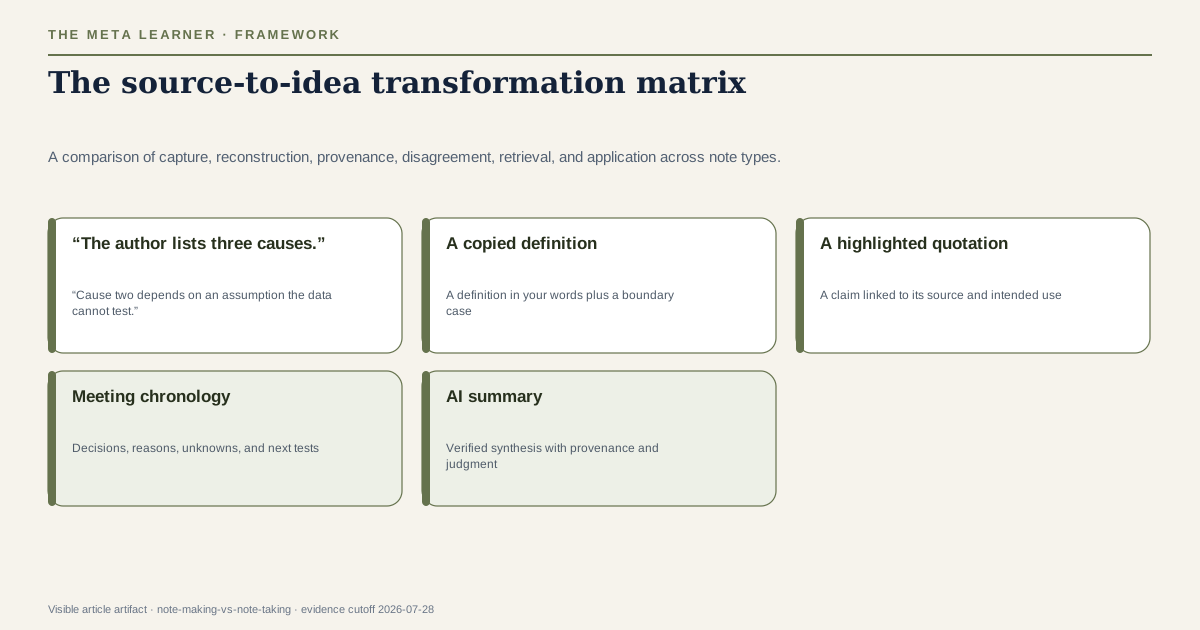
| Note-taking | Note-making | |---|---| | “The author lists three causes.” | “Cause two depends on an assumption the data cannot test.” | | A copied definition | A definition in your words plus a boundary case | | A highlighted quotation | A claim linked to its source and intended use | | Meeting chronology | Decisions, reasons, unknowns, and next tests | | AI summary | Verified synthesis with provenance and judgment |
Capture preserves access. Transformation creates a representation you can inspect and reuse.
The empirical boundary is narrower than the table may suggest:
Studies of note-taking suggest that verbatim transcription can encourage shallow processing, though medium effects and replication debates caution against simple “handwriting always wins” claims. Broader learning evidence supports generation, retrieval, elaboration, and connection to prior knowledge. The valuable variable is cognitive activity, not the romance of a tool.
1, 2, 3Split the record before you connect it
Keep a clear boundary:
- A source note says what this author or dataset reports, with location and context.
- An idea note states your current interpretation, connection, question, or proposed application.
This boundary prevents your inference from being misremembered as the author’s claim. It also lets you revise the idea without corrupting the source record.
Write idea notes as complete claims rather than topic labels. “Spacing” is a folder name; “The desired retention interval should influence the spacing gap” is a proposition that can connect to evidence and decisions.
Provenance failure: the notebook that lost its voices
A researcher copies long passages into a notebook and later cannot tell which statements are sources, interpretations, or open questions.
The researcher audits what each record can prove. Quotations preserve the author’s words; paraphrases test reconstruction; idea notes expose interpretation; project links explain why the distinction matters:
| Observed signal | What it may mean | Next response | |---|---|---| | Long quotation | Provenance is preserved but meaning may not be processed | Add a claim and why it matters | | Confident paraphrase | Source and interpretation may blur | Keep the citation adjacent | | Isolated note | Reuse context is absent | Connect it to a question or project |
Each source note keeps the exact reference, one short quotation when necessary, a paraphrased claim, confidence, and a link to the project decision it informs.
This record design fits analytical reading. It does not imply that every experience should become a claim or that verbatim documentation is dispensable where exact language, consent, or auditability matters.
The forty-eight-hour reconstruction test
Wait forty-eight hours, then reconstruct the source’s argument from the idea notes without reopening quotations. Next, use one claim in a different problem and identify what context must travel with it. If the note supports fluent repetition but not accurate reconstruction or bounded application, it captured language without producing reusable understanding.
Transform one substantial section
After reading one substantial section:
- Close the source and write its main claim from memory.
- Reopen and correct the reconstruction.
- Save one source note with author, date, link, and location.
- Write one idea note: implication, objection, or connection.
- Add one question that would change your interpretation.
- Name a project or decision where the idea could be used.
- Revisit it later without the source and retrieve the relationship.
Use AI, if at all, after your own reconstruction. Ask it to challenge the claim or compare structure, and mark generated suggestions until you verify them.
Use How to Annotate for Argument to reconstruct warrants, compare the AI boundary in How to Use AI in Note-Making Without Outsourcing Interpretation, and scale validated notes through The Evidence Map.
A notation that prevents source laundering
Prefix direct quotation, faithful paraphrase, source claim, your inference, and generated suggestion differently. A visible boundary allows later synthesis without laundering interpretation into evidence. When your view changes, revise the idea note while leaving the source record intact. When the source itself changes—new edition, corrected dataset, retraction—append the factual change and its consequence rather than rewriting history.
For consequential work, sample the notes against reopened passages before reuse. Record whether the failure came from capture, paraphrase, inference, retrieval, or application so the next correction targets the real transformation.
Failure patterns in the note pipeline
- Recording everything because selection feels risky.
- Mixing quotation, paraphrase, and personal inference.
- Tagging heavily before any reuse pattern exists.
- Writing fragments that have no meaning outside the source.
- Summarizing without a question.
- Reviewing by rereading rather than retrieval or application.
When fast capture—or no notes—is better
Detailed note-making costs time and is unnecessary for material that only needs temporary reference. Live settings may require rapid capture before transformation. Some creative and embodied work is poorly represented by propositional notes alone.
Take notes when access matters. Make notes when the material must enter your reasoning, survive separation from the source, or contribute to something new.
Named sources
Evidence and further reading
Published July 29, 2026. Substantively updated July 29, 2026. Evidence last verified July 28, 2026.
- : Rebuilt around source boundaries, argument transformation, disagreement, and future use.