How to Use AI in Note-Making Without Outsourcing Interpretation
Use AI to transform and challenge notes while keeping source selection, interpretation, verification, and final synthesis visibly human-owned.
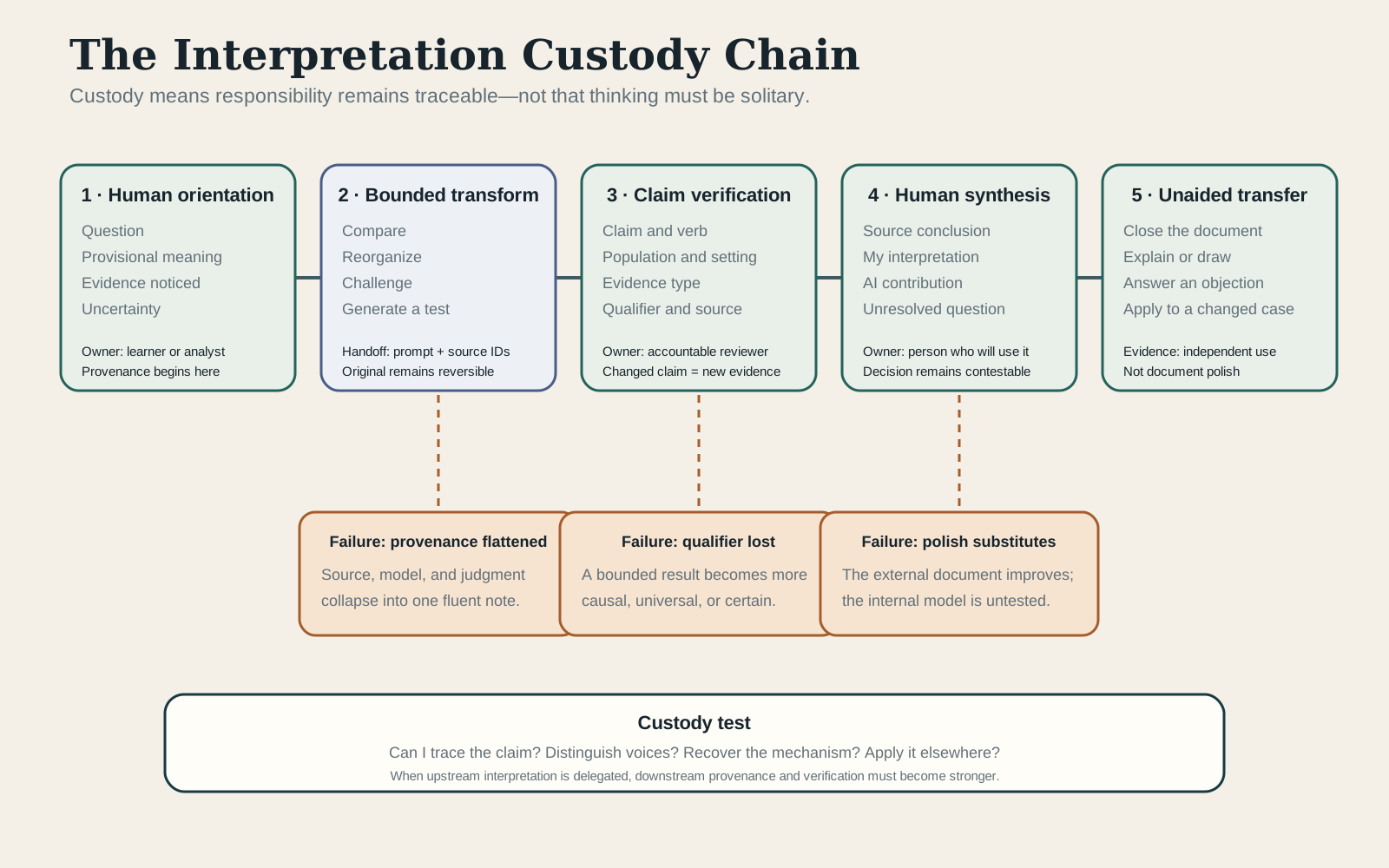
Use AI after you have formed a provisional interpretation, not before. Let it reorganize, question, compare, or test your notes, but keep six acts visibly human-owned: choosing the source, stating what it means, marking uncertainty, verifying transformed claims, retrieving the idea unaided, and deciding what enters your knowledge system. When AI writes both the first account and the final synthesis, you may possess an excellent document without possessing the understanding it appears to contain.
A note can be accurate and still not be yours
Imagine two researchers leaving a seminar with identical, beautifully organized notes. One can reconstruct the speaker’s argument, identify the weakest inference, and apply the model to a new case. The other cannot explain why the third section follows from the second without reopening the document.
The files are equivalent. The knowledge is not.
This is the central danger of AI-assisted note-making. Generative systems can improve the visible object—cleaner headings, sharper summaries, more complete taxonomies—while weakening the learner’s evidence about what has actually been understood. The document becomes more legible at the same moment that intellectual ownership becomes harder to locate.
The problem is not that AI has touched the notes. Pens, databases, search engines, colleagues, and editors have always participated in thinking. The problem is loss of interpretive custody: the chain connecting a source to a claim, a claim to a judgment, and a judgment to a person who can defend or revise it.
Custody does not mean solitary authorship. It means that responsibility remains traceable.
The six acts hidden inside “taking notes”
Note-making compresses several epistemic operations into one ordinary phrase:
| Act | The question being answered | What must remain visible | |---|---|---| | Capture | What did the source actually say? | Quotation, location and provenance | | Selection | What matters for my question? | The learner’s purpose and exclusion rule | | Interpretation | What does this passage mean? | A provisional claim in the learner’s words | | Transformation | In what other form could it be useful? | The instruction given to AI and the resulting change | | Verification | Did the transformation alter the claim? | Comparison with the original evidence | | Retrieval and synthesis | Can I use it without the document? | An unaided explanation, decision or application |
AI can contribute to every row. It should not silently own every row.
The six acts form the article’s custody chain: a synthesis rather than a tested universal workflow.nist-genai, nasem-learning
The distinction matters because fluency is deceptive. A plausible paragraph can conceal a changed causal verb, an erased population boundary, or an invented connection between two authors. NIST’s Generative AI Profile treats confabulation and information integrity as risks that require active evaluation, not stylistic confidence.nist-genai Learning research points in the same direction from another angle: evidence syntheses support retrieval, explanation, and context-sensitive application,nasem-learning while a controlled comparison found stronger later learning from retrieval practice than from elaborative studying under its tested conditions.retrieval-practice
An elegant note is therefore not the outcome. It is an instrument whose value depends on what the reader can subsequently reconstruct and do.
NIST documents confabulation, information-integrity, privacy, and human–AI configuration risks. Learning evidence supports active explanation and retrieval while emphasizing learner, task, and context boundaries. The five-stage custody chain is an editorial synthesis; direct comparative evidence for this exact AI note-making workflow remains limited.
Claim sources: nist-genai, nasem-learning, retrieval-practice
The interpretation custody chain
A defensible workflow has five handoffs.
1. Human orientation
Before prompting, write four sentences:
- The question for which this source matters.
- The author’s central claim as you currently understand it.
- The evidence that seems to carry the most weight.
- The uncertainty, objection, or term you cannot yet resolve.
These sentences may be imperfect. That is their value. They expose the learner’s initial model before a fluent external model replaces it.
2. Bounded transformation
Give AI a reversible job. Good transformations preserve the original and make the change inspectable:
- Compare my interpretation with the source and list omissions.
- Reorganize these verified claims by causal mechanism while retaining source IDs.
- Generate two rival explanations and state what evidence would discriminate between them.
- Convert these claims into retrieval questions without supplying the answers.
- Identify where my wording is stronger than the cited passage.
“Summarize this for me” is not always wrong. It is simply too ambiguous to serve as an epistemic method.
3. Claim-level verification
Compare every material transformation on five dimensions:
- What is the exact claim?
- Who or what does it concern?
- What kind of evidence supports it?
- Which uncertainty or limitation travelled with it?
- Can the statement still be traced to a specific source location?
If a sentence becomes more universal, more causal, or more certain, treat that as a new claim. It requires new evidence; it cannot inherit authority from the source by proximity.
4. Human synthesis
Now decide what enters the permanent note. The final synthesis should distinguish:
- the source’s conclusion;
- your interpretation;
- AI-proposed structure or language;
- unresolved questions;
- the practical consequence you are willing to defend.
This is where custody returns to the learner. A machine can propose a synthesis, but it cannot assume responsibility for what your knowledge base will later present as settled.
5. Unaided transfer
Close everything.
Explain the argument aloud, draw the mechanism, answer a hostile question, or apply the idea to a case that differs from the source. Only then reopen the notes and compare.
The gap between the unaided performance and the polished document is diagnostic. It tells you whether AI improved your thinking or merely improved its external costume.
nasem-learning, retrieval-practiceCase one: AI as a demanding editor
Leila is reading a hypothetical field experiment about generative AI in customer-support work. The case is constructed to expose a verification error; its numerical pattern is not presented as a report of one specific study.
Her first note says:
In this organization, access to the tool reduced average handling time and changed measured quality. Effects differed by worker experience. The study does not establish the same result for research, medicine, or management.
She asks AI to create a table with four columns: measured outcome, proposed mechanism, boundary, and unanswered question. The table is useful, but one cell says:
AI increased productivity across knowledge work.
Leila rejects it. The study measured a particular workflow, organization, worker population, and period. “Across knowledge work” is not a concise paraphrase; it is an unsupported expansion.
She corrects the table, preserves the subgroup result, and asks AI for a transfer case involving legal research. She then closes the notes and explains why evidence about speed, quality, and worker heterogeneity would need to be gathered separately in the new setting.
AI has saved formatting time and produced a useful challenge. Interpretation, verification, and transfer remain hers.
Case two: the immaculate empty notebook
Marcus uploads three papers, asks for comprehensive summaries, tells the model to reconcile disagreements, and imports the result into his knowledge base. The output is superb. Every note has headings, definitions, implications, and suggested links.
Two weeks later, he uses the notes to advise a team. Asked why one paper deserves more weight than another, he cannot remember their methods. Asked whether a recommendation applies to novices or experts, he searches the AI synthesis and finds no population label. Asked which conclusion was his, he cannot tell.
Nothing here requires a spectacular hallucination. The failure is architectural. Marcus never created an independent interpretation against which transformation could be checked. Provenance was flattened. Disagreement became a smooth paragraph. The notebook contains statements, but no visible history of judgment.
Its polish is precisely what makes the weakness dangerous.
The strongest counterargument to The interpretation custody chain
There are situations in which “human first” is the wrong default.
A researcher triaging ten thousand abstracts cannot interpret each one before using automated classification. A disabled learner may need transcription, simplification, or translation before independent engagement is possible. A professional searching a large, personally verified archive may rationally ask AI to surface patterns before reading every source. During an emergency, orientation may matter more than pedagogical purity.
In these cases, extensive AI transformation is justified when four conditions hold:
- The output is labeled as orientation, not settled interpretation.
- Provenance survives at the level needed to reopen the evidence.
- High-consequence claims receive direct human review.
- The final decision is tested against sources, counterevidence, or accountable expertise.
The principle is therefore not “the human must always write first.” It is: the more interpretation is delegated upstream, the stronger provenance and verification must become downstream.
nist-genai, nasem-learningDelegation is not abdication if the custody chain remains visible.
A decision boundary for real work
Use AI freely for:
- formatting information whose meaning is already settled;
- generating alternative structures;
- producing questions and counterexamples;
- locating possible contradictions for human inspection;
- converting verified notes into practice formats;
- checking consistency across source IDs and terminology.
Use AI conditionally for:
- first-pass summaries;
- synthesis across multiple sources;
- translation of evidence;
- prioritization of large document sets;
- recommendations that affect other people.
Keep direct, accountable human control over:
- source selection for consequential claims;
- interpretation of contested or ambiguous evidence;
- privacy, permission and copyright decisions;
- acceptance or rejection of a transformed claim;
- final recommendations in high-stakes settings.
These boundaries are not metaphysical claims about whether machines “understand.” They are operational rules for determining who can inspect the evidence, answer objections, and bear the cost of error.
The custody test
Before keeping an AI-assisted note, ask:
- Can I identify the source and passage behind every important claim?
- Can I distinguish the author’s view, the model’s transformation, and my judgment?
- Did any qualifier, population, method, or uncertainty disappear?
- Can I explain the central mechanism without reopening the note?
- Can I apply it to a changed case and state where the analogy fails?
- Do I know what evidence would make me revise the note?
If the answer to the first three is no, the note is unsafe. If the answer to the final three is no, it may be well documented but not yet learned.
What this method cannot guarantee
Visible provenance does not make a weak source strong. Retrieval does not establish truth. A learner can confidently remember a mistaken interpretation. AI output can remain inaccurate, biased, unstable, or incomplete even when prompts and versions are preserved.
Protected, personal, copyrighted, confidential, or regulated material also introduces questions this method does not answer. Authorization and an approved technical environment must come before convenience.
The goal is not to keep AI at a ceremonial distance from thought. It is to make intellectual responsibility inspectable.
The best AI-assisted notebook is not the one that appears to know the most. It is the one that lets its owner show where every consequential belief came from, why it survived scrutiny, and what would cause it to change.
Apply the custody chain after Note-Making vs Note-Taking, use Verify AI Explanations and Sources at the transformation boundary, and compare the role of questioning in How to Use AI as a Tutor Without Outsourcing Your Thinking.
Named sources
Evidence and further reading
Published July 29, 2026. No substantive revision has been recorded. Evidence last verified July 28, 2026.