AI-Assisted Learning Systems: Tutors, Simulations, Feedback, and Independent Testing
Design an AI learning system that combines explanation, practice, feedback, simulation, and delayed independent tests without outsourcing the target skill.
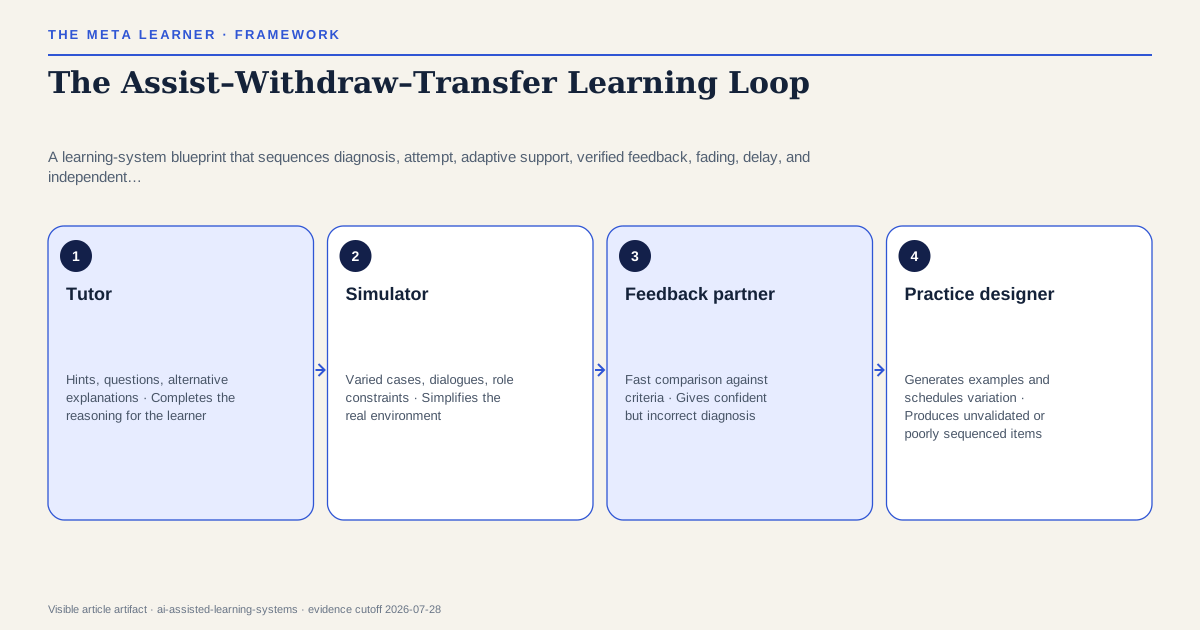
Build AI-assisted learning around seven stages: diagnose, attempt, support, verify feedback, withdraw help, delay, and transfer. Use AI to generate variation, questions, hints, simulations, and provisional feedback. Measure success with later independent performance—not the quality of the AI's explanation or the learner's speed while assisted. Direct evidence for specific generative-AI tutoring designs remains uneven, and feedback quality depends on domain, language, model, and task.
Design for the moment the assistant is absent
An AI system can make a learner look capable. It can finish a sentence, supply a proof step, translate a phrase, suggest a diagnosis, or revise code. The central learning question is whether the person can later perform without that support.
Retrieval-practice research distinguishes effortful recall from additional study and demonstrates benefits on later tests under studied conditions. retrieval, unesco, feedback Feedback research shows that effects vary with what feedback communicates and where it directs attention. feedback UNESCO places human agency, inclusion, privacy, and critical use at the center of generative AI in education. unesco
Four roles, four risks
| AI role | Potential value | Characteristic risk | |---|---|---| | Tutor | Hints, questions, alternative explanations | Completes the reasoning for the learner | | Simulator | Varied cases, dialogues, role constraints | Simplifies the real environment | | Feedback partner | Fast comparison against criteria | Gives confident but incorrect diagnosis | | Practice designer | Generates examples and schedules variation | Produces unvalidated or poorly sequenced items |
Do not let one model play teacher, textbook, examiner, and final authority without external checks.
The assist–withdraw–transfer loop
Diagnose
Begin with an unaided task. Separate missing knowledge, weak retrieval, misconception, strategy, and performance anxiety. A polished self-description is weaker evidence than actual work.
Attempt
Require a response before the model helps. The attempt creates information about the learner and makes feedback interpretable.
Support
Offer the smallest useful intervention: a question, cue, example, partial step, or contrast. Escalate only after another attempt.
Verify
Check factual or linguistic feedback against an approved source, deterministic test, or qualified human. Preserve disputed cases rather than silently accepting the model's authority.
Withdraw
Remove hints, autocomplete, source text, or worked examples. Fading should be planned, not left to learner willpower.
Delay
Retest after enough time that short-term familiarity cannot carry the answer.
Transfer
Change the surface, context, audience, or tool. Learning should travel beyond the original conversation.
Evidence for the diagnosis: the Assist–Withdraw–Transfer Learning Loop
The evidence strongly supports preserving retrieval and designing feedback around learning goals. Authoritative guidance supports human agency and critical evaluation. The seven-stage system is a synthesis; direct comparative evidence for every generative-AI component and learner population is not yet established.
unesco, retrieval, feedbackSeparate three scoreboards
Track:
- Assisted performance: what the learner completes with AI.
- Independent retention: what the learner recalls or performs later without AI.
- Transfer: what the learner can do in a new task or real setting.
A system may improve the first and damage the second by hiding weak retrieval. It may improve retention of facts without improving transfer. Report the scoreboards separately.
A worked design
A professional is learning to evaluate research claims. The baseline is a short article containing one confound, one unsupported causal statement, and one valid conclusion.
The learner annotates unaided. The AI asks which claim would change under an alternative explanation, then reveals one hint. Feedback is checked against an expert key. Two days later, the learner analyzes a different domain article without AI. The system records which error types persist.
The AI contributes adaptive interaction and variation. The independent analysis supplies the evidence of learning.
Build a seven-stage learning loop
- Choose one observable capability.
- Create an unaided baseline and transfer task.
- Define the AI roles and forbidden help.
- Link feedback to trusted evidence or a rubric.
- Plan when support fades.
- Schedule delayed retrieval.
- Compare assisted, delayed, and transfer results.
Configure the tutoring behavior with How to Use AI as a Tutor, adapt the request through Prompting for Learning, and ground the withdrawal phase in Active Recall.
Put the learning claim under human accountability
Create a representative test set before instruction begins: one familiar task, one near-transfer task, one far-transfer task, and one case containing a tempting misconception. A qualified human reviewer should verify the answer key and judge open-ended performance without seeing whether AI support was used. The learner remains the decision owner for ordinary self-study; a teacher, employer, or licensed professional must own consequential assessment.
The human checkpoint reviews three traces together: what the learner attempted, what help the system supplied, and what the learner later did unaided. An evaluation that sees only the final polished response cannot detect substitution. Preserve failures and disagreements rather than letting the model rewrite them into a success narrative. If the learner’s independent score does not improve, reduce assistance, repair prerequisite knowledge, or change the practice task. Do not increase prompting sophistication to hide a weak learning result.
Systems that optimize the feeling of progress
- Asking for an explanation before making an attempt.
- Measuring session completion rather than later performance.
- Keeping hints available on every trial.
- Letting AI grade open-ended work without calibration.
- Generating practice whose answers were never checked.
- Testing with the same wording and context used in practice.
- Treating engagement or affection for the tutor as mastery.
Evidence is stronger for principles than products
Learning effects depend on prior knowledge, subject, feedback, delay, transfer measure, motivation, accessibility, and model quality. Research on retrieval and feedback does not automatically validate a commercial AI tutor. Minors, vulnerable learners, assessment contexts, and high-stakes domains require additional safeguarding and qualified oversight.
The best AI learning system is not the one that always knows what to say. It is the one designed to become unnecessary at the moment competence matters.
Named sources
Evidence and further reading
Published July 29, 2026. No substantive revision has been recorded. Evidence last verified July 28, 2026.