What Happens to Expertise When Novices Can Produce Expert-Looking Work?
A structural analysis of how fluent AI-assisted output can separate appearance from capability, reshape assessment, and either accelerate or conceal learning.
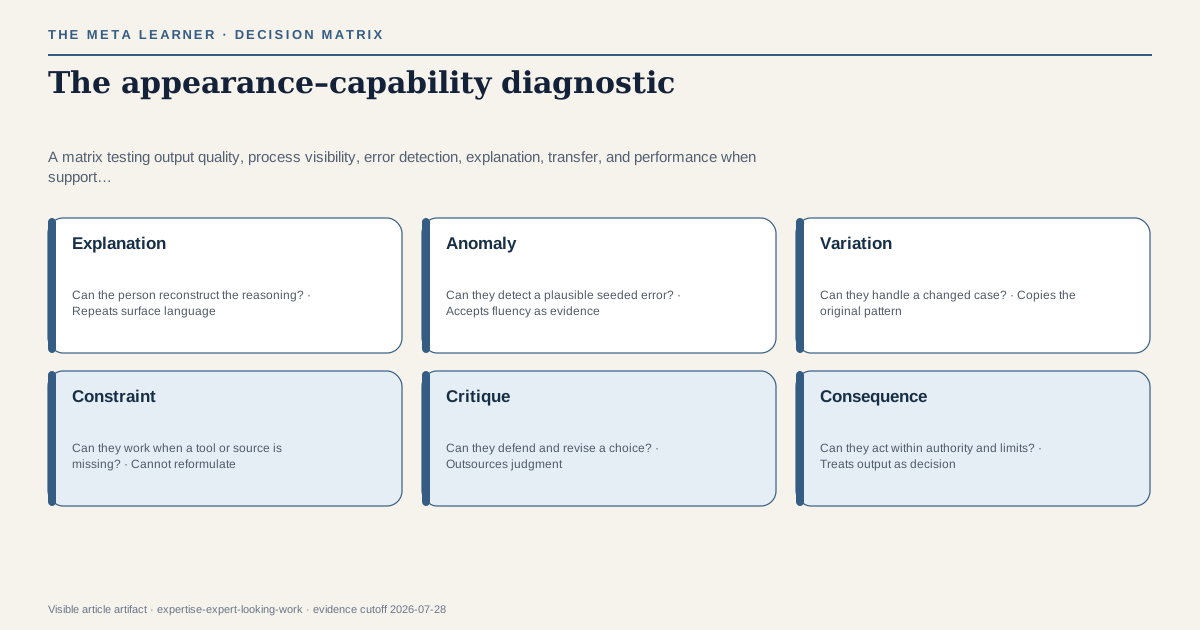
When novices can produce expert-looking work with AI, the artifact no longer proves expertise by itself. It may show strong tool-supported performance, which is valuable, but expertise also includes recognizing deep structure, detecting anomalies, explaining choices, adapting to new cases, and owning consequences. Assessment must move from appearance toward inspectable performance across conditions.
What is observed and what is not
Learning research describes expertise as organized, domain-specific knowledge that supports pattern recognition, problem representation, and conditional use—not simply possession of more facts.nasem-learning, nber-genai-work, opm-work-samples, nist-rmf A polished answer can resemble expert output while omitting this internal organization.
In a field study of customer-support work, access to a generative assistant was associated with measured productivity gains, with larger gains among less experienced workers in that setting.nber-genai-work This is important evidence that assistance can narrow some performance gaps. It does not establish that assisted workers acquired the same transferable expertise as the high performers whose patterns the system may reflect.
U.S. OPM guidance treats work samples and simulations as ways to observe performance on tasks resembling the job.opm-work-samples NIST emphasizes context-specific measurement and governance for AI systems.nist-rmf
The evidence supports a distinction between underlying expertise and assisted output, plus the possibility of real novice gains in bounded work. It does not establish whether long-term AI use generally accelerates, substitutes for, or weakens expertise development.
Claim sources: nasem-learning, nber-genai-work, opm-work-samples, nist-rmf
Our inference: the signal value of polish collapses
For decades, a well-structured essay, clean analysis, or competent prototype served as an imperfect signal of knowledge and effort. Generative systems reduce the production cost of those surfaces. The artifact may still be useful, but its evidentiary meaning changes.
Three capabilities can now be confused:
- Independent capability: what the person can frame, perform, and evaluate without the system.
- Orchestrated capability: what the person can achieve by choosing and controlling tools.
- System capability: what the tool contributes regardless of the operator’s understanding.
Professional performance often depends on all three. The mistake is attributing the combined result entirely to one.
The appearance–capability diagnostic
| Test | What it reveals | A fragile result | |---|---|---| | Explanation | Can the person reconstruct the reasoning? | Repeats surface language | | Anomaly | Can they detect a plausible seeded error? | Accepts fluency as evidence | | Variation | Can they handle a changed case? | Copies the original pattern | | Constraint | Can they work when a tool or source is missing? | Cannot reformulate | | Critique | Can they defend and revise a choice? | Outsources judgment | | Consequence | Can they act within authority and limits? | Treats output as decision |
These tests should not become rituals of deprivation. Tool-supported expertise is legitimate. A pilot’s expertise includes instruments; a scientist’s includes software. The goal is to know where competence resides and whether the system remains safe when conditions change.
Bounded case: a junior analyst
A junior analyst produces a compelling market brief with AI. Rather than dismiss the work or accept it at face value, the reviewer asks for the source ledger, rejected interpretations, and one material correction. The analyst then receives a new segment with noisier data and explains which assumptions no longer transfer.
If the analyst can trace claims, detect a corrupted figure, and revise the model, the assisted artifact may be evidence of emerging expertise. If the reasoning disappears when the tool is unavailable, it remains evidence of orchestrated output, not yet independent capability.
A 30-Day Capability Sprint can preserve the baseline and transfer sample. How to Measure Whether AI Actually Improves Your Work adds review and severe-error measures.
The opportunity: scaffolding closer to practice
AI can give novices rapid examples, explanations, simulations, and feedback. It can externalize expert patterns that were previously available only through proximity to a skilled colleague. Used well, it can shorten the distance between an initial model and meaningful practice.
But scaffolding should fade or vary. Learners need to attempt the problem, compare their model with the assistance, see failures, and perform later under changed conditions. Otherwise the interface can supply the structure that expertise was supposed to build.
Scenarios and signposts for expertise
Accelerated formation. AI expands deliberate, varied practice and feedback. Signposts: improving unaided transfer, better error detection, and progressively lighter scaffolds.
Credential noise. Output quality rises while underlying ability becomes harder to infer. Signposts: portfolios of similar polish, weak oral reconstruction, inflated entry tests, and employers adding more live assessments.
Hybrid expertise. Professions redefine competence as accountable orchestration plus preserved independent judgment. Signposts: contribution ledgers, tool-aware simulations, explicit fallback requirements, and evaluation of system choice.
Assessment signposts
Watch whether institutions compare assisted and unassisted conditions, use representative work samples, preserve process evidence, and reward correction rather than concealment. A move away from take-home artifacts alone would support the thesis; Education After the Take-Home Essay maps that shift.
Also watch who bears assessment cost. Endless surveillance or inaccessible live performance can reproduce inequality. Stronger evidence must remain proportionate to the decision.
Invalidation signals for the appearance–capability diagnostic
The thesis would weaken if polished AI-assisted output proved to be a consistently strong predictor of later transfer, error detection, and accountable independent performance without additional assessment. It would also change if systems could reliably expose the contribution of person and tool by default.
The negative claim should reverse in settings where the output itself is the only relevant outcome, errors are cheap, and the operator’s independent capability has no safety or continuity value.
Limits of the expert-looking thesis
“Expert-looking” is culturally and institutionally defined. Existing research does not establish one general effect of AI assistance on long-term expertise. Work samples can be coached, live tests can be biased, and unassisted performance can undervalue legitimate accessibility tools. The diagnostic must be adapted to domain, disability, consequence, and authorized tool use. Evidence is current to July 28, 2026.
The future of expertise will not be settled by whether AI helped. It will be settled by what the combined system can do—and whether we can still see who understands what.
Named sources
Evidence and further reading
Published July 29, 2026. No substantive revision has been recorded. Evidence last verified July 28, 2026.