How to Measure Whether AI Is Improving Your Work—or Hiding Weakness
Measure AI-assisted work with a baseline, quality rubric, independent cases, total review cost, error severity, transfer, and unaided capability checks.
Measure AI improvement against a saved baseline using representative cases. Track total workflow time, rubric-scored quality, severity-weighted errors, review and exception cost, downstream value, and who gains or loses work. Add delayed or unaided checks for capabilities you still need. If output rises while verification, severe errors, or independent performance deteriorate, AI may be hiding weakness rather than improving the system.
The metrics that flatter AI
AI evaluations often begin where the tool is strongest:
- time to first draft;
- number of outputs;
- user satisfaction immediately after use;
- performance on clean examples;
- self-reported productivity.
These are legitimate observations. They are not the whole value proposition. A fast first draft can create slow review. A plausible answer can reduce the user’s likelihood of checking. More output can overwhelm downstream decision-makers.
Scenario: the AI work gain-loss scorecard under organizational constraints
A communications team tests AI translation for internal, low-risk announcements.
Baseline and AI conditions use fifty past texts across ordinary and idiomatic cases. Independent bilingual reviewers score accuracy, register, omissions, and severity. The team measures total time, correction, and reviewer confidence. A delayed unaided test checks whether editors can still identify critical meaning errors.
The test excludes legal notices, emergency communications, and unsupported languages. Results authorize only the tested class.
Define improvement before testing
Write:
For [task and user], the AI-assisted workflow is better if it changes [primary outcome] by [meaningful threshold] without violating [quality, safety, capability, or equity guardrails].
Freeze the rubric and threshold before seeing results. Include a stop condition for material errors or prohibited data use.
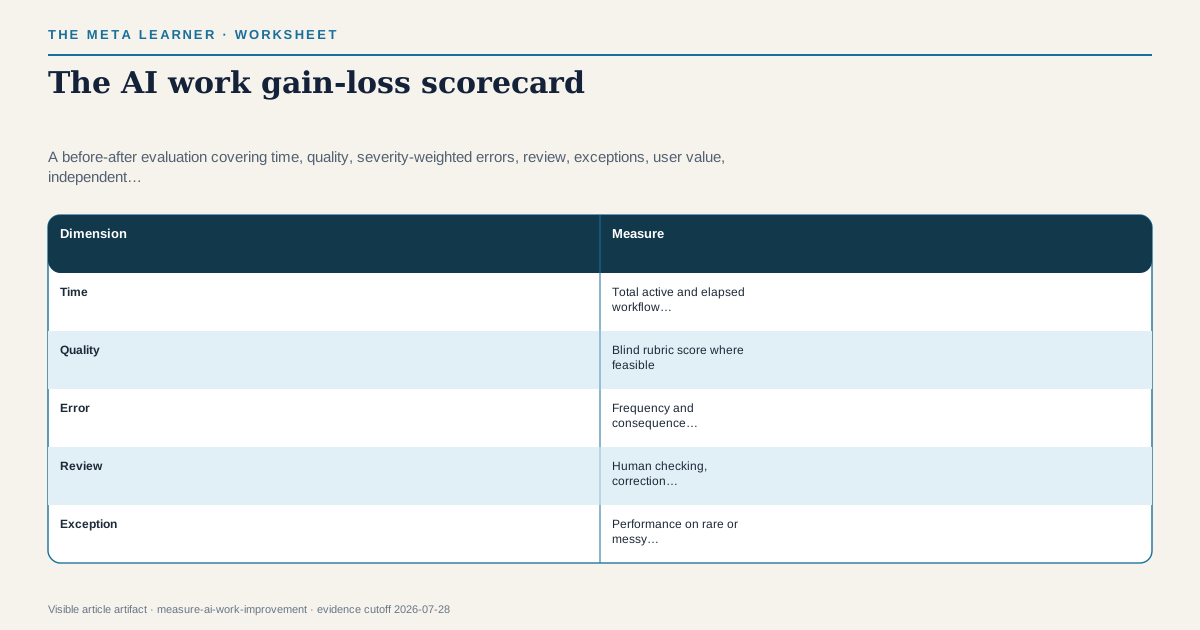
The gain-loss scorecard
| Dimension | Measure | |---|---| | Time | Total active and elapsed workflow time | | Quality | Blind rubric score where feasible | | Error | Frequency and consequence, not count alone | | Review | Human checking, correction, and escalation | | Exception | Performance on rare or messy cases | | Value | Downstream user or decision outcome | | Capability | Later or unaided performance | | Distribution | Who gains time, control, or burden |
Do not collapse these into one composite unless the weights have a defensible decision basis.
Field research has found productivity and quality changes from generative AI in a specific customer-support environment, with heterogeneous effects. NIST provides testing and risk-management resources, while OECD emphasizes context and skill mix. None establishes a universal productivity effect.
Claim sources: nber-genai-work, nist-airc, oecd-ai-skills
Use representative cases
Build a case set before the test:
- common cases;
- boundary cases;
- known failures;
- incomplete or contradictory inputs;
- cases requiring escalation;
- a held-out transfer set.
Randomize order and blind evaluators to condition where practical. Record model, configuration, tool access, prompts or workflow instructions, date, and human experience.
The NBER field study Generative AI at Work examined customer-support agents and reported changes in productivity and customer sentiment, with larger gains among less experienced and lower-skilled workers in that setting.nber-genai-work, nist-airc, oecd-ai-skills Treat that as evidence about the studied environment, not all knowledge work.
Weight errors by consequence
One punctuation correction and one fabricated legal citation are not two equivalent errors. Create categories:
- cosmetic;
- recoverable before use;
- misleading decision;
- privacy or security incident;
- material harm.
Measure detection as well as occurrence. A workflow with fewer but less detectable errors may require stronger controls.
Measure review honestly
Include:
- context preparation;
- prompting or specification;
- waiting;
- source verification;
- corrections;
- coordination;
- exception handling;
- documentation;
- tool failures.
Time saved by one worker and transferred to another is not net savings. Ask each role to report active time and burden.
Check independent capability
If the human must remain able to judge or act without the tool, include:
- blind review before seeing AI output;
- periodic unaided cases;
- explanation of why the answer is correct;
- delayed transfer task;
- error-seeding tests.
OECD’s AI-skills work distinguishes advanced AI skills from the broader foundational, digital, managerial, and human capabilities needed across the workforce.oecd-ai-skills AI assistance should not be allowed to make required oversight fictional.
Run the gain-loss scorecard
- Choose a task already permitted for testing.
- save baseline outputs and time.
- create representative and held-out cases.
- freeze rubric, thresholds, and stop rules.
- test current and AI workflows.
- score blind where feasible.
- include review, exception, and capability cost.
- decide adopt, restrict, redesign, or reject.
Begin with Audit Your Work for Automation, Augmentation, and Human Judgment, instrument Build Your First Useful AI Workflow, and document the evaluation in Build a Skill Portfolio for an AI-Shaped Career. NIST’s resource center supports testing, evaluation, verification, and validation practices.nist-airc
Evaluation designs that hide weakness
- Comparing AI with an unusually poor baseline.
- testing only clean examples.
- scoring polish instead of correctness.
- ignoring source verification and correction time.
- counting errors without severity.
- letting users rate output they cannot independently judge.
- changing prompts until the test set is effectively trained on.
- measuring immediate output while claiming durable capability.
Pre-register the decision rule for the test. State what minimum gain, maximum severe-error rate, review ceiling, and independent-capability floor would justify adoption. Then retain the failed cases and disagreement among reviewers. Without a rule written before results, teams can celebrate whichever metric moved and rationalize whichever one deteriorated. A useful scorecard should also reveal substitution: whose time was saved, whose time was consumed, and whether the system improved the whole workflow or merely shifted invisible labor across it.
Short tests miss system change
A bounded evaluation may not reveal rare harms, drift, adversarial use, changing model behavior, privacy failures, deskilling, surveillance, or long-term job redesign. Field studies can have limited transfer. High-impact deployment requires appropriate legal, security, domain, worker, accessibility, and affected-stakeholder review beyond the scorecard.
The right question is not “Did AI make more?” It is “Which part of the system became better, for whom, at what cost, and how do we know?”
Named sources
Evidence and further reading
Published July 29, 2026. No substantive revision has been recorded. Evidence last verified July 28, 2026.