The 30-Day Capability Sprint: A System for Learning a New Role
Use 30 days to build and test one entry capability through task analysis, representative work samples, feedback, correction, and transfer.
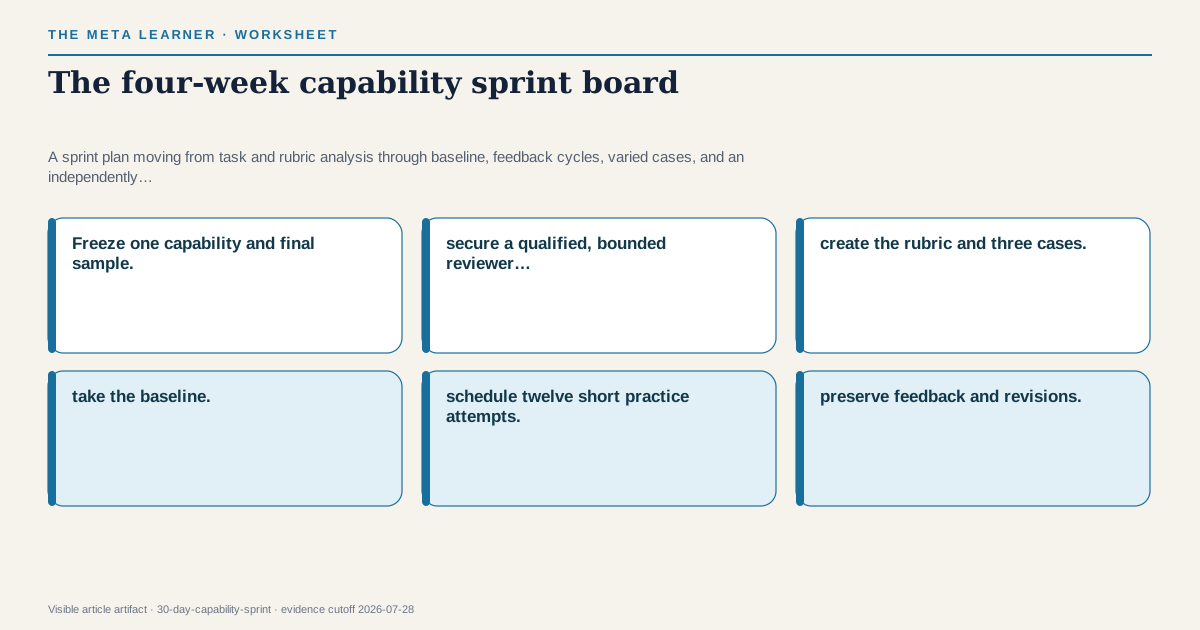
Use a 30-day sprint to build one entry capability, not “learn a role.” In week one, analyze the task and take a baseline. In week two, practise components with feedback. In week three, complete varied realistic cases. In week four, produce a transfer work sample judged against a predeclared rubric. The output is evidence of current performance and remaining gaps—not mastery.
What thirty days can honestly achieve
Thirty days can change performance. It cannot compress years of domain formation, tacit knowledge, supervised cases, or professional responsibility into a calendar challenge.
The honest objective is narrower:
By day 30, I will produce [work sample] from [representative input] to [rubric], with [reviewer] judging it, and I will document which errors still require supervision.
That sentence turns motivation into an evaluable claim.
Choose the capability
Select a task that is:
- central enough to matter;
- bounded enough to repeat;
- safe and lawful to simulate;
- understandable to an evaluator;
- representative of target work;
- not dependent on private access you do not have.
Examples include writing a sourced market brief, cleaning and explaining a public dataset, designing an interview plan, or reviewing an AI output against a rubric.
U.S. OPM guidance describes work samples as tasks that mirror actual job activities and notes both their job relevance and their costs and limits.opm-work-samples, nasem-learning, dunlosky-techniques A self-designed portfolio sample is not an employer’s validated assessment, but realism still matters.
Build the rubric before the sample
Use five dimensions:
- accuracy: correct result and source use;
- process: defensible method and traceability;
- judgment: appropriate trade-offs and escalation;
- communication: fit for the intended user;
- boundary: visible uncertainty and limits.
Add role-specific standards from official guidance or credible practitioners. Freeze the rubric before comparing final work with the baseline.
Work samples can provide job-related performance evidence when they represent actual tasks and use appropriate assessment. Learning evidence supports active practice, feedback, and spacing. No cited evidence establishes 30 days as a general threshold for job readiness.
Claim sources: opm-work-samples, nasem-learning, dunlosky-techniques
Week 1: task model and baseline
- Interview or observe two credible role models where access is appropriate.
- Decompose the task into decisions, inputs, standards, and errors.
- collect three representative public cases.
- complete one unaided baseline under realistic constraints.
- score it and ask a reviewer to identify the highest-consequence error.
Do not study everything first. The baseline reveals the actual gap.
Week 2: components and feedback
Isolate two weak components. Practise each in short cycles:
- predict;
- perform;
- compare;
- receive feedback;
- explain the error;
- retry with a changed case.
Learning research synthesized in How People Learn II emphasizes prior knowledge, metacognition, feedback, and context.nasem-learning Use your errors to decide what theory or instruction to add.
Week 3: varied cases
Complete three cases that differ on important dimensions:
- clean versus incomplete input;
- familiar versus unfamiliar domain;
- low versus moderate ambiguity;
- aligned versus conflicting stakeholder needs.
The goal is not volume. It is to see which parts of performance survive variation.
Week 4: transfer and judgment
Ask the reviewer to choose or approve a new case. Complete it without step-by-step assistance. Submit:
- output;
- source or data record;
- decision log;
- self-assessment;
- known limitations;
- next supervision need.
The reviewer scores the frozen rubric and identifies whether the work is ready for independent use, supervised use, or further practice.
Decomposing a case with the four-week capability sprint board
A customer-success professional wants to test entry capability in research synthesis.
The work sample answers one narrow market question using ten public sources. The rubric checks selection logic, claim-source alignment, contradiction, uncertainty, and executive usefulness. Week-two practice targets citation verification; week-three cases vary source quality. The final evaluator finds strong synthesis but weak quantitative interpretation.
The sprint succeeds because it discovers a specific gap and produces honest evidence. It does not rename the learner a research analyst.
Run the four-week capability sprint
- Freeze one capability and final sample.
- secure a qualified, bounded reviewer commitment.
- create the rubric and three cases.
- take the baseline.
- schedule twelve short practice attempts.
- preserve feedback and revisions.
- complete the unfamiliar transfer case.
- publish or share only material you have rights to use.
Use How to Build a Personal Learning System for the sprint log, study Deliberate Practice, Feedback, and the Path to Expertise for boundaries, and place verified work in Build a Skill Portfolio for an AI-Shaped Career.
Sprint theater and compressed-course traps
- Setting a role identity instead of a performance target.
- Watching instruction without baseline or transfer.
- practising only one clean example.
- choosing a friendly reviewer with no rubric.
- using AI to produce the sample without documenting contribution.
- changing the rubric after seeing the result.
- claiming professional readiness from a personal challenge.
The Dunlosky review supports practice testing and distributed practice while warning that techniques vary in utility and implementation.dunlosky-techniques A sprint should distribute attempts, not cram content.
End with two judgments, not one score. First, did performance on the defined task improve under the rubric? Second, did any improvement transfer to a new case without the training scaffold? Archive the baseline, intermediate attempts, reviewer notes, and final transfer sample so another person can inspect the trajectory. A sprint that produces only a polished artifact may have trained editing, tool use, or familiarity with one example. For a deeper practice design after the sprint, use the Deliberate Practice method and retain the same evidence trail.
A sprint is not a credential
Do not use a self-designed sprint to bypass licensing, formal education, supervised practice, employer authorization, or safety standards. Reviewer quality, case representativeness, and access constrain the result. Learning speed varies, and some disabilities or life conditions make a 30-day cadence inappropriate. Change the duration; keep the evidence standard.
Thirty days is useful because it forces a test. The honest finish line is not “I have become.” It is “Here is what I can now do, how it was judged, and what still requires help.”
Named sources
Evidence and further reading
Published July 29, 2026. No substantive revision has been recorded. Evidence last verified July 28, 2026.