The New AI Divide: Those Who Can Evaluate Systems—and Those Who Can Only Use Them
A structural account of why access and interface fluency may matter less than the ability to test claims, boundaries, failures, incentives, and deployment.
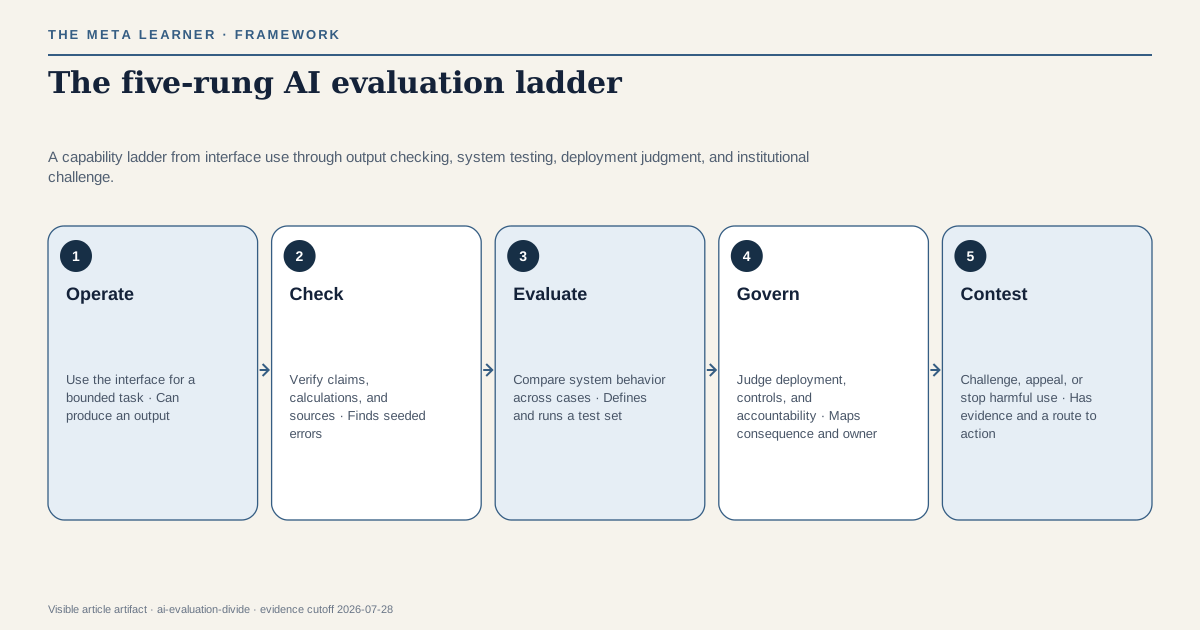
The emerging AI divide is not only between people with and without access. It is between those who can evaluate what a system does, where it fails, whose interests shape it, and whether it belongs in a workflow—and those who can only operate its interface. Evaluation turns use into agency because it makes refusal, correction, and accountability possible.
The observable starting point
Observed facts do not yet show a clean two-group divide. They show fast diffusion of use, formal competency frameworks broader than prompting, and governance methods that require context-specific measurement. The divide is the interpretation tested in this article.
Stanford’s 2026 economic evidence describes rapid diffusion of generative AI use, uneven across countries and settings.stanford-economy, unesco-competency, oecd-ai-skills, nist-rmf Easier interfaces can broaden participation, but usage rates do not measure whether users can detect failure or challenge a deployment.
UNESCO’s student competency framework includes human-centered mindset, ethics, techniques and applications, and system design rather than reducing literacy to prompting.unesco-competency OECD analysis also distinguishes broad foundational and complementary skills from specialized AI capability.oecd-ai-skills NIST frames evaluation and risk management around context, measurement, governance, and lifecycle controls.nist-rmf
The sources support a multidimensional concept of AI competence and rapid but uneven use. “Evaluation divide” is this article’s synthesis; it is not a standardized indicator or a measured global population split.
Claim sources: unesco-competency, oecd-ai-skills, nist-rmf, stanford-economy
From fluency to contestability
Interface fluency answers: Can I obtain a useful output?
Evaluation capability asks:
- What task is the system actually performing?
- Which evidence and data shaped the result?
- How does it fail on representative and adversarial cases?
- Is uncertainty calibrated or merely expressed?
- What changes when the model, prompt, language, or context changes?
- Who benefits, who bears error, and who can appeal?
- Is the deployed workflow better than the baseline?
The final questions require more than individual cleverness. A worker may recognize a failure but lack access to logs, permission to stop use, or protection for dissent. Evaluation agency is competence plus institutional standing.
That standing must be designed for accessibility and language. A test available only to technical specialists in a dominant language can improve model quality while leaving many affected users unable to challenge its use. Evaluation infrastructure should accept evidence from local experience, not only benchmark expertise.
Our inference: easy use can hide unequal agency
As generation becomes ordinary, the visible skill gap may appear to close. Nearly anyone can produce an expert-looking memo, translation, lesson, or prototype. Yet the capacity to distinguish a strong artifact from a fragile one may remain concentrated among people with domain knowledge, source access, statistical understanding, organizational authority, and time.
This creates a paradox. AI can reduce barriers to first production while increasing the premium on invisible evaluative resources. If those resources are not deliberately distributed, “democratization” can mean broad access to output but narrow control over standards.
The inference does not imply every person must become an AI auditor. It implies that affected people need appropriate ways to inspect, question, and escalate.
The five-rung evaluation ladder
| Rung | Capability | Test | |---|---|---| | Operate | Use the interface for a bounded task | Can produce an output | | Check | Verify claims, calculations, and sources | Finds seeded errors | | Evaluate | Compare system behavior across cases | Defines and runs a test set | | Govern | Judge deployment, controls, and accountability | Maps consequence and owner | | Contest | Challenge, appeal, or stop harmful use | Has evidence and a route to action |
Education often stops at operate. Workplace training may add check. Organizations need all five, distributed across roles with clear handoffs.
Use Evaluate Any AI Output for the second rung, How to Verify an AI Explanation for source claims, and How to Measure Whether AI Actually Improves Your Work for workflow outcomes.
Bounded case: an AI-assisted hiring screen
A recruiter can operate a system and recognize obviously poor suggestions. A job candidate affected by it may see only the result. A data scientist may test aggregate error while missing how a particular appeal works. A manager may own the vendor contract but not understand the model.
Evaluation agency requires a system: relevant performance tests, job-related criteria, documentation, monitoring, candidate notice where required, an appeal path, and authority to suspend use. Domain, legal, and employee representatives contribute different knowledge.
This case is deliberately about the distribution of evaluation, not a claim that one framework authorizes hiring automation.
Scenarios and signposts of the divide
Evaluation becomes foundational. Schools and employers teach source checking, test design, failure analysis, and governance. Signposts: assessed work samples, seeded-error exercises, accessible evaluation tools, and recognized escalation roles.
Evaluation becomes a professional enclave. Specialist teams audit systems while ordinary users remain dependent. Signposts: centralized dashboards, low worker access to evidence, and repeated “trust the experts” communication.
Contestability becomes a civic institution. Standards, records, independent audits, and appeal processes make evaluation partly collective. Signposts: interoperable documentation, user-facing explanations, incident disclosure, and protected challenge routes.
The likely future is mixed: foundational checking, specialist depth, and public institutions each solve different parts.
Invalidation signals for the five-rung AI evaluation ladder
The divide thesis would weaken if access to AI reliably produced broad evaluation competence and effective contestability without deliberate education, tools, or governance. It would also weaken if systems became sufficiently transparent, bounded, and reliable that ordinary users faced negligible evaluative burden.
Evidence that would change the interpretation includes representative measures of evaluation skill over time, distribution of error-detection capacity, access to appeal, and whether affected users can alter deployment decisions.
What the divide does not prove
This article does not measure an individual’s intelligence or imply a stable two-class society. Evaluation is task-specific and can be shared across people, institutions, and tools. Domain experts can miss technical failures; technical experts can miss social consequences. Access, disability, language, education, labor power, and regulation all shape agency. The interpretation is bounded by evidence available on July 28, 2026.
The most important AI literacy question may soon be less “Can you use it?” than “Can you tell when its use should change?”
Named sources
Evidence and further reading
Published July 29, 2026. No substantive revision has been recorded. Evidence last verified July 28, 2026.