How to Evaluate AI Output: A Four-Layer Quality Model for Real Work
Evaluate AI output across factual integrity, task fitness, decision impact, and process accountability instead of relying on polish or one accuracy score.
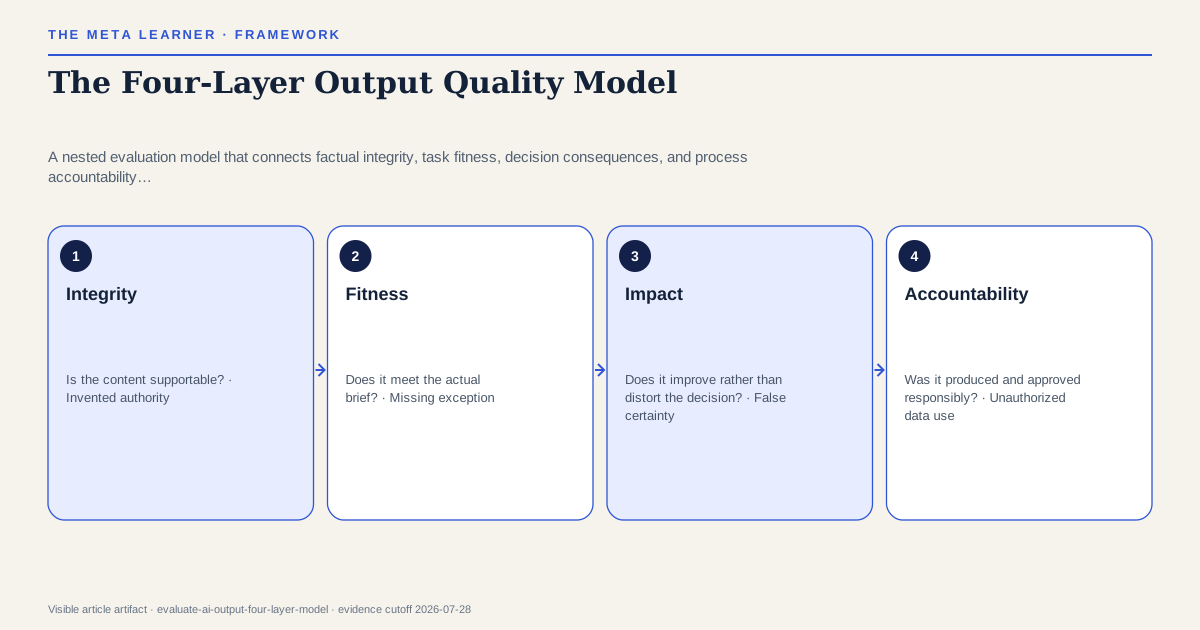
Evaluate AI output in four layers: factual integrity, fitness for the assigned task, effect on the downstream decision, and accountability of the process that produced and approved it. Do not average a critical failure away. If a fabricated source, unsafe recommendation, or unauthorized data flow is a release blocker, it remains a blocker even when the prose is excellent.
Quality depends on what happens next
Two identical paragraphs can have different quality. As private brainstorming, an unsupported possibility may be useful. As a published research conclusion, the same sentence may be unacceptable. Quality belongs to an output in use, not to prose in isolation.
This model is for people reviewing AI-assisted research, writing, analysis, and operational work. It is deliberately not a universal score. NIST frames AI risk through governance, context mapping, measurement, and management. nist, helm, gai HELM demonstrates that model evaluation spans multiple scenarios and metrics rather than one performance number. helm
Layer one: factual integrity
Ask whether checkable claims are supported and correctly scoped.
- Do names, numbers, dates, quotations, and citations match opened sources?
- Are observations separated from inference?
- Are uncertainty and counterevidence represented?
- Do calculations reproduce independently?
- Has supplied material been transformed without changing its meaning?
The unit is the claim, not the document. A report can be “mostly accurate” while its one decision-driving number is wrong.
Layer two: task fitness
Ask whether the output actually satisfies the brief.
An accurate essay is a poor answer to a request for a decision table. A correct summary may omit the one exception the intended reader needs. Test coverage, format, audience, constraints, and usability.
Create observable criteria: “includes all six vendors,” “quotes the governing clause,” “keeps each recommendation under 80 words,” or “labels missing evidence.” Avoid criteria such as “high quality” unless reviewers share anchored examples.
Layer three: decision impact
Ask what a user is likely to believe or do because of the output.
This layer catches problems that sentence-level review misses:
- A balanced-sounding comparison gives unequal evidence to the options.
- A risk is mentioned but visually buried.
- A forecast is read as a promise.
- A technically correct recommendation ignores who bears the downside.
- A summary removes the uncertainty needed for a reversible decision.
Evaluate representative users, not an ideal reviewer with unlimited time. If the output is meant to support a choice, compare the choice and reasoning with and without the AI artifact.
Layer four: process accountability
Ask whether the system of production can be defended.
Record approved inputs, model or system version, source set, tool actions, reviewer, substantive edits, and release decision. Check whether private data was authorized, whether external actions required approval, and whether the named reviewer had the expertise and time to inspect the critical claims.
The generative-AI profile treats governance, pre-deployment testing, provenance, and incident handling as system concerns. gai A good final paragraph does not erase an unauthorized upload or unlogged action.
The nested release rule
The layers are nested rather than interchangeable:
| Layer | Passing question | Example blocker | |---|---|---| | Integrity | Is the content supportable? | Invented authority | | Fitness | Does it meet the actual brief? | Missing exception | | Impact | Does it improve rather than distort the decision? | False certainty | | Accountability | Was it produced and approved responsibly? | Unauthorized data use |
Set blockers before review. Do not let an overall average conceal them. A team might require zero fabricated sources, 95% field accuracy on routine cases, complete coverage of mandatory sections, and explicit human approval for every external release.
What survives the comparison: the Four-Layer Output Quality Model
Authoritative guidance and evaluation research support multidimensional, context-specific assessment. They do not supply one universally valid quality score. The four-layer arrangement is an editorial synthesis that converts those principles into a release decision for knowledge work.
nist, helm, gaiScore one output without collapsing the layers
Take a consequential AI-assisted artifact and use this protocol:
- Write its intended user, decision, and consequence of error.
- Mark every claim that could change the decision.
- Verify those claims against source passages or independent calculations.
- Grade task criteria with anchored examples.
- Give the artifact to a representative user and observe interpretation.
- Audit inputs, permissions, actions, and approval.
- Record blockers separately from scored dimensions.
- Release, revise, or reject with a named owner.
The named owner is accountable for the release decision, not merely for clicking an approval control. Give that person the source trail, evaluation results, unresolved risks, and authority to reject the artifact. A human checkpoint without time, expertise, or visibility is a decorative step rather than a control.
Use How to Verify AI Explanations and Sources for the integrity layer. Build repeatability with AI Evals for Knowledge Work. When results are puzzling, diagnose the family with How AI Systems Fail.
Evaluation shortcuts that hide failure
- Rating style before verifying the decision-driving claims.
- Asking the same model to certify its own answer.
- Combining critical blockers and minor preferences into one average.
- Testing only clean, familiar, English-language examples.
- Assuming users notice a caveat because it exists somewhere.
- Calling a name in an approval field “human oversight.”
- Changing prompts or sources without preserving the earlier baseline.
Boundaries of the four-layer model
The framework is not a validated psychometric instrument, legal standard, or sector-specific assurance method. Reviewers may disagree, ground truth may be unavailable, and downstream effects may appear only after deployment. High-stakes domains require qualified experts, applicable standards, and stronger testing. Thresholds must be set from the real consequence of failure rather than copied from this article.
The decisive shift is from “Does this look good?” to four explicit questions: Is it supportable, is it fit, does it help the decision, and can we defend how it was made?
Named sources
Evidence and further reading
Published July 29, 2026. No substantive revision has been recorded. Evidence last verified July 28, 2026.