How AI Systems Fail: Hallucination, Bias, Drift, and False Confidence
Diagnose four commonly conflated AI failure families, trace their causes across model and workflow layers, and choose controls that can reveal them.
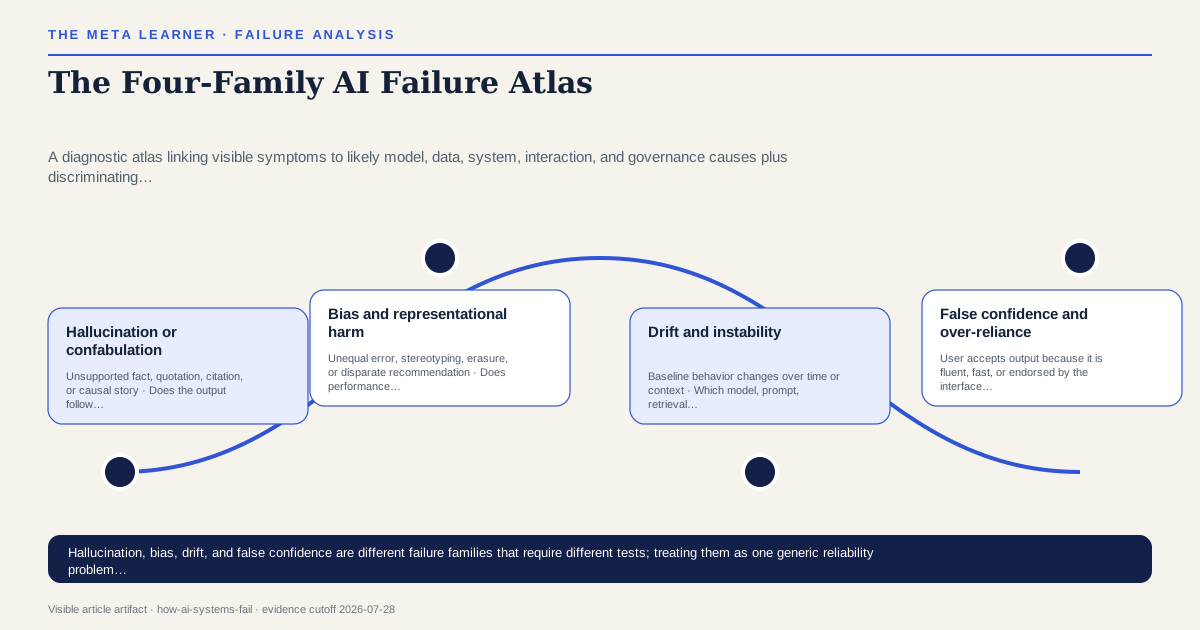
AI systems fail in different ways. Hallucination concerns unsupported content; bias concerns patterned disparities or harmful representations; drift concerns behavior changing relative to a baseline; false confidence concerns users reading fluency or system signals as stronger evidence than they are. Diagnose the family first, then test the layer that could cause it.
Diagnose the family before prescribing the control
Teams often collect every defect under “hallucination.” That label is too blunt. A fabricated source, a systematically worse result for one dialect, a prompt that stops working after a model update, and a manager accepting polished nonsense are not the same failure.
This article provides a diagnostic map for people evaluating real workflows. It does not imply that every failure can be cleanly assigned to one cause. Several families can interact: a retrieval failure can produce a fabrication; interface confidence can amplify automation bias; a changed data source can look like model drift.
NIST's generative-AI profile identifies confabulation, harmful bias, privacy, information integrity, security, and human-AI configuration as related but distinct risk areas. nist, parrots, helm Research on large language models also warns that training-data scale and fluent form can obscure social and epistemic limitations. parrots
The four-family failure atlas
| Family | Visible symptom | Diagnostic question | First test | |---|---|---|---| | Hallucination or confabulation | Unsupported fact, quotation, citation, or causal story | Does the output follow from available evidence? | Trace atomic claims to opened sources | | Bias and representational harm | Unequal error, stereotyping, erasure, or disparate recommendation | Does performance or treatment vary across relevant groups and contexts? | Stratify outcomes and review examples | | Drift and instability | Baseline behavior changes over time or context | Which model, prompt, retrieval source, tool, or policy changed? | Rerun a versioned regression set | | False confidence and over-reliance | User accepts output because it is fluent, fast, or endorsed by the interface | What evidence did the user actually inspect? | Compare decisions with and without AI cues |
The “first test” is a discriminator, not a complete audit.
Hallucination is an evidence relation
A statement is not hallucinatory merely because it is surprising; it fails when it is unsupported by the evidence required for the task. A generated metaphor can be valuable without a citation. A generated legal clause attributed to a statute must match the governing text.
Break prose into checkable atoms: names, numbers, dates, quotations, causal links, and recommendations. Ask what source would support each atom, open it, and compare the exact scope. Retrieval reduces some knowledge gaps but does not guarantee that the model used the right passage or represented it faithfully.
Bias is distributional and contextual
Bias cannot be tested with one agreeable example. Look for patterns across languages, dialects, genders, regions, disability contexts, and other dimensions relevant to the use. The meaningful outcome may be error rate, refusal rate, tone, ranking, allocation, or the burden placed on a human to correct the result.
Dataset composition, labeling practice, optimization objectives, prompt wording, deployment context, and user behavior can all matter. A generic “be fair” instruction does not substitute for specifying the affected population and measuring an outcome.
Drift includes more than the base model
Operational behavior can change when the provider updates a model, but also when a search index changes, source documents are replaced, tools return different fields, system prompts evolve, or users shift to harder cases.
Keep a small regression set with:
- versioned inputs and expected properties;
- model and system configuration;
- retrieved source identifiers;
- tool results and timestamps;
- graded outputs, not only pass/fail totals.
If a failure appears, rerun the layers independently. Otherwise “the AI changed” becomes an unfalsifiable explanation.
False confidence is a human–system failure
Language models optimize outputs, not calibrated human trust. Confident wording may be an interface style rather than a probability estimate. Citations can look scholarly without supporting the adjacent sentence. Human review can also be ceremonial: a reviewer with thirty seconds and no source access is not a robust control.
Holistic evaluation research emphasizes that accuracy alone omits calibration, robustness, fairness, bias, and efficiency. helm In operational settings, add a further metric: can the intended reviewer detect the planted failures under realistic time pressure?
Evidence for the diagnosis: the Four-Family AI Failure Atlas
The sources converge on a system-level view: generative-model quality is multidimensional, language can be plausible without reliable grounding, and risks arise from data, models, deployment, and human interaction. The exact prevalence of each failure remains use-case dependent, so representative local tests are essential.
nist, parrots, helmBuild a failure register from real outputs
Collect twenty to fifty representative cases from one workflow. Include routine inputs, edge cases, sensitive contexts, and deliberately ambiguous requests.
For every defect, record:
- The observable output, without interpreting it yet.
- The violated requirement.
- The likely failure family or families.
- The layer that may have caused it: source, retrieval, model, tool, interface, reviewer, or policy.
- A test that would distinguish competing causes.
- The containment action and accountable owner.
Use How to Verify AI Explanations and Sources for atomic factual checks, compare instability with Why AI Answers Change, and turn severe cases into repeatable tests with AI Evals for Knowledge Work.
Controls that fail by category confusion
- Adding retrieval to solve a biased evaluation rubric.
- Adding a disclaimer to solve fabricated citations.
- Freezing a prompt while the underlying source changes.
- Calling a human review step “oversight” without measuring detection.
- Averaging results across groups that experience different failure rates.
- Treating refusal as the only safe response, regardless of task and consequence.
- Reporting one pass rate without preserving the failed examples.
What this atlas leaves outside the frame
The four families do not exhaust generative-AI risk. Security attacks, confidential-data leakage, intellectual-property disputes, environmental cost, labor effects, unsafe tool actions, and abuse require additional analysis. Categories can overlap, ground truth may be contested, and evaluation itself can encode bias. The atlas is a starting structure for investigation, not a compliance certification or prevalence estimate.
Reliability improves when a team stops asking whether “the AI” failed and starts asking which observable requirement failed, at which layer, under which conditions.
Named sources
Evidence and further reading
Published July 29, 2026. No substantive revision has been recorded. Evidence last verified July 28, 2026.