Why AI Answers Change: Context, Sampling, Model Updates, and Reproducibility
Trace changing AI answers to input context, probabilistic generation, system components, and version changes—and preserve enough state to investigate.
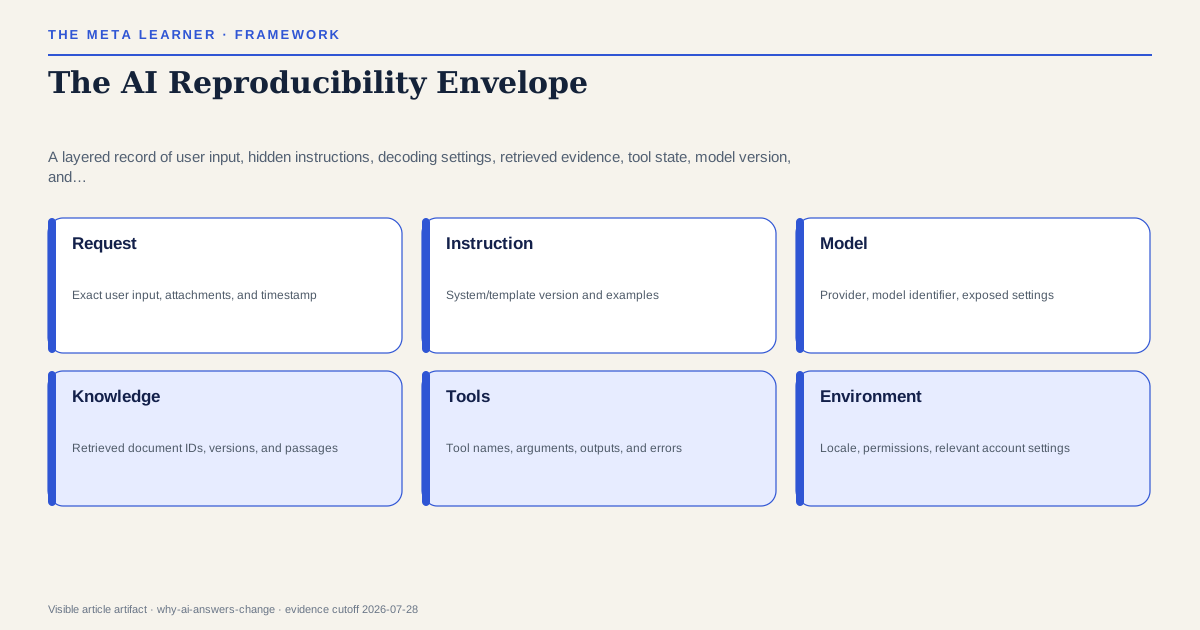
AI answers change because the visible prompt is only one input to generation. Conversation history, hidden instructions, tokenization, retrieved documents, tool results, sampling, model versions, and safety policies can all alter the output. Reproducibility therefore means preserving the relevant system state and testing required properties—not expecting identical prose. Providers expose different amounts of configuration and may not offer deterministic behavior even when a random seed is available.
The same prompt is rarely the same experiment
Copying a sentence into the same interface twice feels like repeating an experiment. Often it is not. The conversation may differ, the search index may have changed, a tool may return new data, or the provider may route the request to an updated system.
Even under fixed conditions, generation can be probabilistic. Transformer models compute contextual representations and language-model systems generate sequences token by token. transformer, helm, nist Decoding can select among plausible continuations rather than retrieve one stored answer.
This article is for people who need to investigate changing outputs, compare systems, or preserve audit evidence. It does not promise bit-for-bit replication from hosted models.
Four sources of variation
1. Context variation
Whitespace, ordering, prior turns, examples, attached files, and hidden system instructions can change what the model attends to. Long contexts also create selection problems: including a fact does not guarantee it will dominate the answer.
2. Sampling variation
At each generation step, multiple tokens may have nonzero probability. Decoding settings influence how alternatives are chosen. Lower randomness can reduce surface variation but does not guarantee factual correctness or identical results across infrastructure.
3. System variation
Retrieval may return different pages; tools may produce changing values; memory may add a user preference; content filters may transform a response. A “model answer” is often the output of an entire application.
4. Version variation
Providers can update weights, routing, prompts, tools, or safety behavior. Internal teams also change templates and source sets. If a result lacks version and time information, later diagnosis becomes guesswork.
Evidence inside the case boundary: the AI Reproducibility Envelope
Model architecture explains why outputs are conditional on context, while evaluation research shows sensitivity across scenarios and metrics. NIST treats generative AI as a lifecycle and system risk problem, including third-party components and changing contexts. These sources support recording system state; they do not guarantee exact reproducibility for any hosted product.
transformer, helm, nistClaim sources: transformer, helm, nist
The reproducibility envelope
Record enough information to explain the result:
| Layer | Minimum useful record | |---|---| | Request | Exact user input, attachments, and timestamp | | Instruction | System/template version and examples | | Model | Provider, model identifier, exposed settings | | Knowledge | Retrieved document IDs, versions, and passages | | Tools | Tool names, arguments, outputs, and errors | | Environment | Locale, permissions, relevant account settings | | Result | Raw output, latency, citations, and action trace | | Evaluation | Rubric version, grader, score, and blockers |
For sensitive work, store hashes or approved identifiers rather than duplicating confidential material. Reproducibility must not become a privacy breach.
Define invariants before demanding sameness
Most knowledge work does not require identical wording. It requires stable properties:
- every recommendation cites an approved source;
- all required fields appear;
- calculations match a deterministic tool;
- uncertainty remains within defined language;
- no external action occurs without approval.
Test these invariants across repeated runs. Surface diversity can be acceptable while a single missing safety condition is not.
Suppose five summaries of the same paper use different sentences. If all preserve the sample, outcome, limitation, and source, variation may be harmless. If one changes correlation into causation, the workflow has a reliability failure.
Capture a reproducibility envelope
Choose one unstable task and run it ten times:
- Save the exact visible request and full available context.
- Freeze the source set and tool outputs where possible.
- Record identifiers, settings, time, and raw responses.
- Grade invariant properties and surface differences separately.
- Change one layer at a time—context, model, retrieval, or decoding.
- Identify which change moves the requirement that matters.
Make the request explicit with The Anatomy of a High-Quality AI Request. Turn required properties into AI Evals for Knowledge Work. Use How AI Systems Fail when variation crosses a quality boundary.
Assign ownership to the invariant
Variation becomes operationally important only when it threatens a named requirement. Assign each invariant a decision owner and a human checkpoint: a researcher owns citation support, a finance lead owns a material calculation, or an operator owns an external action. Give the owner the representative test set and the raw runs, not a reassuring average.
When one run violates an invariant, classify the failure before tuning: input ambiguity, retrieval drift, tool error, model variation, or reviewer inconsistency. Retest the suspected layer while the others remain fixed. This small controlled comparison is more informative than collecting more preferred answers. The accountable owner then decides whether to accept the observed error rate, redesign the workflow, or stop use. The evaluation record should preserve negative runs; deleting them changes the question from reliability to selection.
False fixes for unstable output
- Repeating the prompt until a preferred answer appears.
- Treating a lower temperature as a truth setting.
- Saving only the user message and final prose.
- Comparing outputs after the retrieval corpus changed.
- Demanding identical wording instead of stable requirements.
- Blaming a model update without checking prompts, tools, and sources.
- Using one successful rerun as proof that the problem disappeared.
Reproducibility is not determinism
Hosted systems may hide instructions, routing, infrastructure, or version details, making exact reconstruction impossible. Even a detailed envelope cannot eliminate nondeterminism or downstream change. Some outputs involve current web data that should not be frozen indefinitely. The appropriate record and stability threshold depend on privacy, consequence, cost, and the purpose of the work.
The right question is not “Why did the wording move?” It is “Which part of the system changed, and did a decision-relevant property move with it?”
Named sources
Evidence and further reading
Published July 29, 2026. No substantive revision has been recorded. Evidence last verified July 28, 2026.