What Should You Memorize When AI Can Retrieve Almost Anything?
Memorize the concepts, patterns, procedures, and standards needed to think and judge; retrieve volatile details and verify consequential facts at use.
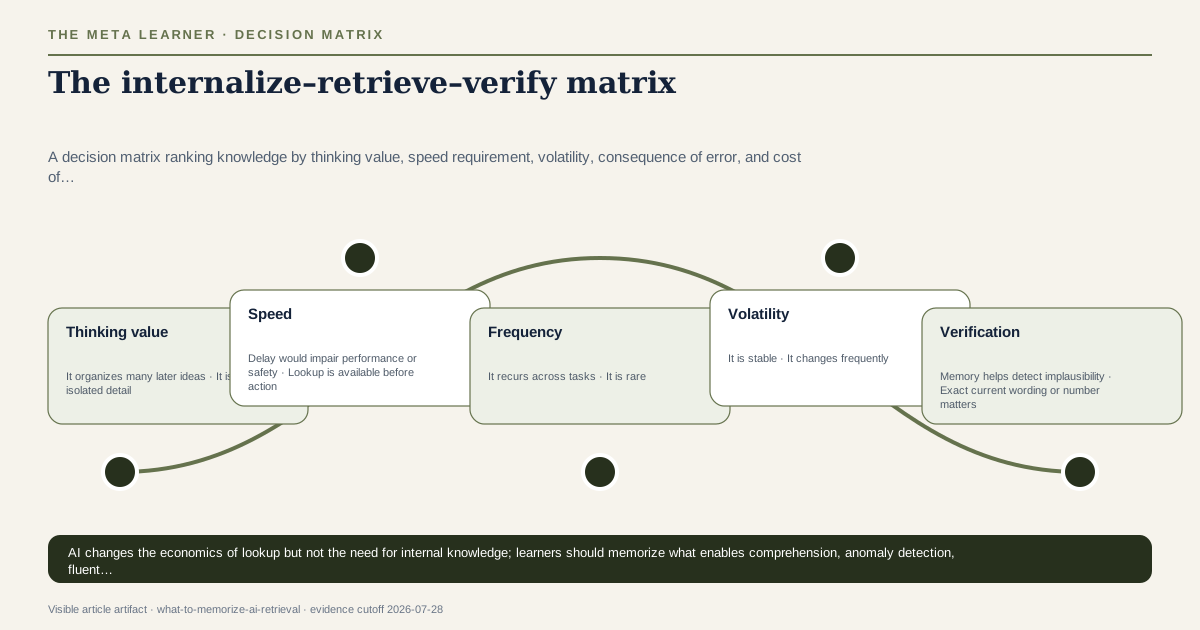
Memorize what you need to understand new information, recognize patterns, ask good questions, perform time-sensitive procedures, and judge whether an answer is plausible. Retrieve details that are volatile, rarely used, or easily verified. For consequential facts, retrieve and verify even if you remember them. AI makes lookup cheaper; it does not supply the internal models required to know what deserves checking.
Retrieval abundance changes the boundary
The old debate—memorize everything or look everything up—was already false. Humans have always offloaded memory into writing, instruments, other people, and institutions. Generative AI changes the speed and interface of that offloading. It can produce a contextualized answer before you formulate a precise query.
That convenience raises a new risk. If too little knowledge is available internally, you may not recognize when an answer is incoherent, outdated, outside scope, or based on a false premise. You can verify a citation only after noticing that verification matters.
Research on cognitive offloading describes how people use physical action or external tools to reduce cognitive demands and how offloading depends on metacognitive judgments.cognitive-offloading, nasem-learning, dunlosky-techniques Offloading is not failure. Unexamined dependence is the problem.
The five-question matrix
For any knowledge unit, score:
| Dimension | Internalize when… | Retrieve when… | |---|---|---| | Thinking value | It organizes many later ideas | It is isolated detail | | Speed | Delay would impair performance or safety | Lookup is available before action | | Frequency | It recurs across tasks | It is rare | | Volatility | It is stable | It changes frequently | | Verification | Memory helps detect implausibility | Exact current wording or number matters |
Add consequence of error. High consequence can require both internal competence and external verification: a clinician knows core principles but still checks current dosage guidance; an engineer understands load paths but consults specifications.
Internalize conceptual infrastructure
Carry:
- foundational vocabulary;
- causal mechanisms and system relationships;
- representative examples and counterexamples;
- common failure modes;
- procedures practiced to fluency;
- ethical and professional boundaries;
- reference ranges or patterns needed to notice anomalies.
How People Learn II emphasizes the role of prior knowledge in learning and the organization of knowledge around conceptual structures.nasem-learning New information is not inserted into an empty store; it is interpreted through what is already available.
Learning science supports the importance of prior knowledge, retrieval, distributed practice, and metacognition, while research on cognitive offloading shows that external supports can reduce internal demand. No fixed list or percentage defines the correct memory boundary across tasks.
Claim sources: nasem-learning, cognitive-offloading, dunlosky-techniques
Retrieve volatile precision
Prefer external retrieval for:
- current laws, policies, prices, schedules, and product specifications;
- long identifiers, exact quotations, and detailed tables;
- rare procedures with reliable checklists;
- comprehensive lists;
- facts where the authoritative source is part of the evidence.
Memory still plays a role: know that the fact is volatile, where authority lives, and what would look implausible. AI can help navigate, but the terminal source should match the consequence.
Verify even what you know
Familiarity can make outdated knowledge feel certain. Build mandatory checks for:
- medication and safety information;
- binding legal or regulatory text;
- security configuration;
- financial rates and thresholds;
- public claims with precise numbers;
- any fact whose error would materially affect another person.
The rule is not “never trust memory.” It is “do not make memory carry a kind of precision or currency it cannot guarantee.”
A worked allocation
A product manager uses AI to analyze experiments.
Internalize: randomization, selection bias, effect size, uncertainty, guardrail metrics, proxy failure, and the distinction between correlation and intervention evidence.
Retrieve: exact sample sizes, analysis code, metric definitions, dates, and prior test results.
Verify at use: privacy rules, experiment eligibility, current thresholds, and any number entering an executive decision.
Without internal concepts, the manager cannot interrogate the AI analysis. Without external records, the manager will improvise detail. Competence is the coordination of both.
Practice a memory portfolio
Choose one professional domain and create three columns:
- Core models: twenty ideas that organize the field.
- Fluent procedures: five actions that must run reliably under time or social pressure.
- External references: authoritative sources for volatile or detailed knowledge.
For each core model, create a retrieval cue and application case. For each procedure, practise with feedback. For each external reference, test that you can locate and interpret it.
Evidence reviews identify practice testing and distributed practice as comparatively effective general techniques, with important implementation and context limits.dunlosky-techniques Use them selectively; maintaining a memory item has a real opportunity cost.
Use the internalize-retrieve-verify matrix
- List thirty facts, concepts, or procedures in your current work.
- Score the five dimensions and consequence.
- Assign each to internalize, retrieve, or verify.
- Build retrieval prompts for the internal set.
- Create named authoritative links for the external set.
- Test one realistic task without AI.
- Repeat with AI and inspect what internal knowledge caught.
- revise the allocation from observed errors.
Use Active Recall and Spaced Repetition for selected durable knowledge, and manage the whole portfolio through How to Build a Personal Learning System.
Memory choices that create dependence
- Memorizing trivia because it is easy to test.
- Offloading foundational concepts before they can guide search.
- Trusting AI because no internal model detects anomalies.
- Memorizing volatile facts instead of knowing their authority source.
- Retrieving everything and losing speed under real conditions.
- Keeping a giant review queue unrelated to actual performance.
- Treating accessibility tools as lesser forms of cognition.
The external column is still an intellectual practice. For each consequential item, keep the original source, the claim it supports, and any live disagreement rather than an AI-generated conclusion alone. Periodically reconstruct the argument from the source and compare it with what the retrieval system returns. This makes external memory a verifiable synthesis layer instead of a cache of borrowed confidence.
There is no universal memory boundary
Memory needs vary with profession, disability, age, language, environment, tool access, and stakes. External aids can increase autonomy and safety, while forced memorization can waste effort or create barriers. Conversely, unavailable networks and failing tools can make offloading risky. Regulated and safety-critical fields require their own competence and reference standards.
The valuable memory is not the answer to every possible question. It is the conceptual equipment that lets you recognize the next question—and refuse an answer that has not earned your trust.
Named sources
Evidence and further reading
Published July 29, 2026. No substantive revision has been recorded. Evidence last verified July 28, 2026.