How to Synthesize 20 Sources Into One Defensible Point of View
Synthesize a bounded source set by extracting comparable claims, grouping evidence, testing contradictions, and writing a qualified point of view.
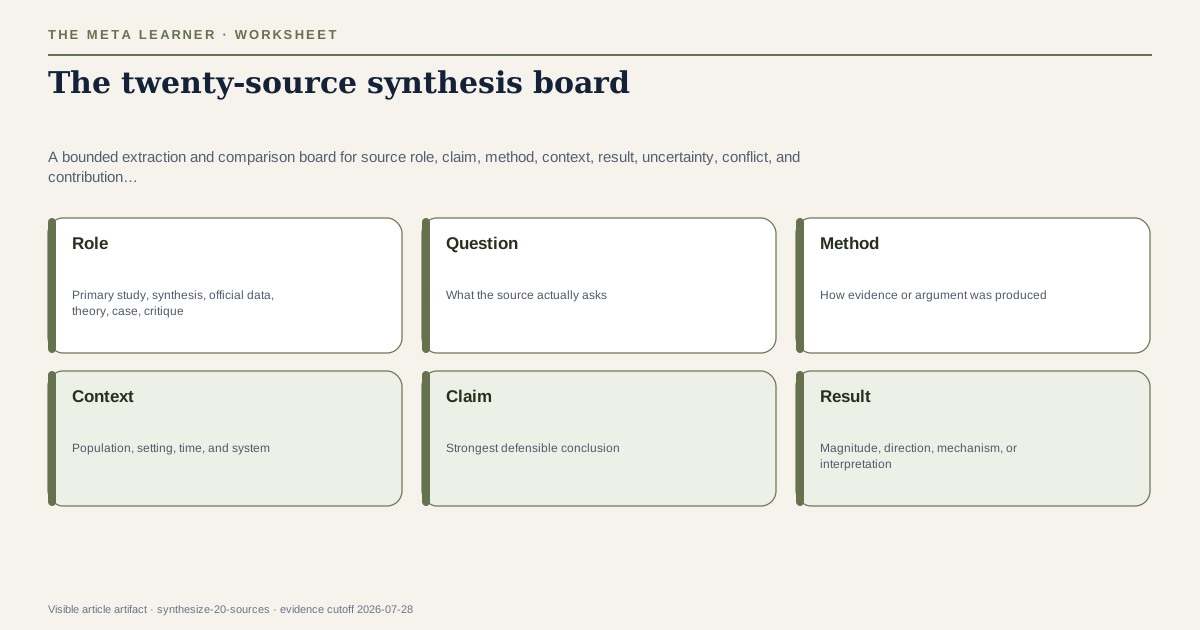
To synthesize 20 sources, define one decision and selection rule, extract every source through the same comparison frame, group claims by function, explain contradictions through method and context, and write the conclusion in layers: what is well supported, what is conditional, what is contested, and what remains unknown. Your point of view should emerge from that structure—not from the most quotable source.
Why twenty summaries are not a synthesis
An annotated bibliography tells you what each source says. A synthesis tells you what becomes visible when the sources are compared: where findings converge, why they diverge, which evidence is load-bearing, and what conclusion survives the differences.
Twenty is not a magic number. It is a useful bounded exercise: large enough to require structure, small enough for an individual to inspect closely. Do not call the result a systematic review unless the question, search, selection, appraisal, and reporting meet the relevant standards.
PRISMA helps systematic reviewers report why a review was done, what methods were used, and what was found.prisma-reporting, cochrane-prepare, cochrane-narrative For a bounded synthesis, borrow the ethic of transparency, not the label.
Freeze the research frame
Before extraction, write:
- decision or question;
- intended audience;
- source date and language boundaries;
- eligible source roles and evidence types;
- exclusion rules;
- definition of a duplicate study or report;
- what would count as convergence, contradiction, or a gap.
Record why each of the twenty sources entered. Otherwise selection can drift toward sources that support the emerging thesis.
Assemble the board before you draft
One row per source:
| Column | What to record | |---|---| | Role | Primary study, synthesis, official data, theory, case, critique | | Question | What the source actually asks | | Method | How evidence or argument was produced | | Context | Population, setting, time, and system | | Claim | Strongest defensible conclusion | | Result | Magnitude, direction, mechanism, or interpretation | | Uncertainty | Precision, bias, missing data, rival account | | Contribution | Define, describe, explain, challenge, design, evaluate |
Add a study-family ID so that one experiment reported in three papers does not masquerade as three independent confirmations.
Group by claim, not by author
After extraction, create claim clusters. For example, research on AI-assisted work might produce:
- measured effects on speed;
- measured effects on quality;
- variation by prior skill;
- changes in task allocation;
- risks to verification and accountability;
- worker experience and power;
- adoption and implementation constraints.
Within each cluster, compare sources directly. Cochrane’s preparation-for-synthesis guidance emphasizes structured tabulation of study characteristics and results before choosing a synthesis method.cochrane-prepare This prevents the final prose from becoming the first place comparisons occur.
Evidence-synthesis guidance supports planning comparisons, tabulating characteristics and results, choosing methods appropriate to the data, and reporting selection transparently. The method here translates those principles for a bounded, mixed-source analytical essay; it does not confer systematic-review status.
Claim sources: cochrane-prepare, cochrane-narrative, prisma-reporting
Explain contradiction before resolving it
When findings differ, test:
- same construct, different measure;
- same outcome, different time horizon;
- different populations or baseline risk;
- intervention implemented at different intensity;
- design supports different inference;
- missing or selectively reported results;
- genuinely incompatible findings.
Do not average incomparable results. Cochrane warns that alternative synthesis methods can mislead and that vote counting by statistical significance is unacceptable.cochrane-narrative In ordinary analytical writing, the analogous error is “twelve sources agree and eight disagree” without considering independence, design, or relevance.
Write the view in four layers
Established within this source set: claims supported by several independent, relevant sources with no material unresolved contradiction.
Conditional: claims that hold under named populations, mechanisms, or implementation conditions.
Contested: claims with credible incompatible evidence or models.
Unknown: questions the source set does not answer.
Then add the editorial judgment:
Given the decision, evidence, consequences, and reversibility, we should [action], because [load-bearing evidence], while monitoring [uncertainty] and avoiding [unsupported inference].
This is a point of view, not a disguised fact. Label it.
A worked miniature
Question: “Should a knowledge-work team use AI for research synthesis?”
The board shows evidence of faster drafting in some tasks, model risks around unsupported claims, wide variation by workflow and expertise, and little direct evidence on durable team capability. The defensible view is not “AI makes research better” or “AI cannot research.”
It becomes:
Use AI for query expansion, comparison formatting, and adversarial review in low-risk research, while keeping source selection, claim verification, and final inference human-owned. Measure total review time and unsupported-claim rate; preserve independent synthesis practice because capability effects remain uncertain.
The view is original because it integrates evidence into a decision boundary, not because it invents a universal claim.
Build the twenty-source synthesis board
- Define the question and selection rule.
- Select twenty sources with explicit roles.
- Extract every row before writing conclusions.
- Group rows into claim clusters.
- identify duplicate studies and dependent citations.
- Explain every major contradiction.
- Draft the four evidence layers.
- Write one labeled editorial judgment.
- Ask what source would most likely reverse it.
- Preserve the board with the published work.
Start with Turn Book Notes Into Reusable Knowledge, use Critical Thinking: A Practical System for Claims and Evidence for warrants, and express action through How to Make Decisions Under Uncertainty.
How a point of view becomes indefensible
- Selecting sources after the conclusion is known.
- Counting reports instead of independent evidence.
- Giving every source equal weight.
- Combining incompatible outcomes for rhetorical neatness.
- Hiding null results in an “other” paragraph.
- Treating absence of evidence as evidence of absence.
- Calling a bounded convenience set comprehensive.
- Removing uncertainty from the executive summary.
What this bounded method cannot claim
Twenty sources may omit decisive evidence because of search terms, access, language, publication bias, or disciplinary boundaries. Mixed evidence cannot always be combined, and a generalist may misclassify methods or results. High-stakes synthesis requires an appropriate protocol, specialist and information-professional involvement, duplicate appraisal where required, and domain-specific standards.
A defensible point of view is not the voice left after uncertainty has been deleted. It is the judgment that remains after uncertainty has been organized.
Named sources
Evidence and further reading
Published July 29, 2026. No substantive revision has been recorded. Evidence last verified July 28, 2026.