How to Build a Personal Knowledge Base That Survives Tool Changes
Build a portable knowledge base with open exports, durable identifiers, source provenance, simple structure, and tested recovery paths.
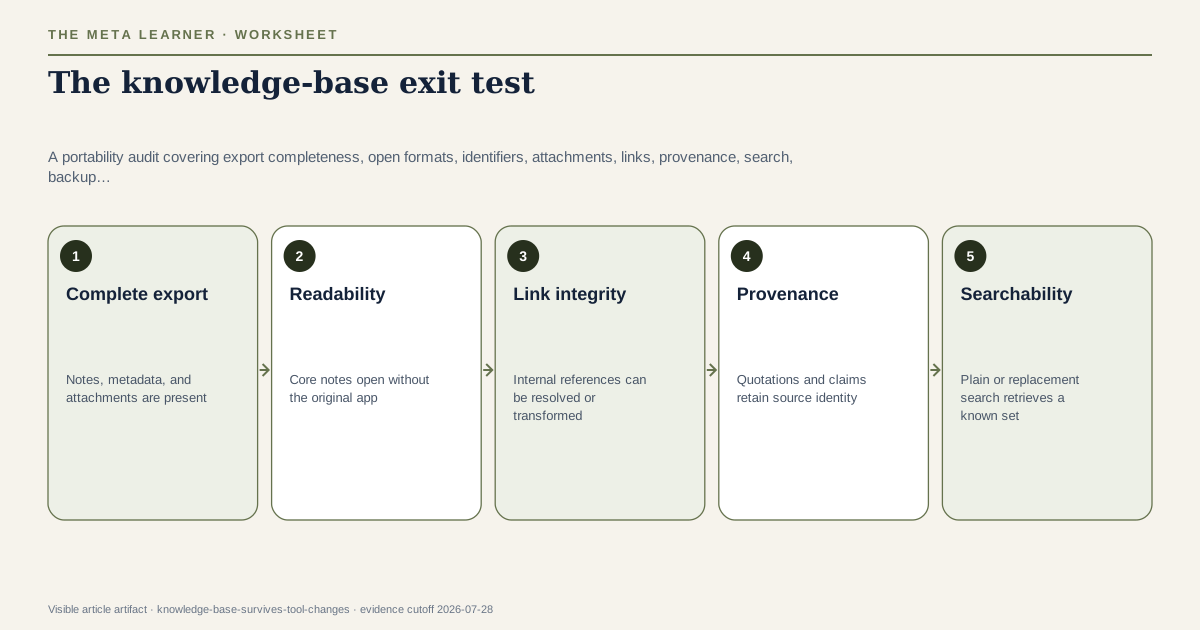
Build a knowledge base that survives tool changes by storing durable content in exportable, documented formats; assigning stable IDs; preserving source and date metadata; separating attachments from app-specific views; and testing a full export and restore. Choose software for today’s workflow, but design the records so another tool—or a plain text search—can still interpret them.
The app is not the knowledge base
Interfaces create an illusion of permanence. A graph view, backlink panel, or AI search feels like the knowledge system because it is where the system becomes visible. But the durable asset is the set of records and relationships beneath the interface.
Tools change ownership, pricing, file formats, APIs, sync behavior, and product direction. Your own practice changes too. A knowledge base should therefore have an exit path before it needs one.
This guide adapts ideas from data stewardship and digital preservation to personal notes. FAIR principles emphasize that data should be findable, accessible, interoperable, and reusable, supported by persistent identifiers, metadata, and provenance.fair-principles, loc-formats, acrl-information A personal knowledge base is not a scientific repository, but these properties expose useful design questions.
Define a portable record
Every durable note should retain:
- a stable ID independent of its title;
- human-readable title;
- creation and substantive modification dates;
- source identity and link;
- note type or evidential role;
- your claim, interpretation, or question;
- links expressed in exportable form;
- attachment references;
- rights, sensitivity, or sharing constraints where relevant.
Do not force every thought into a complex schema. Require metadata where losing it would change meaning. A quotation without a source is damaged; an idea without a dozen tags is often fine.
Prefer inspectable formats
The Library of Congress evaluates format sustainability through factors such as disclosure, adoption, transparency, self-documentation, external dependencies, and intellectual-property constraints.loc-formats For personal text, common readable formats such as Markdown, plain text, CSV, JSON, HTML, or well-documented standards make inspection and migration easier.
Format choice depends on content. Images, audio, diagrams, databases, and annotations require different preservation strategies. “Open” does not mean immortal, and proprietary does not mean unusable. The practical goal is to reduce dependence on one application’s undocumented behavior.
Data stewardship and preservation guidance support identifiers, metadata, provenance, interoperability, and sustainable format choices. Applying these institutional principles to a personal note system is a reasoned adaptation, not evidence that one file format or app produces better learning.
Claim sources: fair-principles, loc-formats, acrl-information
Separate content, relationships, and views
Think in three layers:
- Content: notes, quotations, claims, questions, and attachments.
- Relationships: links, source references, parent projects, and sequence.
- Views: tables, dashboards, graph visualizations, AI summaries, and saved searches.
Views are disposable. Relationships should be exportable. Content should remain readable without reconstructing the original interface.
This separation also makes AI features safer to replace. Embeddings, generated summaries, and chat histories can be rebuilt or discarded; verified source records and human interpretations remain.
Design a boring core
Use the smallest structure that preserves meaning:
/notes
  20260728-claim-retrieval-practice.md
/sources
  doi-10-1126-science-1199327.md
/attachments
  retrieval-practice-figure-1.png
/exports
  index.csv
The exact folders do not matter. The principles do:
- names remain unique;
- internal links can be resolved;
- attachments are not trapped in opaque storage;
- an index can be regenerated;
- source provenance travels with derived notes.
Rehearse the exit with ten real notes
During setup, perform one actual migration rehearsal:
| Check | Passing evidence | |---|---| | Complete export | Notes, metadata, and attachments are present | | Readability | Core notes open without the original app | | Link integrity | Internal references can be resolved or transformed | | Provenance | Quotations and claims retain source identity | | Searchability | Plain or replacement search retrieves a known set | | Backup | A separate copy exists with clear date and scope | | Restore | A fresh location can reconstruct a usable system |
Record failures as design constraints. A backup you have never restored is an assertion, not evidence.
Preserve information ethics
Information has value, as the ACRL framework notes, and creation carries attribution, rights, and privacy implications.acrl-information Your knowledge base should not become an ungoverned copy of confidential documents, licensed databases, private messages, or personal data.
Store links and lawful excerpts where full copies are not permitted. Separate private, client, and public material. Encryption and access control may be more important than convenience. Deletion requirements can conflict with archival instincts.
A migration example
A researcher has 4,000 notes inside an app. Export produces HTML files, but source URLs are embedded only in a proprietary property; attachments have opaque names; links point to internal IDs.
The researcher does not begin by choosing a new app. She defines a transformation:
- extract each internal ID as the stable note ID;
- map properties into a CSV index;
- copy source URLs into each note header;
- rename attachments with stable IDs;
- translate internal links;
- sample 100 notes and verify provenance;
- import into a test system and compare retrieval.
The project is a data migration with acceptance tests, not a weekend of copying.
Run the knowledge-base exit test
- Select ten representative notes, including attachments and links.
- Export them using the best available method.
- Open the export without the original application.
- check IDs, dates, sources, formatting, links, and attachments.
- Import into a neutral folder or alternate tool.
- Search for three known claims.
- Document loss and decide whether it is acceptable.
- Fix the record design before scaling the system.
Connect the durable core to How to Build a Personal Learning System, create generative records through Note-Making vs Note-Taking, and preserve provenance with Turn Book Notes Into Reusable Knowledge.
Portability failures hidden by convenience
- Assuming sync is backup.
- Exporting notes but not attachments or metadata.
- Using titles as the only identifier.
- depending on app-only links, queries, or transclusions.
- Preserving AI summaries while discarding source records.
- Encrypting data without testing key recovery.
- Copying protected or sensitive material without authority.
- Designing a taxonomy so elaborate that migration becomes impossible.
A durable record should preserve the intellectual structure as well as the bytes. For a consequential note, retain the original source, the exact claim being used, a compact argument reconstruction, and any material disagreement discovered later. A migration succeeds only if a future reader can rebuild the evidence map and synthesis without the vanished application’s interface.
Personal systems are not archives
This design is for personal continuity, not digital preservation at archival scale. File formats can degrade, links can disappear, and exported relationships may lose semantics. Organizational, medical, legal, financial, and research records can carry retention, deletion, security, audit, and licensing obligations that require approved systems and specialists.
Use the tool whose interface helps you think today. Keep the knowledge in a form that does not require today to last forever.
Named sources
Evidence and further reading
Published July 29, 2026. No substantive revision has been recorded. Evidence last verified July 28, 2026.