What Makes a Scenario Signpost Useful? An 80-Indicator Test
Which combinations of observability, direction, threshold, time window, and scenario exclusivity make an indicator discriminating rather than decorative? Executed on frozen inputs
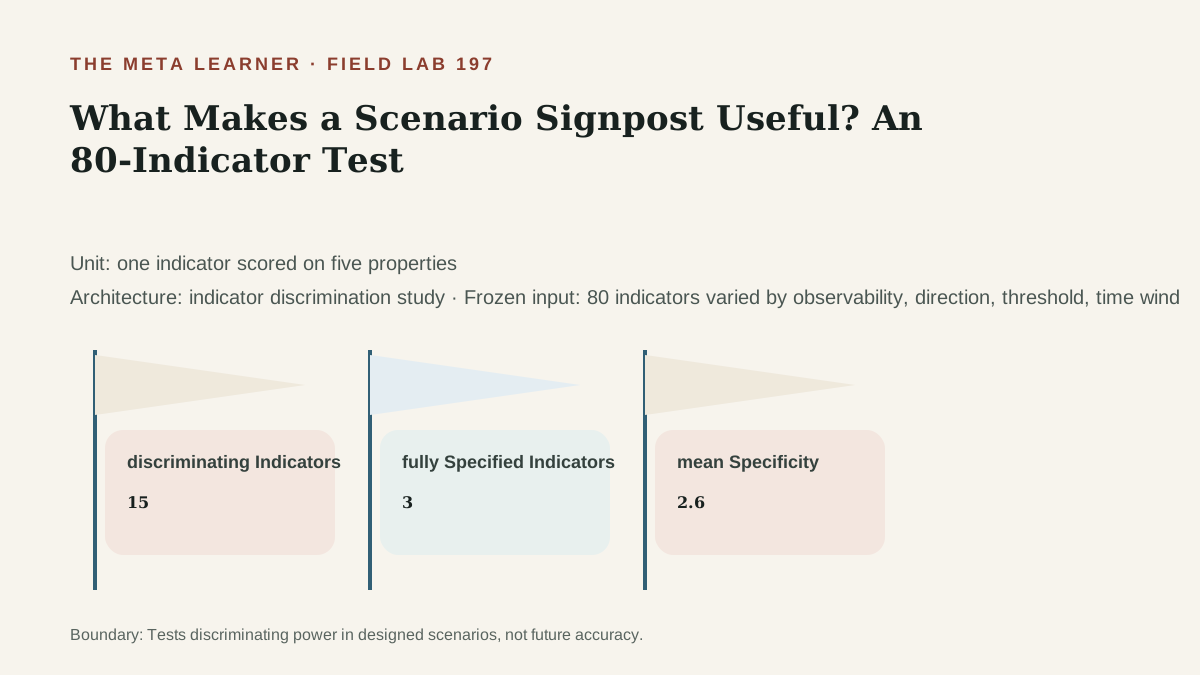
Only the declared indicators were tested, and only indicators that were observable, directional, thresholded, time-bound, and sufficiently scenario-exclusive qualified as discriminating. Write the observation, direction, threshold, time window, and rival scenario before monitoring begins. The classification applies to one indicator scored on five properties; it does not predict which scenario will occur.
A signpost must exclude something
A signpost discrimination indicator is useful only if it can later embarrass the story that produced it. The predetermined research question is: Which combinations of observability, direction, threshold, time window, and scenario exclusivity make an indicator discriminating rather than decorative? The experiment classifies one indicator scored on five properties; it neither predicts the future nor assigns probabilities to the scenarios.
A vague trend phrase can fit several futures after the fact and therefore cannot tell a reader which scenario is becoming more plausible. Here, the signpost discrimination baseline matters because a signpost fitting every scenario cannot discriminate among them. Specificity in scenario-planning indicators is tested as a condition of later accountability, not as evidence of foresight.
Frozen signpost discrimination indicators include indicators: 80; properties: 5. Each scenario-planning indicators property is visible, allowing a reader to reproduce the label without accepting the scenario narrative that motivated it.
Audit the labels behind signpost discrimination
The complete sanitized raw data is the canonical record for this run. At row level, signpost discrimination shows which properties produced each classification. Retaining non-discriminating scenario-planning indicators indicators is essential because they resist a simple “more detail is better” story.
- Row 1 — indicator Id: I01; observable: true; directional: true; thresholded: true; time Bound: true; scenario Exclusive: true; specificity: 5.
- Row 2 — indicator Id: I02; observable: false; directional: true; thresholded: true; time Bound: true; scenario Exclusive: true; specificity: 4.
- Row 3 — indicator Id: I03; observable: true; directional: false; thresholded: true; time Bound: true; scenario Exclusive: true; specificity: 4.
- Row 4 — indicator Id: I04; observable: false; directional: false; thresholded: true; time Bound: true; scenario Exclusive: true; specificity: 3.
- Row 5 — indicator Id: I05; observable: true; directional: true; thresholded: false; time Bound: true; scenario Exclusive: true; specificity: 4.
- Row 6 — indicator Id: I06; observable: false; directional: true; thresholded: false; time Bound: true; scenario Exclusive: true; specificity: 3.
- Row 7 — indicator Id: I07; observable: true; directional: false; thresholded: false; time Bound: true; scenario Exclusive: true; specificity: 3.
- Row 8 — indicator Id: I08; observable: false; directional: false; thresholded: false; time Bound: true; scenario Exclusive: true; specificity: 2.
- Row 9 — indicator Id: I09; observable: true; directional: true; thresholded: true; time Bound: false; scenario Exclusive: true; specificity: 4.
- Row 10 — indicator Id: I10; observable: false; directional: true; thresholded: true; time Bound: false; scenario Exclusive: true; specificity: 3.
- Row 11 — indicator Id: I11; observable: true; directional: false; thresholded: true; time Bound: false; scenario Exclusive: true; specificity: 3.
- Row 12 — indicator Id: I12; observable: false; directional: false; thresholded: true; time Bound: false; scenario Exclusive: true; specificity: 2.
- Row 13 — indicator Id: I13; observable: true; directional: true; thresholded: false; time Bound: false; scenario Exclusive: true; specificity: 3.
- Row 14 — indicator Id: I14; observable: false; directional: true; thresholded: false; time Bound: false; scenario Exclusive: true; specificity: 2.
- Row 15 — indicator Id: I15; observable: true; directional: false; thresholded: false; time Bound: false; scenario Exclusive: true; specificity: 2.
- Row 16 — indicator Id: I16; observable: false; directional: false; thresholded: false; time Bound: false; scenario Exclusive: true; specificity: 1.
- Row 17 — indicator Id: I17; observable: true; directional: true; thresholded: true; time Bound: true; scenario Exclusive: false; specificity: 4.
- Row 18 — indicator Id: I18; observable: false; directional: true; thresholded: true; time Bound: true; scenario Exclusive: false; specificity: 3.
- Row 19 — indicator Id: I19; observable: true; directional: false; thresholded: true; time Bound: true; scenario Exclusive: false; specificity: 3.
- Row 20 — indicator Id: I20; observable: false; directional: false; thresholded: true; time Bound: true; scenario Exclusive: false; specificity: 2.
- Row 21 — indicator Id: I21; observable: true; directional: true; thresholded: false; time Bound: true; scenario Exclusive: false; specificity: 3.
- Row 22 — indicator Id: I22; observable: false; directional: true; thresholded: false; time Bound: true; scenario Exclusive: false; specificity: 2.
- Row 23 — indicator Id: I23; observable: true; directional: false; thresholded: false; time Bound: true; scenario Exclusive: false; specificity: 2.
- Row 24 — indicator Id: I24; observable: false; directional: false; thresholded: false; time Bound: true; scenario Exclusive: false; specificity: 1.
- Row 25 — indicator Id: I25; observable: true; directional: true; thresholded: true; time Bound: false; scenario Exclusive: false; specificity: 3.
- Row 26 — indicator Id: I26; observable: false; directional: true; thresholded: true; time Bound: false; scenario Exclusive: false; specificity: 2.
- Row 27 — indicator Id: I27; observable: true; directional: false; thresholded: true; time Bound: false; scenario Exclusive: false; specificity: 2.
- Row 28 — indicator Id: I28; observable: false; directional: false; thresholded: true; time Bound: false; scenario Exclusive: false; specificity: 1.
The executed signpost discrimination record shows that only indicators that were observable, directional, thresholded, time-bound, and sufficiently scenario-exclusive qualified as discriminating. Row-level scenario-planning indicators fields support that bounded finding, while no field represents human learning, reader comprehension, or real-world deployment.
lab-recordClaim sources: lab-record
The reviewed method source supplies a relevant standard for context, traceability, or explicit evaluation of scenario-planning indicators. It disciplines interpretation of scenario-planning indicators; it does not generate or independently confirm this local aggregate.
method-sourceClaim sources: method-source
Results: which signpost discrimination indicators actually discriminated
| Recorded result | Value | |---|---| | discriminating Indicators | 15 | | fully Specified Indicators | 3 | | mean Specificity | 2.6 |
After classification, signpost discrimination produced a narrow result: only indicators that were observable, directional, thresholded, time-bound, and sufficiently scenario-exclusive qualified as discriminating. It makes later evaluation of scenario-planning indicators possible, but does not warrant that a signpost will occur or that the surrounding scenario is sound.
The prespecified negative finding for signpost discrimination is equally important: Several highly specified indicators still failed the test because they were compatible with more than one scenario. It marks the point at which this scenario-planning indicators method becomes silent, a condition a reader needs before deciding whether to use the rule.
Specificity can track the wrong mechanism
A highly specific signpost can still be wrong. Specificity makes later evaluation possible; it does not increase forecasting skill or rescue scenarios built on weak causal assumptions.
A specific signpost discrimination indicator can still track the wrong mechanism. Its scenario-planning indicators classification guides monitoring design, while causal plausibility and forecasting performance remain independent grounds for revision.
That reversal condition keeps signpost discrimination from becoming either technological maximalism or ritual caution. The scenario-planning indicators procedure earns its place only when it makes a consequential uncertainty, tradeoff, or failure more visible.
Eighty indicators face a five-part test
The classification rule is applied without retrospective adjustment in 3 stages:
- Freeze eighty indicators crossing five binary specificity properties.
- Score one point for each property and require scenario exclusivity for discrimination.
- Report the declared classification rule and every indicator-level result.
Across the signpost discrimination diagram and JSON, the same unit, sample, and result fields remain visible. If those scenario-planning indicators representations disagree, the visual is wrong; visual polish cannot override the canonical executed record.
Turn trend language into an observable threshold
Write the observation, direction, threshold, time window, and rival scenario before monitoring begins. Monitoring signpost discrimination should preserve its threshold and time window. If the scenario-planning indicators scenario changes, version the indicator rather than editing it until every observation looks confirmatory.
The working sequence for signpost discrimination is specific to this study: lock the question and baseline, freeze the unit, execute the declared transformation, retain negative findings, and separate the local result from any transfer claim.
Specificity is not prophecy
Vague signpost discrimination signposts make every future confirmatory; excessively narrow ones become trivia. Another scenario-planning indicators failure occurs when specificity is mistaken for probability and causal connection goes unexamined.
Reproducibility in scenario-planning indicators also fails when a download cannot regenerate the claim in the prose. This signpost discrimination record keeps protocol, sample, aggregates, limitations, negative findings, and row-level output in one parseable object so that disagreement can reach the actual computation.
Where this signpost discrimination result stops
Specificity is necessary for later falsification but does not establish forecasting accuracy. The designed indicators permit reproducible classification but contain no forecast probabilities or future observations. Discrimination is necessary for later evaluation, not sufficient for accuracy.
This signpost discrimination limit specifies the next experiment. Transfer of this scenario-planning indicators result requires records from the target context, the same visible denominator, and a fresh execution—not stronger adjectives attached to the present run.
Related reading:
- Continue with the prerequisite analysis of signpost discrimination.
- Continue with a comparison that tests a neighboring boundary.
- Continue with the next practical application.
signpost discrimination matters only if a future observation can force the scenario to change.
Named sources
Evidence and further reading
Published July 29, 2026. No substantive revision has been recorded. Evidence last verified July 28, 2026.