What Would Change Your Mind? Falsifiability, Counterevidence, and Honest Updating
A belief becomes accountable when you state what would lower confidence, distinguish it from rivals, and trigger a changed decision.
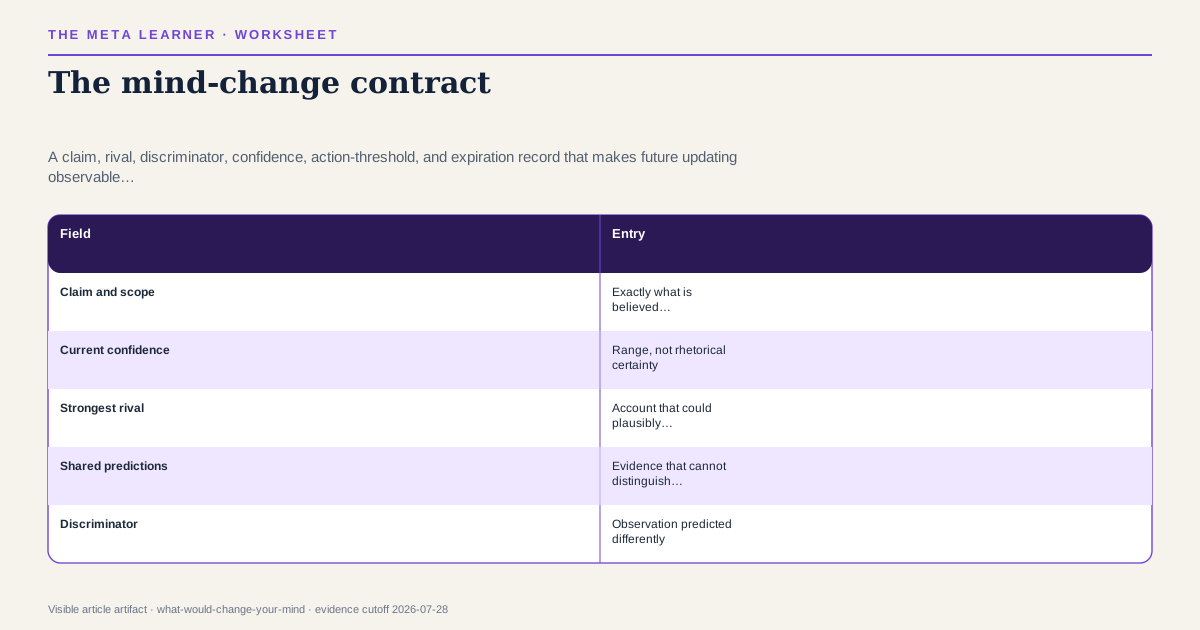
State the claim precisely, construct its strongest plausible rival, identify observations the two accounts predict differently, and write how each result would change confidence or action. “I would change my mind if the evidence were convincing” is not a test; the criteria must be specific enough to constrain you before the result arrives.
The unfalsifiable-belief problem
Some beliefs survive every outcome by changing their explanation after the fact. If a project succeeds, the strategy worked. If it fails, the team did not believe enough. If an expert disagrees, expertise is corrupt; if an outsider agrees, independence proves the point.
This guide is for empirical and strategic claims that should be revisable. It does not demand one dramatic conversion. Most rational updating changes scope or confidence before it reverses a belief.
Steelman the rival
A token alternative protects the favored view. Give the rival:
- a causal mechanism;
- its best supporting evidence;
- conditions under which it should outperform;
- a knowledgeable advocate’s formulation;
- an observation your preferred account struggles to explain.
If the rival still sounds absurd, ask someone who holds it to correct your representation.
What survives the comparison: the mind-change contract
Platt’s account of strong inference emphasizes alternative hypotheses and experiments capable of excluding them. Experiments on “consider the opposite” found reductions in some biased judgments when people generated reasons a preferred conclusion could be wrong. Philosophy of science also treats falsification as influential but contested: testing is embedded in auxiliary assumptions, practices, and multiple methods rather than one universal recipe.
platt-inference, lord-opposite, sep-methodClaim sources: platt-inference, lord-opposite, sep-method
From slogan to discriminator
Claim: “Remote work reduces team innovation.”
Weak reversal condition: “A good study showing otherwise.”
Stronger contract:
- population: product teams performing interdependent creative work;
- outcome: independently rated novelty and implementation after six months;
- proposed mechanism: fewer unplanned cross-role encounters;
- rival: autonomy and wider recruitment improve idea diversity;
- discriminator: communication pattern and diversity mediate outcomes in opposite directions;
- update: two preregistered multisite studies with credible measurement would move confidence from 70 to below 45 percent.
Numbers do not manufacture objectivity. They make the promised movement visible.
The mind-change contract
| Field | Entry | |---|---| | Claim and scope | Exactly what is believed, for whom, where, and when | | Current confidence | Range, not rhetorical certainty | | Strongest rival | Account that could plausibly fit current facts | | Shared predictions | Evidence that cannot distinguish the accounts | | Discriminator | Observation predicted differently | | Update rule | How much confidence changes under each result | | Action threshold | When behavior changes | | Expiration | When an untested claim must be revisited |
Keep the contract with the decision record. Do not replace it after the outcome.
Falsification is not a knockout punch
An apparent counterexample may reflect bad measurement, implementation failure, or a legitimate boundary condition. A theory is usually tested with auxiliary assumptions about instruments, samples, and context.
That does not make every rescue legitimate. Ask whether the boundary was specified before the result, whether the repair predicts new evidence, and whether the same generosity is offered to rivals. An explanation that grows a new exception after every miss loses informational value.
Write a mind-change contract
- Narrow one consequential claim.
- Estimate current confidence as a range.
- write the strongest rival without ridicule.
- list what both accounts predict.
- identify one feasible discriminator.
- prewrite upward and downward updates.
- set a separate action threshold.
- schedule an expiration if evidence will arrive slowly.
- invite adversarial review of the contract before collecting more evidence.
The action threshold may remain stable while belief moves. A safety decision can require very high confidence even after meaningful updating.
An adversarial result
Suppose the discriminator favors your claim, but the measurement was chosen after inspecting the data. The result should update less than the same pattern from a preregistered measure. Evidence quality is part of the contract.
Suppose the rival wins in a low-stakes laboratory setting but not in the target organization. Narrow the claim and test the contextual difference. Do not call either result definitive by default.
Evidence that would settle the contest around the mind-change contract
Reverse or substantially lower confidence when a credible design repeatedly produces an outcome your account considered unlikely, a rival predicts that outcome and additional evidence, or a central auxiliary assumption fails. Increase confidence when your account survives severe tests that live rivals do not.
Reverse the decision when confidence crosses the stated threshold, downside or reversibility changes, or a new option dominates. Belief and action are related but not identical.
Counterevidence evasions
Keep an update audit that another person can reconstruct. Record the prior range, the new observation, which rival predicted it better, and the resulting change in belief or action. If the numerical update is only illustrative, say so. The discipline is not performative Bayesian precision; it is preventing the same evidence from being called decisive when favorable and irrelevant when unfavorable. A stable belief should show the chain of tests it survived.
- Defining “convincing” only after seeing the result.
- Demanding perfection from rivals and anecdotes for the favored view.
- Moving the population or outcome after failure.
- Treating one anomaly as total refutation.
- Offering a rival that no informed person holds.
- Updating language but not probability or action.
- Forgetting claims whose expiration date passed without a test.
Where falsifiability is not enough
Not every meaningful claim has a simple decisive test. Observations are theory-laden, multiple models can fit limited data, and ethical or interpretive questions include values beyond empirical prediction. “Consider the opposite” does not eliminate motivated reasoning. Use the contract to improve accountability, not to declare complex inquiry solved.
Intellectual humility becomes operational when another person can see the evidence you promised to respect.
Build the anatomy with critical thinking, inspect confirmation bias, and quantify updates through calibrated confidence.
Named sources
Evidence and further reading
Published July 29, 2026. No substantive revision has been recorded. Evidence last verified July 28, 2026.