Confirmation Bias: Why More Research Can Make You More Wrong
Prevent research volume from hardening a preferred belief by separating discovery from testing, budgeting disconfirmation, and scoring rival explanations.
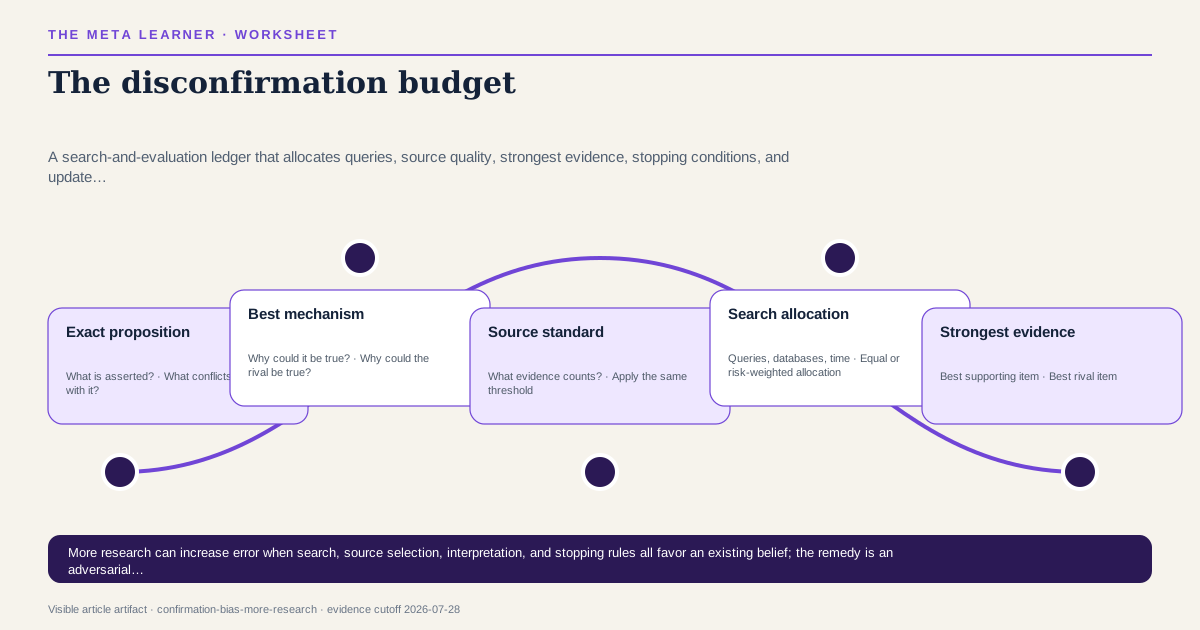
Before searching, write your current belief, its strongest rival, and evidence that would move you. Give both positions comparable query effort and source standards, record rejected evidence with reasons, and stop according to a rule set before seeing the result. More reading is corrective only when the process can let the rival win.
Evidence can polarize
The comforting model of research is additive: collect more information and move closer to truth. But evidence passes through choices. We phrase queries, select results, trust familiar institutions, scrutinize hostile claims, interpret ambiguity, and decide when enough has been read.
If those choices depend on the conclusion we prefer, ten hours of research can produce a larger, more sophisticated defense of the starting belief. Volume increases confidence while selection hides from view.
Evidence inside the case boundary: the disconfirmation budget
Nickerson’s review describes confirmation bias across information search, interpretation, and memory. In a classic experiment, people with opposing views evaluated mixed studies differently and became more polarized. A separate line of experiments found that deliberately considering how the opposite conclusion could be true reduced some judgment biases. These findings support procedural counterweights, not a claim that all disagreement is irrational.
nickerson-confirmation, lord-assimilation, lord-oppositeClaim sources: nickerson-confirmation, lord-assimilation, lord-opposite
Run a disconfirmation budget
Create the protocol before opening the search engine:
| Field | Preferred claim | Strongest rival | |---|---|---| | Exact proposition | What is asserted? | What conflicts with it? | | Best mechanism | Why could it be true? | Why could the rival be true? | | Source standard | What evidence counts? | Apply the same threshold | | Search allocation | Queries, databases, time | Equal or risk-weighted allocation | | Strongest evidence | Best supporting item | Best rival item | | Defeater | What would materially weaken it? | What would weaken the rival? | | Update | Prior → posterior range | Record reasons |
Equal time is not always equal rigor. If one claim has already received years of attention, allocate more of the new search to credible alternatives. If one side bears a higher burden of proof, state why.
Separate discovery from testing
During discovery, map vocabulary, mechanisms, stakeholders, and evidence types. Do not score the thesis after every search result. Early search ranking can anchor the entire investigation.
During testing:
- freeze the claim at a falsifiable level;
- search databases and primary institutions, not only web summaries;
- include null results, replications, retractions, and boundary conditions;
- reconstruct the strongest rival argument;
- apply the same causal and methodological questions to both;
- update a range, not a ceremonial confidence label.
An AI assistant can generate rival queries, but it may reproduce the framing and source pattern embedded in the prompt. Ask it for candidates; open and judge the sources yourself.
A worked research failure
A manager believes remote work reduces innovation. Searching that phrase returns opinion pieces, company surveys, and selected studies that fit the frame. Each new item appears independent, even when many repeat the same underlying report.
The rival is not “remote work always improves innovation.” It is that observed differences may depend on task, coordination design, measurement, selection, career stage, and the meaning of innovation. The disconfirmation budget requires source tracing, multiple outcome measures, and studies capable of distinguishing location from management practice.
The resulting conclusion might still be critical of remote work for a particular team. It becomes narrower, conditional, and linked to evidence that could reverse it.
Consider the opposite properly
“Play devil’s advocate” often produces a weak objection that makes the preferred case look stronger. A real opposite exercise asks:
- Under what plausible world is the rival true?
- Which observation would be surprising under my view but expected under it?
- Which competent person has the strongest opposing model?
- What result did I dismiss, and would I dismiss it if its direction reversed?
- Which method would I demand from the other side?
Write the rival before writing the synthesis. Otherwise it becomes a paragraph of caveats after the narrative has already won.
The rival model: asymmetry can be rational
Not all evidence deserves equal weight. A large preregistered study may outweigh several anecdotes. A primary official record may defeat recycled commentary. Extraordinary claims may properly require stronger evidence.
The test is whether the standard follows source quality and claim burden rather than congeniality. State the rule before applying it, show rejected sources, and ask whether the same defect would disqualify favorable evidence.
When the reference class behind the disconfirmation budget breaks
Increase confidence when the preferred claim survives the strongest rival, independent high-quality sources converge, predicted observations occur, and the result holds across relevant populations and measures.
Decrease or reverse when:
- the evidence chain traces back to one weak source;
- the effect disappears under a better comparison;
- the rival predicts anomalies the preferred model cannot;
- results depend on selective outcomes, populations, or time windows;
- search terms encode the conclusion;
- no imaginable finding has been allowed to count against the claim.
Sometimes the correct update is greater uncertainty rather than switching sides.
Research-process failures
- Counting articles instead of independent evidence.
- Searching only the preferred claim’s vocabulary.
- Demanding experiments from rivals while accepting anecdotes for allies.
- Treating mixed evidence as permission to keep the prior unchanged.
- Stopping immediately after finding a prestigious supporting source.
- Asking AI for “evidence that X is true.”
- Adding limitations only after the conclusion is fixed.
- Confusing emotional discomfort with disconfirmation.
The bounded verdict from the disconfirmation budget
Adversarial search consumes time and still depends on access, expertise, and judgment. Balanced attention can create false equivalence when evidence quality is sharply asymmetric. Confirmation-bias research describes tendencies, not a diagnosis of any individual disagreement. Decisions under deadlines require risk-proportionate stopping rules rather than exhaustive neutrality.
Precommit to what would change your mind, build procedural protection because awareness is insufficient, and audit each side with claim-level critical thinking.
Named sources
Evidence and further reading
Published July 29, 2026. No substantive revision has been recorded. Evidence last verified July 28, 2026.