Why Knowing Your Biases Is Not Enough
Bias literacy becomes useful only when it changes the decision environment: records, defaults, independent estimates, feedback, incentives, and accountability.
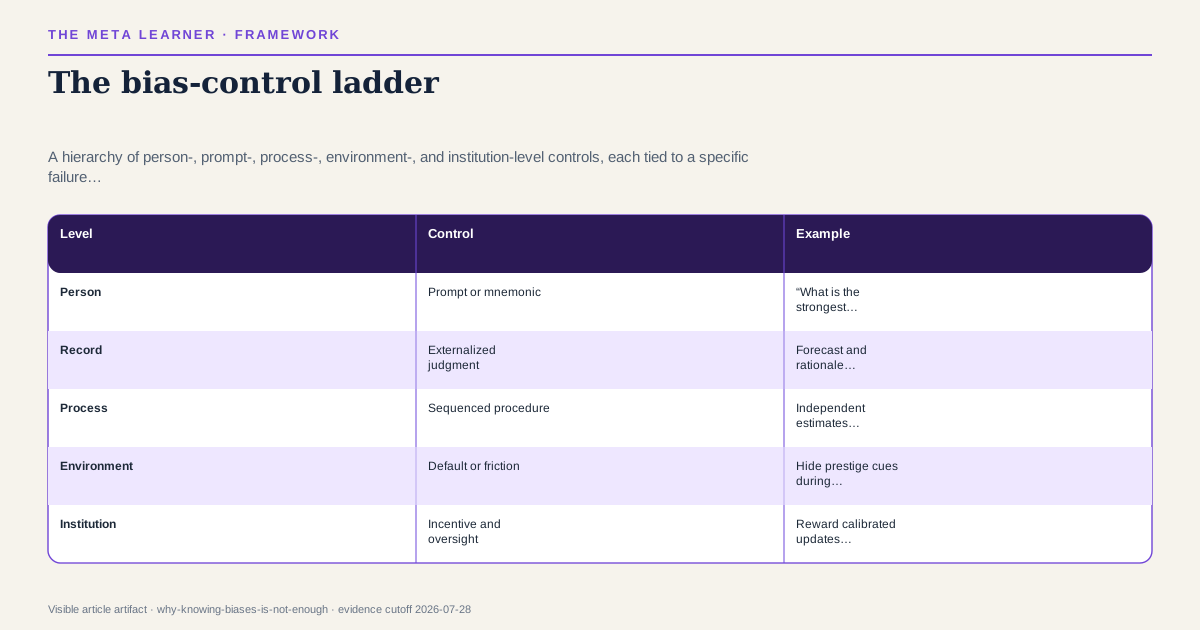
Do not stop at teaching bias names. Identify the recurring decision and its failure mechanism, then add the lowest-cost control that changes behavior: independent estimates, precommitted criteria, a required rival, delayed judgment, defaults, checklists, audit trails, or accountable review. Test the control on new decisions and retain it only if outcomes improve.
A label is not a control
Knowing the term “confirmation bias” can help describe someone else’s argument without changing one’s own search. Knowing “anchoring” does not prevent the first number on a page from shaping judgment. A catalogue of biases can even produce intellectual overconfidence: the learner recognizes vocabulary and mistakes recognition for transfer.
The practical question is not “Which bias explains this person?” It is “Which part of this decision process predictably fails, and what control changes the conditions under which it fails?”
The bias-control ladder: evidence and boundary
A major review of decision improvement organizes interventions around modifying the decision maker and modifying the environment. Experiments have found improvements on targeted bias tasks after instructional interventions, while consider-the-opposite procedures have reduced particular judgment errors in specific settings. These results justify testing concrete controls; they do not show that awareness of a label generalizes automatically.
milkman-decision, morewedge-training, lord-oppositeClaim sources: milkman-decision, morewedge-training, lord-opposite
Diagnose the transfer chain
Bias knowledge must survive at least five gates:
- Detection: Notice that the current situation is relevant.
- Retrieval: Recall the correct principle under pressure.
- Selection: Choose a suitable countermeasure.
- Execution: Have time, data, authority, and incentive to use it.
- Feedback: Learn whether the judgment improved.
A workshop can succeed on a quiz and fail at every later gate. That is a performance–transfer distinction: remembering the definition immediately after instruction is not evidence of better unaided choices weeks later.
Build a bias-control ladder
Start low, escalate with stakes and recurrence:
| Level | Control | Example | |---|---|---| | Person | Prompt or mnemonic | “What is the strongest rival?” | | Record | Externalized judgment | Forecast and rationale timestamped | | Process | Sequenced procedure | Independent estimates before discussion | | Environment | Default or friction | Hide prestige cues during first review | | Institution | Incentive and oversight | Reward calibrated updates, audit exceptions |
Each control must name a mechanism. “Use a checklist” is not enough. Specify which omission it catches, when it appears, who completes it, and what happens when a warning fires.
A worked redesign
An investment committee learns about anchoring and groupthink. Meetings still begin with the senior sponsor’s preferred valuation. Junior analysts then adjust around it, and the final memo reports consensus.
The redesigned process collects independent ranges before the meeting, hides names during initial aggregation, requires one analyst to model a rival reference class, and logs the initial and final estimates. The chair speaks last. Six months later, forecasts are scored by category.
No one must diagnose an internal bias at the perfect moment. The environment preserves independent information and makes movement visible. Training can explain why the procedure exists, but the procedure carries the load.
Match control to failure
Use a premortem when a team overlooks failure paths. Use natural frequencies when conditional probabilities are opaque. Use blind review when irrelevant identity cues influence evaluation. Use a base rate when a vivid case erases the denominator. Use a cooling-off period when affect drives an avoidable, irreversible choice.
Generic “slow down” advice can fail. More time may allow motivated reasoning to build a better defense. Add a rival search, external criterion, or independent review instead of delay alone.
The rival model: knowledge can matter
Awareness is not useless. A memorable concept can help people notice a pattern, create shared language, and understand a safeguard. Targeted training can improve performance on some tasks. The strongest conclusion is not “education never works.” It is that education should be connected to retrieval cues, practice, environment, and outcome feedback.
Awareness may be sufficient for a low-stakes, familiar problem with immediate feedback. It is least sufficient when incentives reward the biased result, stakes produce defensiveness, the decision is rare, or others bear the cost.
Test the control, not the intention
Predefine evidence of improvement:
- fewer omitted alternatives;
- probability forecasts closer to observed frequencies;
- reduced variance attributable to irrelevant order or identity cues;
- earlier detection of known failure modes;
- better decisions on new cases without reminders;
- no unacceptable delay or bureaucratic burden.
Compare against the old process where feasible. A control that creates ritual, workarounds, or false confidence should be redesigned or removed.
Signals that should suspend the bias-control ladder
Prefer individual instruction when the task is stable, the learner controls the environment, the correct cue is recognizable, feedback is rapid, and the cost of error is bounded.
Move toward process or institutional controls when:
- the failure repeats across people;
- incentives favor one conclusion;
- expertise and status suppress challenge;
- the decision is high-stakes or hard to reverse;
- memory must operate under stress;
- harms fall on people outside the room.
Reverse a chosen control if it adds delay without catching its target failure, shifts bias elsewhere, or encourages people to outsource judgment mechanically.
Debiasing failures
- Teaching long taxonomies without decision practice.
- Using bias labels as insults or retrospective explanations.
- Installing one checklist for unrelated mechanisms.
- Measuring recall rather than transfer.
- Ignoring incentives and power.
- Assuming a tool-generated second opinion is independent.
- Celebrating reduced variance when everyone adopted the same wrong anchor.
- Keeping a safeguard because it looks rigorous, not because it works.
The jurisdiction of the bias-control ladder
Bias concepts describe statistical tendencies and contested taxonomies, not clinical diagnoses or proof that a particular person is irrational. Controls can impose cost, create new distortions, and fail outside studied tasks. High-stakes process changes require local evaluation, relevant expertise, and attention to rights, incentives, and who bears errors.
See how bias enters research selection, precommit to reversal evidence, and test real transfer with an evidence-of-learning audit.
Named sources
Evidence and further reading
Published July 29, 2026. No substantive revision has been recorded. Evidence last verified July 28, 2026.