How to Tell Whether You Actually Learned Something
Replace time spent and fluent review with delayed retrieval, error evidence, independent performance, and transfer under realistic conditions.
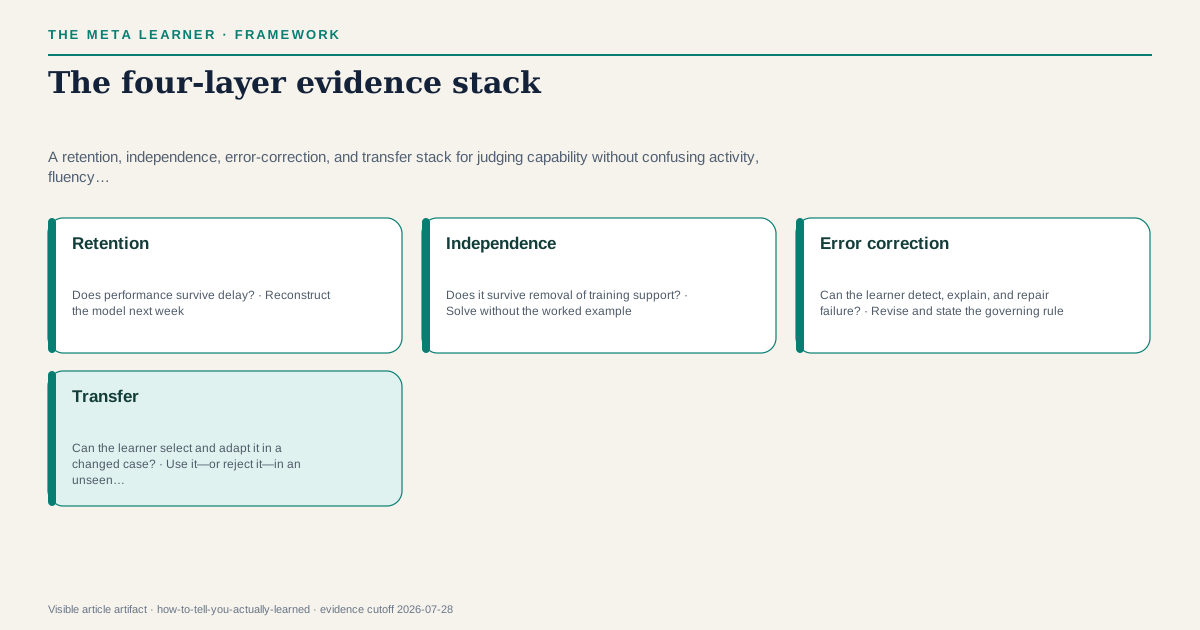
You have evidence of learning when you can perform the intended capability after a meaningful delay, with only the supports the real situation permits, explain and correct important errors, and adapt the knowledge to a changed case. Time spent, pages completed, familiar wording, and one successful imitation are activity signals—not sufficient evidence.
The evidence problem
Learning is a relatively durable change in knowledge or capability. Performance is what can be observed now. The two are connected, but instruction can inflate performance temporarily through prompts, recent repetition, predictable order, or an answer that remains visible.
This guide is for anyone finishing a course, book, tutorial, or AI session and asking whether anything became usable. It begins by defining the target, because there is no content-free test of “knowing.”
The four-layer evidence stack: evidence and boundary
Integrative reviews distinguish transient practice performance from durable learning and document conditions in which easier acquisition does not predict better retention. Reviews of study techniques give relatively broad support to practice testing and distributed practice while emphasizing task and criterion. National Academies syntheses describe learning as knowledge organized for reasoning, application, and continued learning in context.
soderstrom-performance, dunlosky-techniques, how-people-learnClaim sources: soderstrom-performance, dunlosky-techniques, how-people-learn
Define the capability before the test
“Learn causal inference” is not an assessable outcome. Possible capabilities include:
- explain a counterfactual in plain language;
- draw a causal graph from a scenario;
- identify a collider;
- choose an adjustment set;
- critique a causal claim in a paper.
Each requires different evidence. A quiz on vocabulary cannot validate the final four.
The four-layer evidence stack
| Layer | Question | Example evidence | |---|---|---| | Retention | Does performance survive delay? | Reconstruct the model next week | | Independence | Does it survive removal of training support? | Solve without the worked example | | Error correction | Can the learner detect, explain, and repair failure? | Revise and state the governing rule | | Transfer | Can the learner select and adapt it in a changed case? | Use it—or reject it—in an unseen scenario |
Not every low-stakes fact needs all four layers. Consequential capabilities do. The stack is a design tool, not a universal scoring scale.
Build a criterion sample
Use a small set of tasks that represents the future performance rather than every fact in the source. Include:
- one central, typical case;
- one near competitor designed to expose confusion;
- one changed representation or context;
- one boundary case where the method should not be used.
Write the scoring rule before attempting the test. Otherwise hindsight lets a plausible response redefine success.
A worked learning claim
Claim: “I learned to evaluate AI-generated research summaries.”
Weak evidence: ten summaries read, notes highlighted, and a course certificate.
Stronger test: after forty-eight hours, inspect an unseen summary with two subtle source mismatches. Identify the claims, trace them to primary sources, classify the mismatches, and write a corrected account. Allow normal browser access but not an AI system that performs the source comparison. Repeat on a different domain.
This test is not comprehensive, but its supports and error conditions match the claim far better.
Build a four-layer learning test
- Write one sentence beginning, “In the real situation, I must be able to…”
- List the tools and cues the real situation permits.
- Create two representative and two boundary tasks.
- Attempt a baseline before more study.
- Test again after a delay without training-only support.
- Classify errors by mechanism, not just score.
- Correct with feedback and complete a fresh parallel task.
- Add one changed context and explain what transfers.
Keep the baseline. Improvement is easier to see when the original performance has not been rewritten by memory.
Score process and result separately
A correct answer can result from luck, a hidden cue, or a faulty process that happened to land well. A wrong answer can result from a sound process with one arithmetic error. Score both:
- result quality—accuracy, completeness, consequence;
- process quality—representation, source use, checks, and revision.
This distinction matters in uncertain decisions where outcomes arrive late and luck is substantial.
Use AI without invalidating the test
AI can generate practice cases, but verify that the cases have valid answers and do not leak the method in their wording. It can compare a response with a rubric, but preserve the original and audit material claims.
If AI will be available in real work, include it at the transfer layer. Define what the human must still do: frame, verify, choose, or take responsibility. A tool-inclusive test is realistic only when it does not outsource the capability being claimed.
False evidence of learning
- Hours logged or content completed.
- Recognition immediately after exposure.
- Copying a demonstrated procedure.
- A high score on items identical to practice.
- Improvement visible only with escalating hints.
- An artifact whose human and tool contributions are undefined.
- One successful case with no competitor or boundary.
These signals can support a learning story. None completes it.
What one test cannot establish
Assessment is a sample of behavior, not direct access to knowledge. Results vary with fatigue, anxiety, language, disability, motivation, tools, and scoring. Delayed transfer tests are costly and can still underrepresent complex expertise, ethical judgment, or teamwork. Use repeated, proportionate samples and qualified evaluators where the consequences are high.
The honest question is not “Did I finish?” It is “What can I now do, under what conditions, and what evidence would make that claim false?”
Calibrate cue support with recognition is not recall, test distance with transfer of learning, and turn errors into a feedback loop.
Named sources
Evidence and further reading
Published July 29, 2026. No substantive revision has been recorded. Evidence last verified July 28, 2026.