Feedback That Improves Learning: Timing, Specificity, and Learner Control
Useful feedback compares work with a criterion, locates the error, and changes the next attempt. More comments and faster correction are not always better.
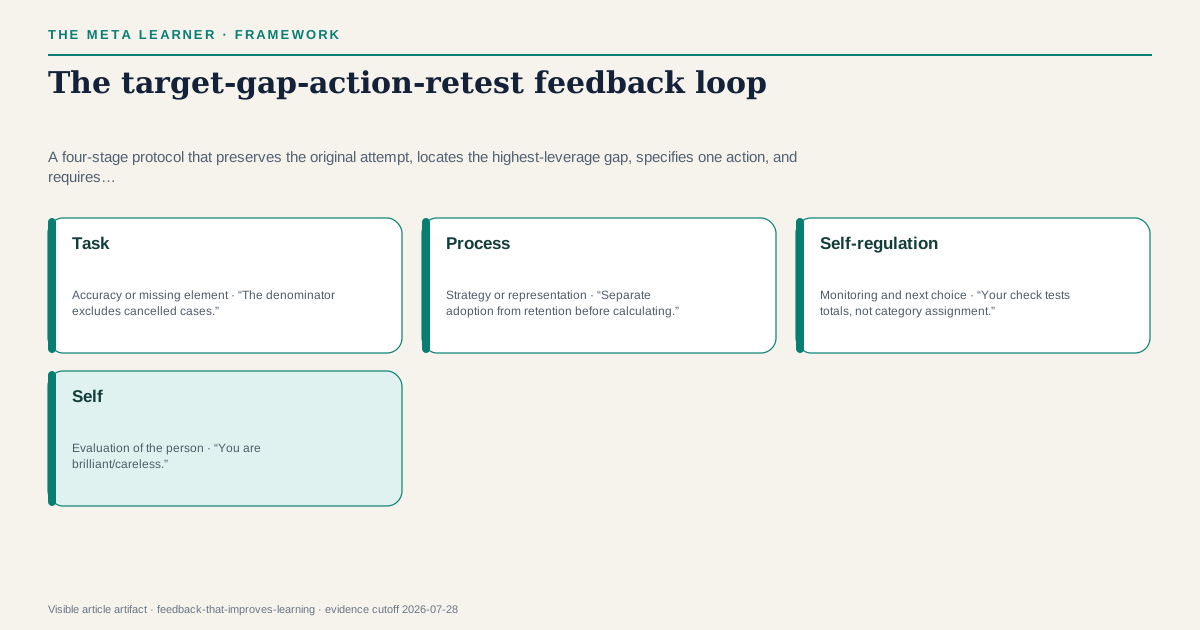
Feedback improves learning when the learner knows the target, can inspect the gap between the target and a preserved attempt, receives information specific enough to act on, and must use it in a new attempt. Timing should protect safety and prevent entrenchment while still allowing genuine generation and self-detection. Effective timing and specificity differ by task, expertise, emotional state, and whether immediate safety or delayed independent detection is the priority.
The feedback problem this guide solves
Feedback is often discussed as if quantity and speed guaranteed value. A document returns with sixty comments. An AI rewrites every sentence instantly. A coach says “great job.” None necessarily helps the learner produce a stronger next performance.
This guide is for people giving or seeking feedback on complex learning. It separates information about the task from judgments about the self and treats uptake as part of the feedback design.
Why the evidence supports the target-gap-action-retest feedback loop
Major reviews conclude that feedback can have positive or negative effects depending on its focus and use. Information about the task, process, and self-regulation is generally more actionable than praise or criticism directed at the person. Formative feedback is most useful when it helps close a gap between current and desired performance, while learner monitoring and control shape whether that information changes study or action.
hattie-timperley, shute-feedback, butler-winneClaim sources: hattie-timperley, shute-feedback, butler-winne
Four questions a feedback loop must answer
- Target: What would competent performance look like here?
- Gap: Where does this attempt diverge, and why does that matter?
- Action: What should change in the next attempt?
- Retest: Did the change survive without the comment beside it?
If the target is opaque, comments look arbitrary. If the original attempt is replaced, the learner cannot compare. If no retest occurs, correction can be mistaken for learning.
Choose the level of feedback
| Level | Useful focus | Example | |---|---|---| | Task | Accuracy or missing element | “The denominator excludes cancelled cases.” | | Process | Strategy or representation | “Separate adoption from retention before calculating.” | | Self-regulation | Monitoring and next choice | “Your check tests totals, not category assignment.” | | Self | Evaluation of the person | “You are brilliant/careless.” |
The first three levels can support action. Person-level praise may encourage, but it gives weak information about what to repeat. Person-level criticism can threaten identity while leaving the error mechanism untouched.
Timing is a design choice
Immediate feedback is important when an error is dangerous, when a novice could repeat and encode a misconception, or when the task provides no way to detect failure. A short delay can be useful when the learner needs time to complete a retrieval or diagnosis attempt.
“Delayed feedback is better” and “instant feedback is better” are both too coarse. Ask which cognitive act the delay protects. If waiting merely lets an error propagate, intervene. If interruption prevents the learner from generating and checking a full hypothesis, wait until the attempt is visible.
A before-and-after example
Weak comment:
This analysis is confusing. Be clearer.
Actionable comment:
The conclusion combines two populations. In the next version, state the eligible population before the effect estimate, then test whether the claim still holds for each subgroup.
The second comment names a gap, explains its consequence, and specifies an operation. It still leaves the learner to perform that operation.
Design a feedback loop
For one recurring task:
- Publish a criterion or strong exemplar before the attempt.
- Ask the learner to mark the least certain decision.
- Preserve the submitted version.
- Select the highest-leverage gap; do not comment on everything.
- Explain why the gap matters to the target.
- Specify a next action without writing the final answer.
- Require revision or a parallel attempt.
- Test the same principle later without the comment.
When several errors share one cause, comment on the cause. Editing every symptom can make the artifact look better while teaching less.
Learner control without abandonment
Choice can improve uptake: ask whether the learner wants feedback on argument, evidence, or language first; let them predict where feedback will concentrate; invite a response explaining which comment they accepted or rejected.
Control does not mean the reviewer withholds standards. In high-stakes work, non-negotiable safety, legal, or factual errors should be explicit. The learner can still own the reasoning that repairs them.
When AI gives feedback
AI can supply plentiful comments with uncertain validity. Anchor it to a rubric, require quotations from the learner’s actual work, and ask it to separate observed text from inferred intent. Verify factual and domain-specific comments against trusted sources or accountable expertise.
Do not accept a silent rewrite as feedback. Request diagnosis, rationale, and a bounded revision prompt. Keep the original so the learner can see what changed.
Feedback that fails
- Commenting on every local flaw and hiding the governing pattern.
- Praising identity instead of describing effective choices.
- Correcting before a genuine attempt exists.
- Waiting while a consequential misconception is repeatedly practised.
- Giving advice that exceeds the learner’s present capacity to use it.
- Treating disagreement as noncompliance.
- Measuring satisfaction with comments instead of subsequent performance.
Limits and boundary conditions
Feedback studies vary across ages, domains, tasks, delivery modes, and outcome measures. The broad finding that feedback matters does not provide a universal timing rule or effect size. Power relationships, culture, trust, language, and psychological safety affect interpretation. High-stakes professional work may require accountable supervision beyond a learner-controlled loop.
The smallest complete unit of feedback is not a comment. It is a changed attempt whose improvement can be tested.
Sequence support with worked examples and productive struggle, embed it in deliberate practice, and verify persistence with evidence of actual learning.
Named sources
Evidence and further reading
Published July 29, 2026. No substantive revision has been recorded. Evidence last verified July 28, 2026.