Worked Examples vs Productive Struggle: When Help Accelerates Learning—and When It Replaces It
Novices often need worked examples; capable learners need fading and generation. Use evidence of error and transfer to choose the next level of help.
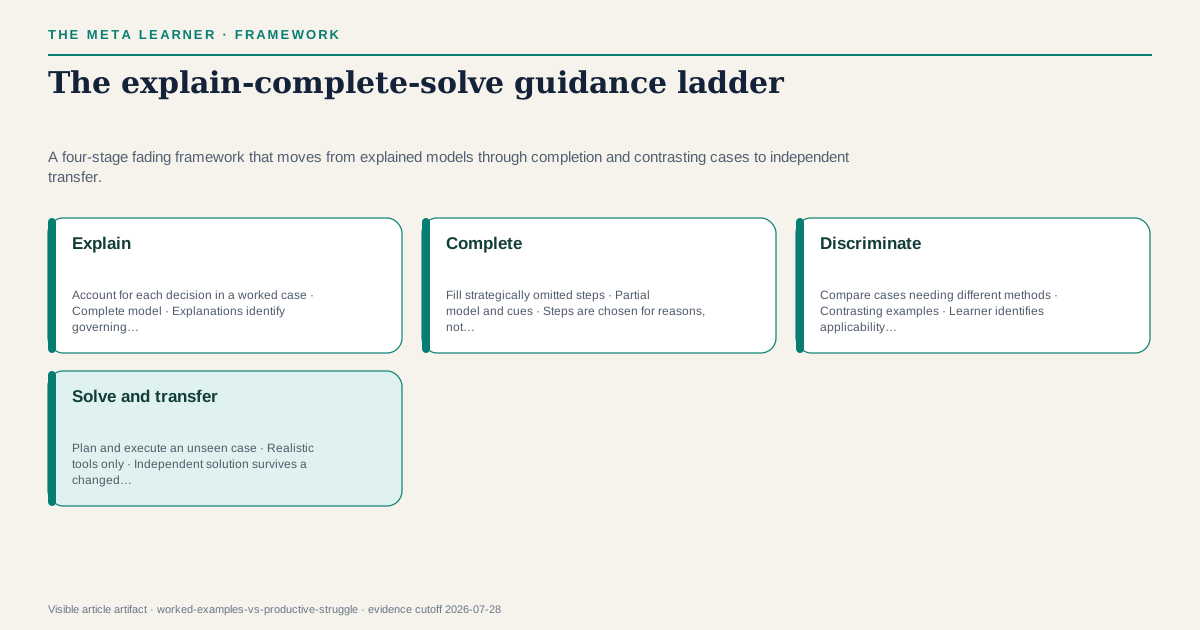
Use worked examples when a learner lacks the schema needed to recognize a good solution path. Ask the learner to explain and complete examples, then fade steps and introduce independent problems. Use problem-first struggle when learners have enough prerequisite knowledge to generate interpretable attempts and when instruction or feedback will help them compare those attempts with a stronger model.
The false choice this article resolves
One camp says, “Do not tell learners; discovery creates understanding.” Another says, “Do not let novices flounder; show the correct procedure.” Both can point to evidence because learner knowledge, task structure, sequencing, and outcome change which design works.
This comparison is for teachers and self-learners deciding how much support to provide now. It does not settle a philosophy of education. It gives a fading rule.
What the evidence establishes for the explain-complete-solve guidance ladder
Reviews of worked examples find benefits for novice learning in structured domains, especially when examples direct attention to relevant solution relations rather than merely displaying an answer. Expertise-reversal research shows that guidance can become redundant or harmful as knowledge grows. Research on problem solving before instruction identifies benefits under specific designs, particularly when initial attempts prepare learners to notice and compare critical features during subsequent instruction.
atkinson-examples, kalyuga-reversal, loibl-problem-solvingClaim sources: atkinson-examples, kalyuga-reversal, loibl-problem-solving
What an example must actually show
A worked example is not a polished final answer. A useful example exposes:
- the problem representation;
- why a method applies;
- the sequence of decisions;
- intermediate states;
- checks and likely errors;
- conditions under which the method would not apply.
If the learner simply copies steps, the example has replaced performance. Add self-explanation prompts: “Why this step?”, “What changed?”, “Which condition licenses the operation?”, “What would make it invalid?”
What makes struggle productive
Struggle is productive when it generates prior models that can later be contrasted, reveals a knowledge gap, activates relevant features, and remains bounded enough for the learner to persist. It is not productive merely because an answer is withheld.
A problem-first phase needs a designed landing:
- preserve the learner’s attempt;
- surface the strategy and assumptions;
- present or co-construct the canonical relation;
- compare, not merely replace;
- test a new case.
Without that comparison, “discovery” can end as confusion followed by a lecture.
The explain-complete-solve guidance ladder
| Stage | Learner action | Support | Exit evidence | |---|---|---|---| | Explain | Account for each decision in a worked case | Complete model | Explanations identify governing relations | | Complete | Fill strategically omitted steps | Partial model and cues | Steps are chosen for reasons, not guessed | | Discriminate | Compare cases needing different methods | Contrasting examples | Learner identifies applicability conditions | | Solve and transfer | Plan and execute an unseen case | Realistic tools only | Independent solution survives a changed context |
Move by evidence, not by elapsed time. A learner may be advanced in one subcategory and novice in another.
A worked comparison
A novice analyst is learning discounted cash-flow modeling. Sending her directly to a blank spreadsheet consumes attention on layout, notation, and tool operations while the central issue—how assumptions propagate—remains obscure.
Begin with a complete, annotated model. Ask her to explain why each cash flow is timed and discounted. Next remove selected formulas. Then contrast a stable business with one whose terminal assumptions dominate value. Finally give a new case and ask her to defend the sensitivity analysis.
An experienced analyst learning a new regulatory constraint may benefit from a problem-first attempt: existing modeling schemas allow the initial failure to expose exactly how the new rule changes them.
Move through the guidance ladder
For one target skill:
- Define the final unaided or tool-supported performance.
- Diagnose prerequisites with one representative task.
- Select a worked example that exposes decisions, not only steps.
- Require explanation before imitation.
- Convert it into a completion problem.
- Add a contrasting case that changes the applicable method.
- Attempt an unseen problem after a delay.
- Restore support only at the smallest failed decision.
This last rule matters. If the learner misidentifies the problem type, do not automatically replay the entire example. Repair classification, then test again.
When AI supplies the example
AI can generate variations quickly, but an unverified worked example can teach a coherent error. Anchor examples in an authoritative solution or expert-reviewed rubric. Ask AI to vary surface features while preserving the governing structure, then independently check that it did so.
Also prevent the tool from completing the target operation. If the goal is model selection, the AI may supply data and feedback but should not silently choose the model.
Guidance errors
- Showing an answer without the decisions that produced it.
- Asking novices to search a huge solution space in the name of agency.
- Keeping every annotation after it becomes redundant.
- Fading by schedule rather than demonstrated competence.
- Treating frustration as evidence of deep processing.
- Giving feedback that erases the learner’s original reasoning.
- Using only one example, so surface details become the apparent rule.
Where the comparison stops
Much worked-example evidence concerns well-structured domains and short- to medium-term outcomes. Productive-failure designs vary substantially, and their benefits should not be generalized to all unguided discovery. Motivation, identity, collaboration, accessibility, and tool fluency also shape results. Use the ladder as a hypothesis and test delayed, independent performance.
The intelligent question is not “guidance or struggle?” It is “what support lets this learner perform the next piece of thinking—and when should that support disappear?”
Check the desirable-difficulty boundary, diagnose cognitive load, and design the correction with feedback that improves learning.
Named sources
Evidence and further reading
Published July 29, 2026. No substantive revision has been recorded. Evidence last verified July 28, 2026.