Transfer of Learning: Why Knowledge Fails to Travel
Knowledge rarely transfers by magic. Teach the deep structure, conditions of use, contrasting cases, and adaptation required in a changed context.
Knowledge fails to transfer when it is tied to the wording, example, setting, or cue used during learning and the learner never identifies the underlying relation or its conditions of use. Build transfer gradually: establish the original skill, compare contrasting cases, make applicability conditions explicit, vary one dimension at a time, and require adaptation in an unseen problem.
The portability problem
A learner solves ten equations in a textbook and misses the same relation inside a work problem. A manager understands incentives in one industry and imports the model carelessly into another. A student can define confirmation bias and does not detect it in her own research.
These are all called transfer failures, but they differ in distance, cueing, knowledge, and criterion. This article is for anyone who wants a capability to survive beyond its training example.
What the evidence establishes for the transfer-distance staircase
Research treats transfer as multidimensional: knowledge domain, physical and social context, time, function, and modality can all change. Analogical-transfer experiments show that people often fail to use a relevant prior solution unless the structural relation is noticed or cued, while comparison can support schema formation. National Academies syntheses emphasize strong initial learning, underlying principles, varied contexts, and transfer as active adaptation.
barnett-ceci, gick-holyoak, how-people-learnClaim sources: barnett-ceci, gick-holyoak, how-people-learn
Surface similarity is a seductive guide
Novices often sort problems by visible objects; experts are more likely to see governing relations. Two finance cases may share terminology while requiring different causal models. A medical and an engineering problem may look unrelated while sharing a feedback structure.
The answer is not to ignore surface features. Some are genuine conditions of applicability. The learner must distinguish a decorative difference from a causally relevant one.
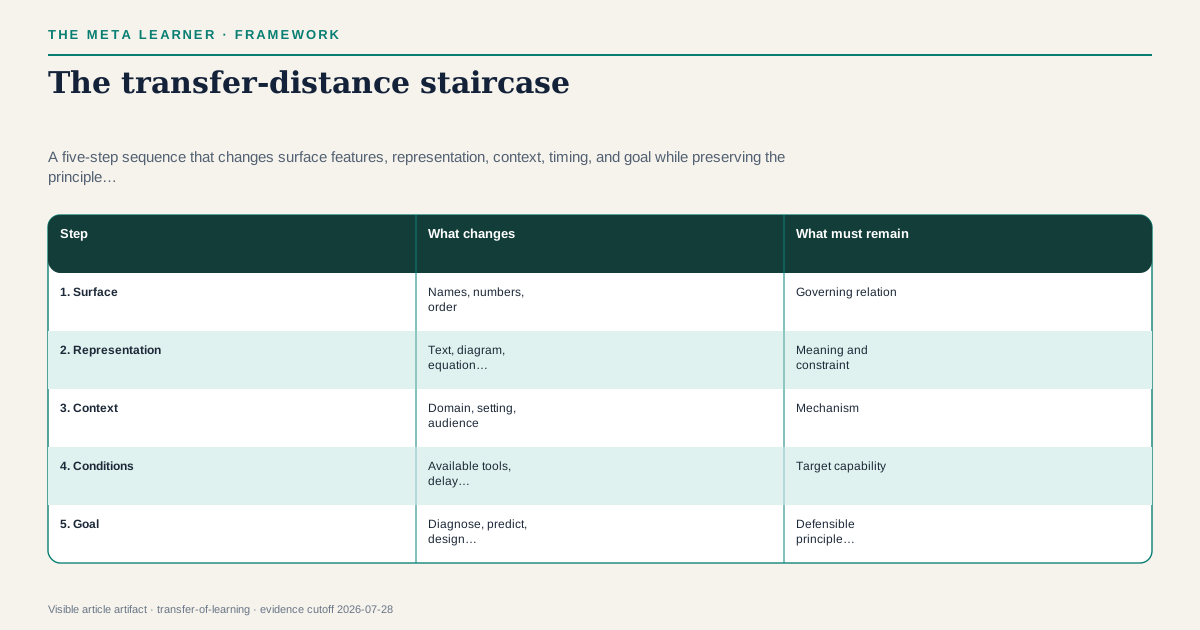
The transfer-distance staircase
Start from one mastered example and change dimensions deliberately.
| Step | What changes | What must remain | |---|---|---| | 1. Surface | Names, numbers, order | Governing relation | | 2. Representation | Text, diagram, equation, demonstration | Meaning and constraint | | 3. Context | Domain, setting, audience | Mechanism | | 4. Conditions | Available tools, delay, uncertainty | Target capability | | 5. Goal | Diagnose, predict, design, explain | Defensible principle and boundary |
At each step, ask the learner to state why the principle still applies—or why it no longer does. Refusal to transfer can be correct when a boundary changed.
Compare cases, do not merely accumulate them
Variation alone can look like noise. Place two cases side by side:
- What is structurally common?
- Which feature changes the correct response?
- What tempting surface cue points the wrong way?
- What evidence distinguishes the methods?
This makes the applicability condition part of the knowledge rather than an instruction known only to the teacher.
A transfer autopsy
A team learns a prioritization matrix in a workshop. In the exercise, every option has stable scores and one decision owner. At work, scores are disputed, dependencies change, and affected people hold different values. The team says the method “does not transfer.”
The autopsy reveals that they learned cell arithmetic, not the assumptions that make aggregation defensible. The repair is not more matrix practice. It is a comparison between stable and contested cases, followed by a decision about when the matrix is a conversation aid and when it creates false consensus.
Build a transfer staircase
For one capability:
- Define the original criterion and verify it without close support.
- State the deep relation and its boundary conditions.
- Build one near case with changed surface details.
- Change representation and require reconstruction.
- Move to a different context with one preserved mechanism.
- Add a case where the method should not be used.
- Delay the final test and withhold the label of the relevant method.
- Score selection, adaptation, explanation, and result separately.
The negative case is essential. A learner who applies a favored method everywhere has learned a trigger, not judgment.
Transfer can mean learning faster
One-shot independent performance is not the only evidence. Prior knowledge may help a person learn the new domain faster once its details are introduced. This “preparation for future learning” matters when far contexts cannot be mastered in advance.
Measure what additional support is needed and how efficiently the learner uses it. Independence at first contact and accelerated learning are related but different outcomes.
Tools change the transfer test
If real work includes documentation or AI, permit those tools—but keep the target operation with the learner. A test of causal framing can allow lookup of formulas while withholding an AI-generated causal graph. A test of source evaluation can allow search while requiring the person to justify source independence.
State the tool boundary so “transfer” does not become a hidden memory test or a fully outsourced performance.
Transfer design failures
- Assuming a learner will spontaneously notice the relevant analogy.
- Varying every feature at once.
- Practising only positive examples.
- Confusing repeated success with flexible selection.
- Calling a wholly different capability “far transfer.”
- Teaching a slogan without its conditions of applicability.
- Assessing immediately with the method name printed above the problem.
What transfer evidence means
Transfer is not a single effect and “distance” has no universal scale. Findings depend on initial mastery, similarity, cueing, delay, measure, and opportunity to learn in the new context. A successful case does not prove domain-general power, while one failure may reflect missing prerequisite knowledge rather than an inert principle.
Transfer is not knowledge teleporting intact. It is a new act of recognition, selection, and adaptation.
Use first principles and analogy to inspect structure, interleaving to practise selection, and evidence of learning to build the assessment.
Named sources
Evidence and further reading
Published July 29, 2026. No substantive revision has been recorded. Evidence last verified July 28, 2026.