Recognition Is Not Recall: Why Familiarity Feels Like Learning
Familiar material can feel mastered while remaining unavailable for explanation or use. Build tests that separate recognition, recall, and transfer.
Recognition means identifying an answer when it is present; recall means generating it when it is absent. Familiarity can make recognition fast and create a persuasive feeling of mastery, yet the knowledge may still be unavailable for explanation, production, or transfer. Test at the level the real task demands. Recognition is a legitimate target in tasks that actually require recognition, and no single test measures every form of knowledge.
The illusion this article addresses
You reread a page and every sentence seems obvious. You watch an expert solve a problem and anticipate the next move. You reveal a flashcard answer and think, “Of course.” Then a blank page, live conversation, or unfamiliar case arrives and the knowledge disappears.
Nothing mysterious happened. The study environment supplied cues that the performance environment withheld. Recognition and recall overlap, but they are not interchangeable measures. A multiple-choice item can ask for sophisticated discrimination; a recall prompt can ask for trivial reproduction. The important question is not which test sounds harder. It is which cognitive act the target performance requires.
Three kinds of success
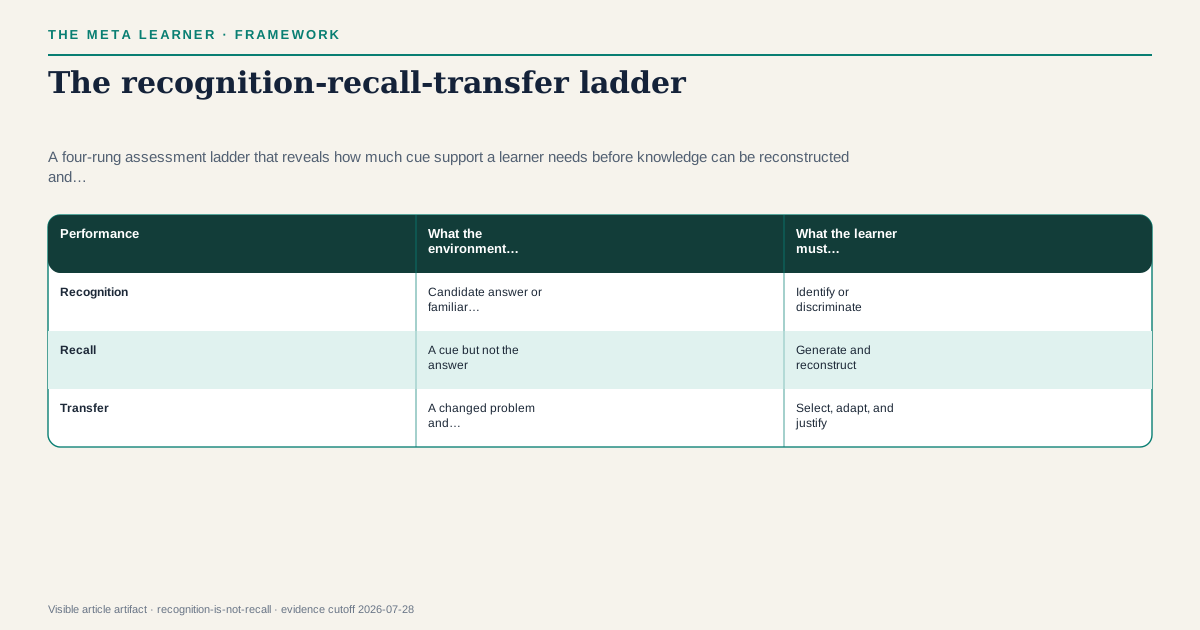
| Performance | What the environment supplies | What the learner must do | |---|---|---| | Recognition | Candidate answer or familiar pattern | Identify or discriminate | | Recall | A cue but not the answer | Generate and reconstruct | | Transfer | A changed problem and context | Select, adapt, and justify |
A fourth state—relearning—also matters. Faster relearning can reveal residual knowledge even when immediate recall fails. But it still does not prove that the answer was available when needed.
Why the evidence supports the recognition-recall-transfer ladder
Research on judgments of learning shows that people use cues such as processing fluency and beliefs about study methods when predicting later performance. Those cues can be misleading. Experimental comparisons have repeatedly found that retrieval practice can improve delayed performance even when additional study or elaboration feels more productive during learning. These results support matching practice to a later criterion rather than trusting familiarity.
karpicke-concept-mapping, dunlosky-techniques, yang-fluencyClaim sources: karpicke-concept-mapping, dunlosky-techniques, yang-fluency
Why “I knew that” is weak evidence
Once an answer is visible, it changes the task. The learner no longer has to search memory, choose among competing responses, or reconstruct the sequence. Hindsight compresses the difference between I could have produced this and I can understand it now that it is present.
Fluency adds another distortion. Clear typography, a coherent lecturer, repeated examples, and an agreeable explanation can all make processing easier. Ease can be valuable: unnecessary confusion is not a learning virtue. The error is using ease as the outcome measure.
A case: the fluent strategy deck
An executive rereads a strategy deck before a board discussion. With the charts visible, she recognizes every assumption. Without the deck, she cannot name the three causal dependencies or explain which observation would invalidate the plan.
The failure is not “poor memory” in the abstract. Her practice stopped at recognition while the meeting requires recall and adversarial transfer. A better rehearsal closes the deck, reconstructs the causal chain, tests it against a new scenario, and then uses the source to correct omissions.
Build a capability ladder
Take one concept and climb without skipping a rung:
- Discriminate. Select the correct account from two plausible alternatives and explain why the rival is wrong.
- Reconstruct. Produce the account from a sparse cue with the source closed.
- Vary. Answer with wording, notation, and order changed.
- Transfer. Decide whether the concept applies to an unseen case and justify the boundary.
Record the first rung at which performance collapses. That is your next practice target.
The ladder avoids two equal errors. It does not dismiss recognition as useless: diagnostic professions, visual identification, and quality control can depend on fine recognition. It also does not assume free recall is the summit of learning: reciting a definition may reveal less understanding than choosing correctly between close cases.
Match the test to the future
For conversation, practise spontaneous production and repair. Source evaluation instead requires detecting subtle differences with the source present. A programming test should require producing and debugging a solution under realistic tool access. Emergency action needs retrieval under the relevant time and cue conditions.
Define permitted support explicitly. “With documentation,” “from memory,” and “with an AI assistant” are different capabilities. A realistic assessment can include tools while still withholding the part that the learner must supply.
A better confidence question
Do not ask, “How well do I know this?” Ask:
- What prompt will the future situation provide?
- What output must I generate?
- What supports will be available?
- How different will the next case be?
- What error would matter?
Then predict a specific score or performance before testing. The gap between prediction and result is calibration evidence. A general feeling of confidence leaves nothing to compare.
Diagnostic mistakes
- Revealing an answer before making a complete attempt.
- Reusing identical wording, order, and examples.
- Treating all multiple-choice tests as shallow and all recall as deep.
- Counting comprehension of feedback as correction of the original error.
- Testing trivia from a topic whose real goal is application.
- Removing tools that will be available—or allowing tools that perform the target skill.
What this comparison cannot prove
Recognition, recall, and transfer are broad families of tasks rather than pure mental processes. Performance depends on cue quality, scoring, prior knowledge, delay, anxiety, and the match between practice and criterion. Retrieval tests can also reward memorized wording when poorly designed. Use multiple samples of the target capability and do not infer a stable trait from one failed attempt.
The productive conclusion is not “recognition is bad.” It is that every claim of learning contains an implicit test. Make that test visible.
For a diagnosis of access failure, read why we forget. Then design stronger evidence with how to tell whether you learned and practise with active recall.
Named sources
Evidence and further reading
Published July 29, 2026. No substantive revision has been recorded. Evidence last verified July 28, 2026.