Why Do We Forget What We Learn? Memory, Interference, and Retrieval
Forgetting is not one process. Diagnose weak encoding, retrieval failure, interference, and changed cues before choosing how to relearn.
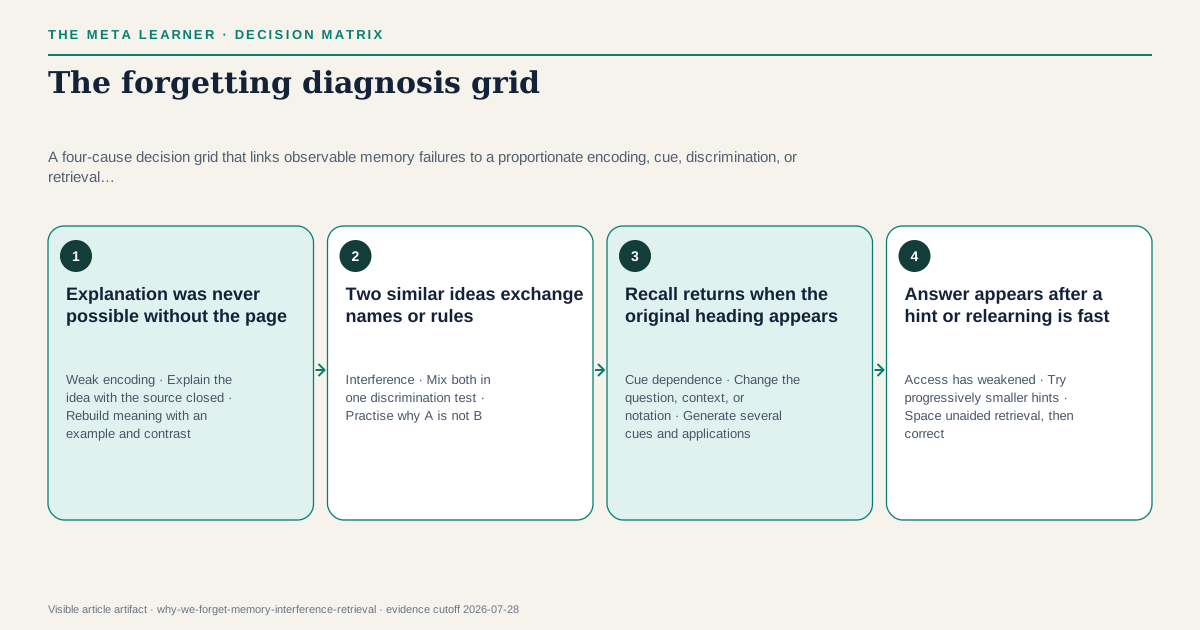
We forget for different reasons: the material may never have been encoded well, newer or older memories may compete with it, the cues available at recall may differ from those present during learning, or access may have weakened even though relearning remains possible. Diagnose the failure before adding more study. Often the best repair is an effortful retrieval attempt followed by targeted feedback, not another complete reread.
The question this article answers
This article is for a learner who understood something yesterday and cannot produce it today. It asks a narrower and more useful question than “Why is my memory bad?”: what kind of failure produced this particular forgetting, and what evidence would distinguish it from the alternatives?
The familiar “forgetting curve” is a population-shaped description, not a clock inside every mind. Murre and Dros reproduced the steep-then-flatter form of Ebbinghaus’s data, but the exact curve depends on material, prior knowledge, practice, delay, cues, sleep, and interference. It cannot tell you that every fact should be reviewed on the same fixed day.
Four routes to an empty answer
- Insufficient encoding. The learner processed a sentence but did not build a discriminable meaning, relation, or procedure.
- Interference. Similar names, rules, or procedures compete. Old knowledge can obstruct new learning; new learning can obstruct access to old knowledge.
- Cue mismatch. The memory is easier to access with the original prompt, setting, or example than with the cue the real task supplies.
- Retrieval weakness. The knowledge is available under support but not sufficiently accessible for unaided use at the required time.
These routes can coexist. A vocabulary item may have been shallowly encoded, confused with a neighbor, and tested only in the order in which it appeared. “Forgotten” describes the outcome; it does not identify the cause.
The forgetting diagnosis grid: evidence and boundary
Experimental memory research supports rapid early loss followed by slower change under some conditions, while contemporary accounts distinguish decay, interference, and retrieval competition rather than treating forgetting as one mechanism. Testing research also shows that retrieving studied material can produce better delayed retention than additional study, although the benefit depends on successful or corrected retrieval and an appropriate final test.
murre-forgetting, wixted-forgetting, roediger-testingClaim sources: murre-forgetting, wixted-forgetting, roediger-testing
The forgetting diagnosis grid
Use behavior, not a feeling of blankness, to choose a response.
| Observable pattern | Leading hypothesis | Discriminating check | Proportionate repair | |---|---|---|---| | Explanation was never possible without the page | Weak encoding | Explain the idea with the source closed | Rebuild meaning with an example and contrast | | Two similar ideas exchange names or rules | Interference | Mix both in one discrimination test | Practise why A is not B | | Recall returns when the original heading appears | Cue dependence | Change the question, context, or notation | Generate several cues and applications | | Answer appears after a hint or relearning is fast | Access has weakened | Try progressively smaller hints | Space unaided retrieval, then correct |
The grid is an original decision aid, not a validated clinical instrument. Its purpose is to stop indiscriminate restudy.
Interference is often the missing explanation
People frequently respond to a confused memory by adding more examples of the same kind. That can increase competition. If you confuse precision with recall, studying each definition separately may make both more fluent while leaving the boundary invisible. A better practice set alternates near neighbors, asks which concept applies, and requires the feature that rules the other one out.
Interference also changes with goals. A pianist learning a revised fingering, a lawyer tracking two jurisdictions, and a programmer moving between similar languages face different competitors. The relevant unit is not “the topic” but the response that must win among plausible alternatives.
Retrieval is an act of reconstruction
Recall is not playback from an archive. The learner uses a cue to reconstruct a target from stored relations. That is why changing the cue can expose brittle knowledge and why multiple meaningful cues can make access more resilient.
Before looking, attempt the answer. Then compare the reconstruction with a trusted source. Mark whether the error was omission, substitution, sequence, condition, or explanation. That classification tells you more than a binary right/wrong score.
Use the retrieval repair protocol
Choose one item you expected to remember.
- Write the exact performance required: define, distinguish, explain, execute, or apply.
- Attempt it without support and preserve the attempt.
- Give yourself one minimal cue. Record whether access returns.
- Compare with the source and classify the error.
- Create one contrast with the nearest competitor.
- Generate two new cues: one conceptual and one situational.
- Retrieve again after a delay and in a changed context.
If the first attempt shows no meaningful representation, stop testing and re-encode. If a small cue restores a good answer, more reading is unlikely to be the best first move.
Failure modes
- Treating one universal forgetting curve as a personal review calendar.
- Restudying the entire chapter when one discrimination failed.
- Counting recognition of the answer as successful recall.
- Testing with exactly the same wording and order used during study.
- Repeating an incorrect response without prompt correction.
- Assuming every lapse signals low ability rather than a modifiable cue or interference problem.
Evidence boundary
Laboratory memory tasks simplify the knowledge, stakes, emotions, and social conditions of real expertise. Retrieval practice does not repair a false model, and repeated testing can entrench error when feedback is absent. Sleep, attention, health, stress, and neurological conditions can also affect memory. Persistent or concerning changes in everyday functioning need professional assessment, not a study protocol.
The practical shift is modest but consequential: do not ask only whether you forgot. Ask what the pattern of failure reveals.
Continue by separating recognition from recall, then apply active recall and spaced repetition to the specific weakness you found.
Named sources
Evidence and further reading
Published July 29, 2026. No substantive revision has been recorded. Evidence last verified July 28, 2026.