Scenario Planning vs Forecasting: When Each Clarifies the Future
Use forecasts for resolvable uncertainty and scenarios for structurally different futures, then connect both to decisions, signposts, and invalidation.
Use forecasting when you can define an event, horizon, and resolution criterion and can defend a probability. Use scenario planning when different structural conditions would change actors, incentives, or causal relationships. Connect them by assigning probabilities only where warranted, testing decisions across scenarios, and monitoring signposts that trigger a change in action.
Two tools, two epistemic jobs
“What will happen?” hides several questions. Will a regulation pass this year? How many customers will renew next quarter? What would education look like if AI tutoring becomes cheap but trusted assessment remains scarce?
The first two can become resolvable forecasts. The third is a scenario question: it reorganizes incentives, institutions, and bottlenecks. Forcing all three into a single forecast creates false precision. Treating all three as imaginative scenarios avoids accountability.
The rival models
Forecast everything. This wins when events are well defined, feedback is frequent, base rates exist, and decision value depends on magnitude or timing. Forecasting forces specificity that scenario prose can evade.
Scenario everything. This wins when the purpose is to surface assumptions, consider structural breaks, coordinate stakeholders, or identify robust capabilities—not to claim predictive accuracy.
Each model fails outside its boundary. A scored forecast cannot represent a future whose actors and rules are endogenous. A vivid scenario cannot answer whether an inventory threshold will be crossed next month.
What survives the comparison: the forecast-scenario bridge
Scenario-planning scholarship presents scenarios as disciplined descriptions of multiple possible futures used to test strategy under uncertainty. Forecasting tournaments demonstrate that precisely worded questions, probabilities, scoring, updating, and aggregation can make near-term judgment more transparent and improve predictive performance. The methods overlap, but their primary outputs and standards of evaluation differ.
schoemaker-scenarios, tetlock-tournaments, mellers-superforecastingClaim sources: schoemaker-scenarios, tetlock-tournaments, mellers-superforecasting
Choose the method by question
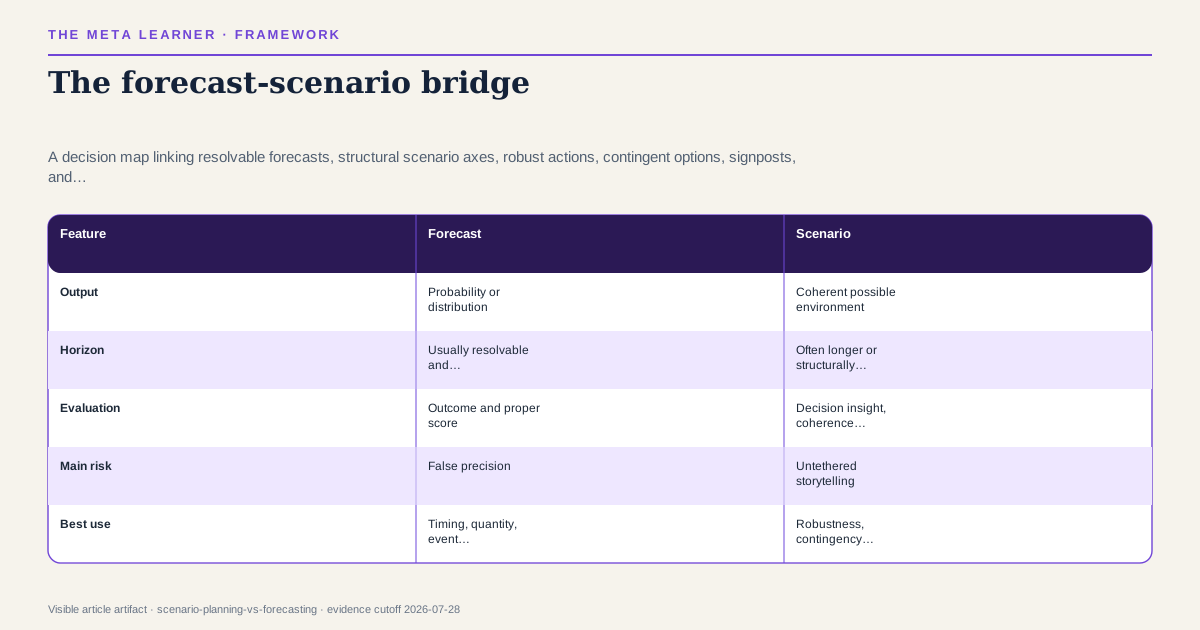
| Feature | Forecast | Scenario | |---|---|---| | Output | Probability or distribution | Coherent possible environment | | Horizon | Usually resolvable and bounded | Often longer or structurally open | | Evaluation | Outcome and proper score | Decision insight, coherence, signposts | | Main risk | False precision | Untethered storytelling | | Best use | Timing, quantity, event occurrence | Robustness, contingency, option design |
Do not choose by executive taste. Choose by what must be learned for the decision.
Build a forecast-scenario bridge
- Decision: What choice must be made now?
- Forecastable variables: Which events have definitions, horizons, and useful reference classes?
- Structural uncertainties: Which changes would alter relationships rather than merely values?
- Scenario set: Construct a small set whose combinations are distinct and decision-relevant.
- Robust actions: What works acceptably across most scenarios?
- Contingent options: What should be prepared but not yet committed?
- Signposts: Which observable developments move the world toward or away from a scenario?
- Invalidation: What would make an axis, forecast, or scenario irrelevant?
This bridge prevents the scenario workshop from ending in posters.
A worked future
A learning company must decide whether to invest in proprietary explanatory content, assessment infrastructure, or an AI interface.
Near-term forecasts can address the cost of model usage, renewal among current customers, delivery time, and the probability of a specific platform policy change by a stated date. They should be recorded and scored.
Structural scenarios might combine two uncertain axes: whether general AI explanations become effectively abundant and whether institutions continue to trust conventional credentials. The four resulting environments change where scarcity lies. In several, verified assessment and distinctive evidence become more defensible than generic generation. In another, integration and distribution dominate.
The robust action may be to preserve source provenance and build assessment data that can travel across interfaces. A contingent option may be a deeper credential partnership if institutional signposts strengthen. The scenarios do not predict which quadrant “will happen.”
Probabilities belong on claims, not decorations
Some scenario teams assign percentages to each narrative because numbers appear rigorous. If the scenarios are not mutually exclusive and collectively exhaustive, those probabilities are incoherent. If the horizon is distant and the structure can change, narrow numbers overstate knowledge.
You can still forecast signposts: the probability of a law passing by a date, an adoption threshold being crossed, or a technology meeting a benchmark. Those forecasts update strategic attention without converting an entire world into one dubious number.
Evidence that would settle the contest around the forecast-scenario bridge
Move from scenarios toward forecasts when signposts make the uncertainty measurable, the horizon shortens, stable reference classes emerge, and a probability would change the action.
Move from forecasts toward scenarios when:
- repeated misses reveal a structural break;
- the event definition depends on institutional change;
- actors adapt to the forecast itself;
- causal relationships vary across plausible environments;
- the probability range is so wide that robustness matters more than ranking.
Retire a scenario when its causal chain contradicts observed facts, its key driver is no longer uncertain, or it produces no distinct decision. Do not keep all old worlds alive merely to appear open-minded.
Futures-method failures
- Calling three versions of the same trend “scenarios.”
- Selecting axes for drama rather than decision relevance.
- Treating every scenario as equally likely without saying why.
- Publishing a forecast with no resolution criterion.
- Scoring forecasts selectively and forgetting misses.
- Designing signposts that can only be recognized in hindsight.
- Discussing futures without naming a present owner or action.
- Letting an AI produce internally fluent worlds with unverified premises.
What the debate leaves decidable: the forecast-scenario bridge
Forecast accuracy depends on question selection, feedback, data, and stationarity. Scenario quality is harder to score and vulnerable to facilitator bias, group conformity, and narrative seduction. Neither method substitutes for domain evidence, ethical judgment, or contingency resources. Long-horizon numbers should be presented with especially wide uncertainty.
Calibrate resolvable claims with a forecast ledger, trace second-order effects, and use expected value only where probabilities and consequences are defensible.
Named sources
Evidence and further reading
Published July 29, 2026. No substantive revision has been recorded. Evidence last verified July 28, 2026.