Second-Order Effects: Why Good Ideas Produce Bad Outcomes
Trace reactions, feedback, delays, substitution, and displaced costs before a promising intervention turns its first success into a later failure.
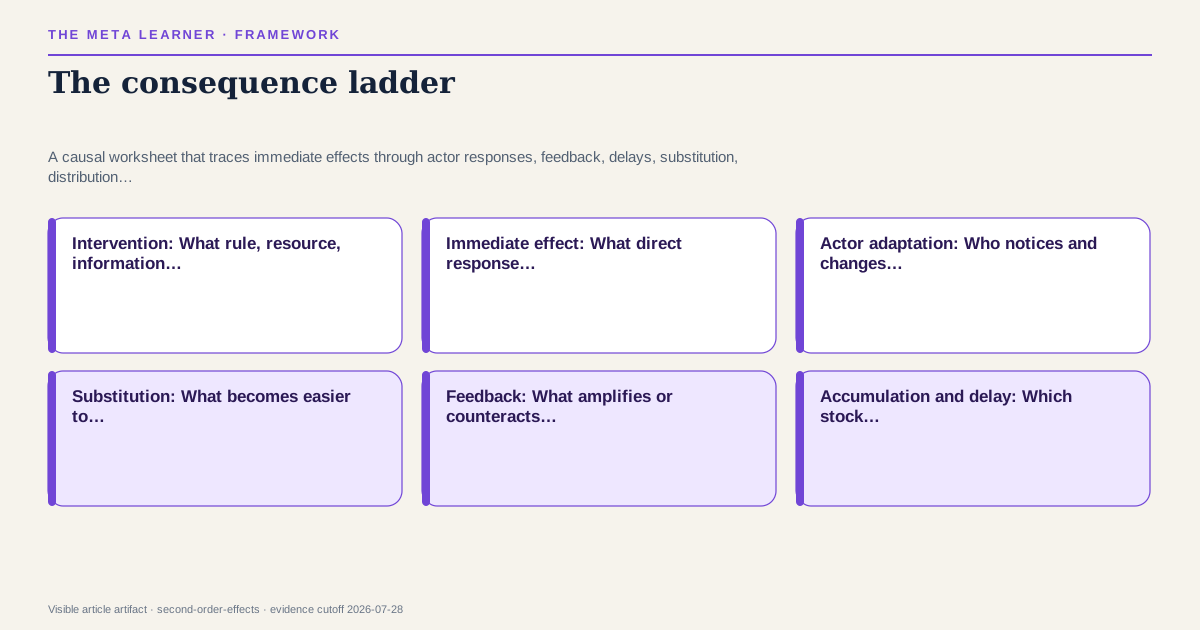
Start with the intended first-order effect, then ask how each affected actor can adapt, which metric can be gamed, where costs move, what feedback reinforces or balances the change, and which effects arrive late. Stop the chain when no credible mechanism remains. Monitor the pivotal links and predefine a rollback or redesign threshold.
The first effect changes the system
A subsidy lowers the immediate price. A performance metric focuses attention. A notification increases short-term response. A generative tool reduces the time needed for a draft. These first-order effects may be real.
They also alter behavior. Suppliers change prices, workers optimize the metric, users tune out notifications, and organizations increase expected output. The intervention becomes part of the environment it was meant to improve. A good idea can therefore achieve its immediate target while damaging the underlying goal.
A worked intervention
A company rewards support agents for closing tickets quickly.
First order: average closure time falls. Agents then adapt. Difficult tickets may be closed prematurely, split, reassigned, or routed away. Customers reopen cases, creating repeat volume. Experienced agents may avoid mentoring because it slows their metric. Managers see better headline performance before customer trust and staff capability deteriorate.
The revised measurement set includes first-contact resolution, reopen rate, customer-reported resolution, case difficulty, and learning contribution. Qualitative review samples the cases most likely to be hidden by averages. The reward rule is tested on a bounded group with a stop threshold for reopened or misclassified work.
The solution is not “measure everything.” More metrics can create more games. It is to protect the actual goal and look for adaptation.
The consequence ladder: evidence and boundary
Merton’s analysis identified several sources of unanticipated consequences in purposeful social action, including incomplete knowledge and the effects of existing commitments. System-dynamics scholarship emphasizes feedback, nonlinearity, accumulation, and delays that make learning from outcomes difficult. Meadows’ leverage-point framework argues that changing parameters, information flows, rules, goals, and paradigms can have very different systemic effects.
merton-unanticipated, sterman-learning, meadows-leverageClaim sources: merton-unanticipated, sterman-learning, meadows-leverage
Build a consequence ladder
Write the chain as testable links:
- Intervention: What rule, resource, information, or constraint changes?
- Immediate effect: What direct response is expected?
- Actor adaptation: Who notices and changes behavior?
- Substitution: What becomes easier to fake, avoid, or replace?
- Feedback: What amplifies or counteracts the response?
- Accumulation and delay: Which stock changes slowly?
- Distribution: Who gains now, who pays later or elsewhere?
- Signpost and stop rule: Which observation triggers redesign?
For each arrow, write a mechanism and evidence level. A chain of plausible sentences is not yet a causal model.
Trace four recurrent mechanisms
Compensation. An improvement in one place is offset elsewhere. Faster drafting can lead to more drafts, leaving review time unchanged.
Reinforcement. An early advantage attracts resources, producing cumulative dominance that appears to validate the original selection.
Balancing response. Growth triggers congestion, resistance, regulation, or resource depletion that slows it.
Delay. Benefits arrive quickly while maintenance debt, skill erosion, environmental cost, or loss of trust appears later.
These patterns are hypotheses, not universal laws. Use local evidence to identify which loop is active.
The adversarial case: analysis paralysis
Second-order language can defeat any proposal. For every action, someone can invent a remote catastrophe; for every reform, an incumbent can warn of unforeseen consequences. Inaction also has first-, second-, and third-order effects.
Bound the analysis by:
- causal plausibility;
- magnitude and recoverability;
- time horizon relevant to the decision;
- evidence from comparable systems;
- ability to monitor a leading indicator;
- asymmetry of acting versus waiting.
Spend more attention on credible pathways to irreversible harm, not on the largest number of imaginable steps.
Use a rival system model
Create at least one model in which the intervention works because adaptation is beneficial. A transparent metric can coordinate effort; cheaper creation can free capacity for review; a subsidy can enable scale economies rather than rent capture.
Then ask which early observations discriminate between the preferred and rival models. If both predict the same first-order success, monitor the second-order variable: reopen rate, review depth, price pass-through, dependency, or capability.
The reversal test for the consequence ladder
Proceed when the intended effect has a supported mechanism, downstream harms are bounded or reversible, leading indicators exist, and the intervention can be redesigned.
Reverse, pause, or widen the model when:
- actors optimize the proxy while the goal stagnates;
- benefits depend on costs shifted to an excluded group;
- reinforcing feedback creates lock-in before evaluation;
- delayed harm crosses a non-negotiable threshold;
- the supposedly independent effects share a hidden driver;
- the intervention removes the capacity needed to recover.
Continue despite an adverse signal when it was predicted as a temporary transition cost and later indicators support the mechanism—provided the cost and affected parties agreed to that boundary.
Systems-reasoning failures
- Adding “and then” without a causal mechanism.
- Treating every feedback loop as quantifiable.
- Ignoring the consequences of inaction.
- Mapping actors but not their incentives or power.
- Optimizing a proxy after it becomes a target.
- Watching lagging outcomes when early stop signals exist.
- Assuming an intervention’s effects remain independent.
- Using a complex diagram to conceal weak evidence.
Where the consequence ladder stops guiding the decision
Second-order effects become harder to predict with each causal step. System boundaries, strategic adaptation, rare shocks, and contested values limit any map. The consequence ladder should prioritize monitoring and robust design, not claim omniscience. Decisions involving safety, rights, or large externalities require domain and stakeholder review beyond a general framework.
Learn the underlying feedback-loop method, place uncertain chains into scenarios, and preserve a tested recovery path.
Named sources
Evidence and further reading
Published July 29, 2026. No substantive revision has been recorded. Evidence last verified July 28, 2026.