Reversible vs Irreversible Decisions: Match Deliberation to the Stakes
Decide faster without becoming careless by separating reversible experiments from choices that create durable harm, lock-in, or lost option value.
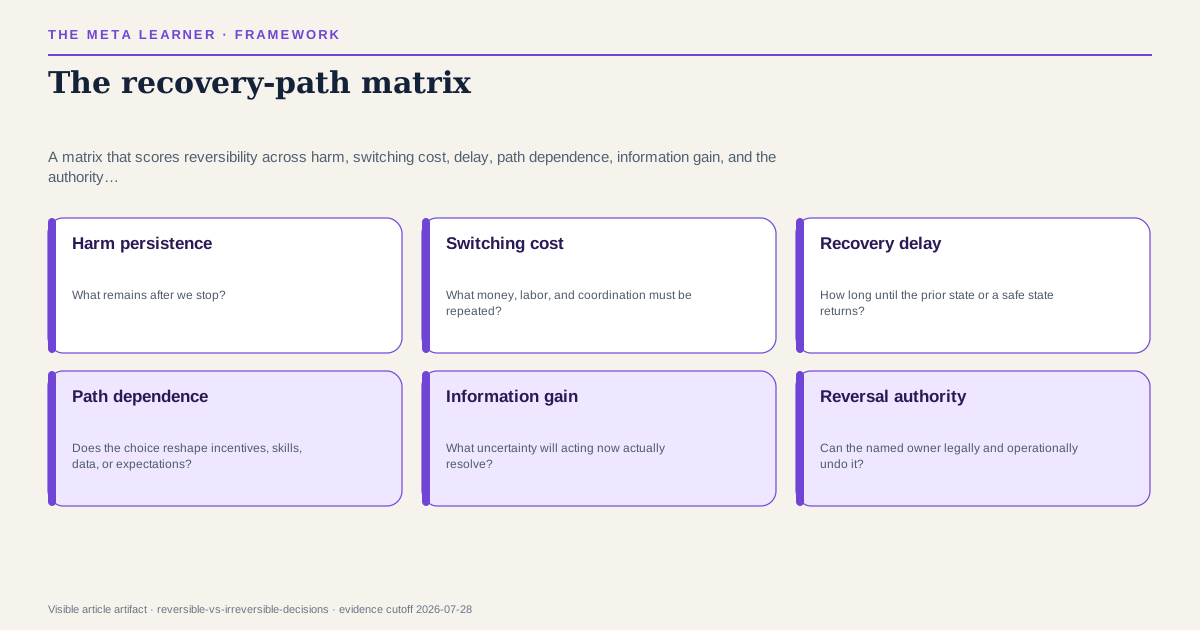
Treat reversibility as a recovery path, not a label. Ask what could be harmed, how quickly the choice can be undone, which costs remain, what future options it closes, and who has authority to reverse it. Move quickly only when downside is bounded, monitoring is possible, and a stop rule preserves a genuine way back.
Reversibility is a spectrum
Changing a draft headline is not like migrating a core database. Hiring a contractor is not like exposing a vulnerable population to an unvalidated system. Yet teams often divide choices into two rhetorical bins: “two-way doors,” which invite speed, and “one-way doors,” which invite ceremony.
Real decisions have several kinds of reversibility. Data may be recoverable while trust is not. A contract may contain an exit clause while switching costs make departure impractical. A pilot may be technically stoppable after it has changed expectations, incentives, or public commitments. Reversibility is therefore a claim to audit.
A worked decision
A university considers using an AI tool to generate formative comments on student drafts.
One framing says the choice is reversible: licenses can be cancelled. A recovery-path analysis finds several layers. A short opt-in test using synthetic or appropriately governed data may be stoppable. Uploading historical student work could create privacy obligations that persist. Students might adapt their writing to the system. Instructors could lose practice diagnosing misconceptions. Institutional endorsement might create an expectation of availability.
The reversible version is narrower: one course, draft-only feedback, instructor review, no grading, explicit data rules, a comparison against current feedback, and a stop rule for material factual or pedagogical failure. It can answer whether the workflow saves review time without degrading useful feedback. It cannot establish long-term learning or fairness across the institution.
The recovery-path matrix: evidence and boundary
Decision theory provides tools for comparing acts by possible outcomes and preferences. Information-value analysis asks whether learning before acting is worth its cost. Experimental research on changeable choices found that keeping an option revisable can alter satisfaction with the chosen outcome. Together, these sources show that reversibility offers learning and flexibility but can also carry cognitive and commitment costs.
gilbert-ebert, howard-information-value, sep-decision-theoryClaim sources: gilbert-ebert, howard-information-value, sep-decision-theory
Score the recovery path
Assess six dimensions, each from low to high:
| Dimension | Audit question | |---|---| | Harm persistence | What remains after we stop? | | Switching cost | What money, labor, and coordination must be repeated? | | Recovery delay | How long until the prior state or a safe state returns? | | Path dependence | Does the choice reshape incentives, skills, data, or expectations? | | Information gain | What uncertainty will acting now actually resolve? | | Reversal authority | Can the named owner legally and operationally undo it? |
A decision is not safely reversible because one cell is low. A software feature flag may make code rollback immediate while copied personal data, discriminatory effects, or customer confusion persist.
Design a real reversible experiment
A useful reversible choice has:
- a bounded population and duration;
- a baseline recorded before intervention;
- leading indicators for benefit and harm;
- a predetermined stop or escalation rule;
- retained resources needed to return;
- a named owner with permission to stop;
- a record of what the test cannot establish.
Without these conditions, “pilot” can become a euphemism for an under-governed launch. The learning value is also limited if the pilot environment differs from the eventual system on the very mechanism that matters.
The rival model: commitment has value
More reversibility is not always better. Keeping every alternative open can delay skill accumulation, weaken coordination, encourage repeated comparison, and prevent people from adapting to a chosen path. The Gilbert and Ebert experiments are a warning against assuming that changeability automatically improves subjective outcomes.
This rival model wins when learning from commitment is central, switching itself is expensive, the option set creates recurring distraction, and the downside of choosing is bounded. Choosing one curriculum for a defined term may produce better evidence than allowing constant weekly switching.
Match deliberation to stakes
Use rapid, documented action when consequences are local, recoverable, observed quickly, and informative. Use deeper review when harm is delayed, distributed to others, legally durable, difficult to detect, or capable of changing the future option set.
Do not equate financial price with stakes. A cheap public claim can damage credibility; an expensive but insured and modular service can remain recoverable. Include dignity, rights, dependency, reputation, and learning debt in the consequence map.
The reversal test for the recovery-path matrix
Upgrade a supposedly reversible choice to high-deliberation when:
- stopping cannot restore affected people, data, or trust;
- the test creates lock-in before results arrive;
- benefits are visible immediately but harms are delayed;
- no one owns monitoring or has authority to stop;
- the information gained will not distinguish the live options;
- reversal transfers costs to people excluded from the decision.
Downgrade deliberation when a smaller, safer experiment can isolate the key uncertainty and a tested recovery path exists. Sometimes waiting is the irreversible action: a deadline passes, a skill atrophies, or a valuable option expires.
Reversibility mistakes
- Calling cancellation the same as recovery.
- Ignoring sunk integration and retraining costs.
- Using “move fast” where others bear the downside.
- Running a pilot without a baseline or decision rule.
- Preserving options that create no useful information.
- Treating extensive analysis as harmless when delay has a cost.
- Letting the person advocating the choice define whether it is reversible.
Where the recovery-path matrix stops guiding the decision
The recovery-path matrix organizes judgment but does not assign probabilities or settle ethical and legal duties. Some consequences are unknown before action, and stakeholders may value them differently. Decisions involving safety, rights, minors, health, employment, or irreversible environmental effects require relevant professional and institutional review.
First frame the right problem. Then expose opportunity cost and, where uncertainty is quantifiable, compare options with expected value.
Named sources
Evidence and further reading
Published July 29, 2026. No substantive revision has been recorded. Evidence last verified July 28, 2026.