Expected Value: How to Compare Risky Options Without False Precision
Use expected value as a transparent comparison, then stress-test probability, utility, tail risk, dependence, uncertainty, and the value of more information.
List mutually exclusive outcomes for each option, assign probability and consequence ranges rather than invented point estimates, and calculate a range of weighted outcomes. Then test which assumptions change the ranking, whether losses are survivable, whether outcomes interact, and whether buying more information is worth its cost. Formal models do not determine ethically permissible outcomes, valid probabilities, or a common value scale for every stakeholder.
A formula is not a forecast
Expected monetary value is simple:
sum of each outcome’s probability × its monetary consequence
The arithmetic can be exact while the model is fiction. Outcomes may be omitted, probabilities copied from an irrelevant reference class, benefits double-counted, or incomparable values forced into currency. A decimal answer can disguise judgments that were never precise.
Expected value is most useful as a structured argument. It makes uncertain beliefs, consequences, and trade-offs inspectable. It is least useful when its numerical surface is treated as authority.
The range-based expected-value table: evidence and boundary
Decision theory distinguishes acts, possible states, consequences, beliefs, and preferences rather than reducing every choice to one raw payoff. Prospect theory documents systematic patterns such as reference dependence and different sensitivity to gains and losses, challenging simple descriptive models of expected-value maximization. Information-value theory formalizes the benefit of learning before choosing when that information can change the preferred act.
sep-decision-theory, kahneman-tversky-prospect, howard-information-valueClaim sources: sep-decision-theory, kahneman-tversky-prospect, howard-information-value
Build a range-based decision table
For each option, record:
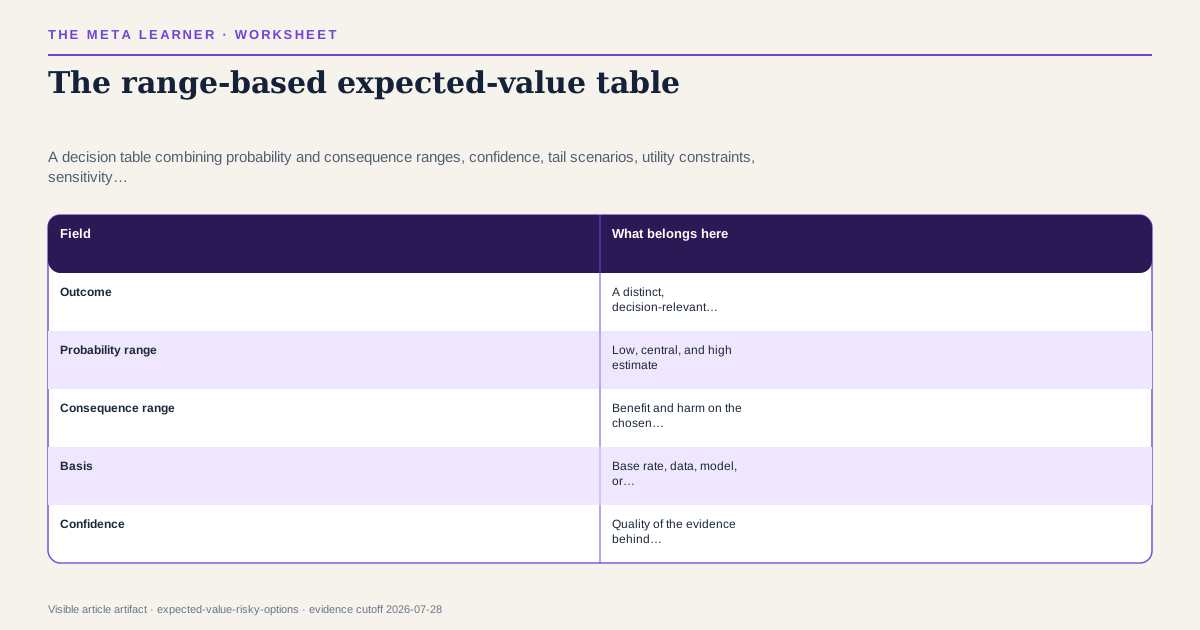
| Field | What belongs here | |---|---| | Outcome | A distinct, decision-relevant result | | Probability range | Low, central, and high estimate | | Consequence range | Benefit and harm on the chosen scale | | Basis | Base rate, data, model, or elicited judgment | | Confidence | Quality of the evidence behind the range | | Owner | Who receives the benefit or bears the loss | | Recovery | Whether the downside can be reversed |
Ensure outcomes are mutually exclusive enough not to be counted twice and collectively broad enough to include failure, delay, and abandonment. “Success, moderate success, failure” is not useful until each is operationally defined.
A worked comparison
A research team can build a full data product or run a two-week evidence pilot. The full build has higher upside if demand and data access both materialize, but it consumes most of the budget. The pilot has smaller direct payoff but can reveal whether the data can legally and reliably be obtained.
Point estimates might make the full product appear superior. The range-based table shows its ranking depends almost entirely on two uncertain assumptions: usable-data probability and renewal demand. It also reveals dependence—the probability of technical delivery is not independent of data access.
The decision may become sequential: buy the pilot’s information, then choose the build only if the result crosses a threshold. The pilot’s value is not its immediate revenue; it is the chance to avoid a larger bad allocation or confirm a promising one.
Use sensitivity before precision
Vary one assumption across its defensible range. Then vary interacting assumptions together. Ask:
- Which input changes the preferred option?
- Does the ranking survive pessimistic but plausible values?
- Is the apparent advantage smaller than estimation error?
- Which outcome dominates the model because it is enormous but extremely uncertain?
- What observation would narrow the pivotal range?
Report the threshold. “Option A wins if renewal probability exceeds roughly 35 percent” is more decision-useful than “A has an expected value of 127,438.”
Expected value is not expected utility
The same monetary loss matters differently to a solvent institution and a person for whom it means insolvency. Repeated small bets and a single existential bet are not equivalent. Preferences may also be reference-dependent and sensitive to how gains and losses are framed.
Add explicit constraints before optimizing:
- maximum tolerable loss;
- minimum liquidity or safety reserve;
- legal, ethical, and rights-based limits;
- concentration across correlated bets;
- who can consent to bearing downside;
- whether repeated opportunities actually exist.
An option with the highest modeled average can still be unacceptable.
The adversarial case
Suppose a rare catastrophic outcome has a poorly known probability. Multiplying one speculative point probability by a huge cost creates false confidence. Ignoring it creates false safety.
Use scenarios and bounds: what is the credible worst case, which safeguards reduce exposure, which evidence could update likelihood, and what decisions are robust across the range? If the downside is irreversible and borne by others, a positive expected payoff does not automatically license the action.
Signals that should suspend the range-based expected-value table
Prefer the higher expected-value option when its advantage persists across plausible ranges, losses are survivable, outcomes are sufficiently well specified, and no binding constraint is crossed.
Reverse toward a lower modeled value when:
- a tail loss threatens survival or violates a duty;
- probabilities depend on the same hidden factor and were multiplied as if independent;
- the result hinges on one weak estimate;
- utility or distribution differs materially from the monetary total;
- a staged option buys decision-changing information cheaply;
- the option set omits the best feasible alternative.
If neither option dominates across reasonable assumptions, preserve optionality or gather information rather than laundering uncertainty through decimals.
Expected-value errors
- Probabilities that do not sum coherently across outcomes.
- Double-counting benefits or ignoring maintenance.
- Treating confidence in evidence as the probability of an outcome.
- Assuming independent risks without a mechanism.
- Using averages where one failure causes ruin.
- Hiding value judgments inside monetary proxies.
- Performing arithmetic before defining the decision.
- Calling sensitivity analysis “pessimism.”
The jurisdiction of the range-based expected-value table
Expected-value analysis is only as credible as its outcome set, probabilities, and value representation. Deep uncertainty, strategic interaction, moral rights, non-compensable harms, and distribution across people may resist a single scalar comparison. High-stakes models should be independently reviewed and presented with ranges, assumptions, and unresolved disagreement.
Start with opportunity cost, ground probabilities in base rates, and maintain a calibration record.
Named sources
Evidence and further reading
Published July 29, 2026. No substantive revision has been recorded. Evidence last verified July 28, 2026.