Opportunity Cost: The Decision Hidden Inside Every Yes
Make opportunity cost concrete by naming the best displaced alternative, testing scarcity, and comparing portfolios instead of isolated benefits.
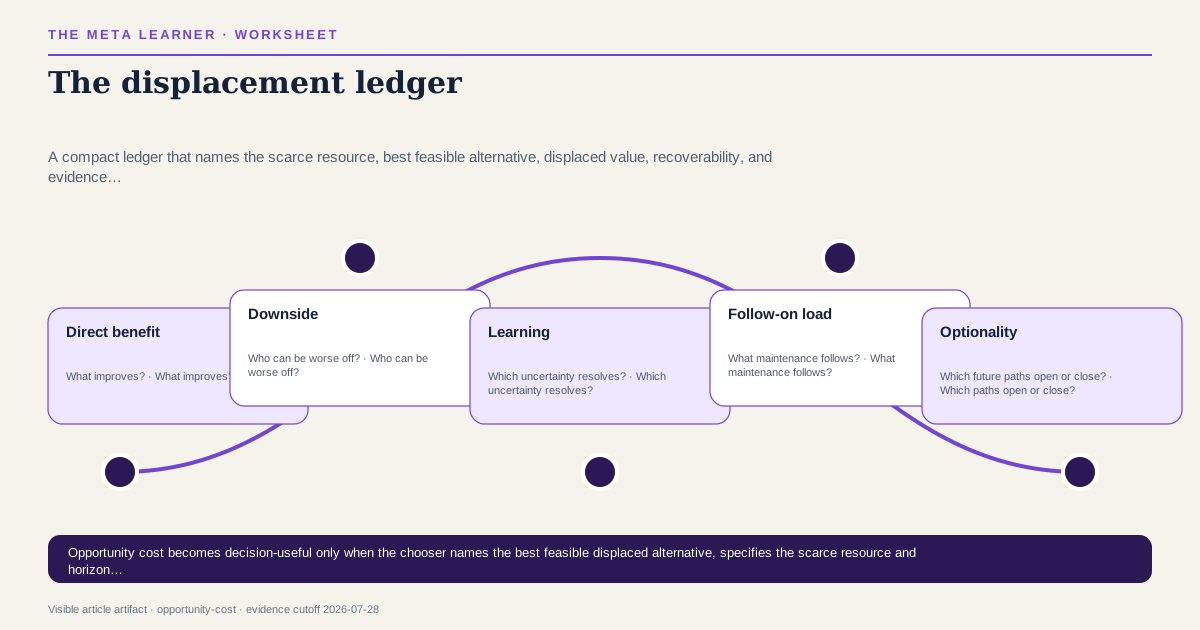
Name the scarce resource consumed by a choice, then identify the best feasible alternative use of that same resource over the same time horizon. Compare the two complete option portfolios—including delay, switching, learning, and recoverability. If you cannot name a displaced alternative, you have not yet calculated an opportunity cost.
Every choice has a shadow option
A project proposal usually lists what the project could create. It rarely lists what the same team, capital, reputation, or month of attention will no longer create. That omitted alternative is not an abstract economic footnote. It is part of the decision.
Opportunity cost is often paraphrased as “everything has trade-offs,” which is too vague to guide action. The relevant cost is not every imaginable road not taken. It is the value of the best feasible alternative displaced by the choice, as judged at the moment of decision.
The rival model: slack is not waste
An aggressive opportunity-cost mindset can make every unallocated hour appear lost. That rival interpretation is dangerous. Slack can absorb shocks, support exploration, allow reflection, and keep future options alive. Rest is not necessarily time stolen from the most measurable project.
The scarcity question must therefore be real. If two options can coexist without impairing quality, forcing a trade-off creates false austerity. If the resource is renewable and recovery is cheap, extensive comparison may cost more than it saves. The point is disciplined allocation, not permanent utilization.
What survives the comparison: the displacement ledger
Experimental work on opportunity-cost neglect found that choices can change when an outside option is made explicit, indicating that people do not always consider alternatives spontaneously. Buchanan’s account locates cost in the chooser’s forgone opportunity rather than only in recorded expenditure. Decision theory formalizes comparison among acts and consequences, while leaving the representation of value open to scrutiny.
frederick-opportunity, buchanan-cost-choice, sep-decision-theoryClaim sources: frederick-opportunity, buchanan-cost-choice, sep-decision-theory
Build the displacement ledger
For any consequential yes, complete six lines:
- Choice: What exactly receives the resource?
- Scarce resource: Money, calendar time, expert attention, trust, data, or organizational capacity?
- Best feasible alternative: What would actually be done instead—not a fantasy unconstrained by authority or capability?
- Displaced value: Which outcomes, learning, or options are lost?
- Recovery path: When and at what cost can the allocation change?
- Reversal evidence: What observation would make the alternative superior?
Use the same population and horizon on both sides. Comparing this quarter’s revenue from option A with ten years of social value from option B merely hides the choice inside incompatible units.
A worked allocation
A small education company can spend the next six weeks adding an AI chat feature or repairing lesson completion and feedback.
The feature case lists novelty, marketing value, and possible engagement. Its ledger must also name the shadow option: fewer broken lesson paths, better evidence about learner progress, and lower support burden. The relevant scarce resource is not only engineering hours. It includes the founder’s attention, the opportunity to learn from current users, and credibility if a public AI feature fails.
This does not prove that the chat feature is wrong. It changes the question from “Is AI strategically important?” to “Does this specific feature beat the best available use of the same six weeks under our present evidence?”
Compare portfolios, not slogans
Options contain bundles:
| Component | Option A | Best alternative | |---|---|---| | Direct benefit | What improves? | What improves? | | Downside | Who can be worse off? | Who can be worse off? | | Learning | Which uncertainty resolves? | Which uncertainty resolves? | | Follow-on load | What maintenance follows? | What maintenance follows? | | Optionality | Which future paths open or close? | Which paths open or close? | | Reversibility | What remains if stopped? | What remains if stopped? |
The comparison prevents a familiar error: treating one option as a vivid proposal and the other as empty space. “Do nothing” may itself be a portfolio of continued costs, accumulated knowledge, expiring options, and avoided harms.
Price the cost of delay
Waiting consumes options too. For each alternative, ask:
- Does useful information arrive if we wait?
- Does an external deadline or compounding benefit expire?
- Can a smaller test preserve both options?
- Does delay create learning debt, reputational drift, or avoidable harm?
The best choice may be a sequence rather than a winner: run a bounded diagnostic now, keep capacity available, then allocate after evidence arrives. Information has value only if it can change the later decision.
Evidence that would settle the contest around the displacement ledger
Choose the apparently lower-return option when it protects against irrecoverable harm, preserves a uniquely valuable future option, or generates information that changes a larger decision. Reverse toward the vivid proposal when the alternative is not actually feasible, its projected value depends on resources unavailable in the relevant horizon, or the scarce resource was misidentified.
Reopen the ledger when:
- a constraint changes;
- the best alternative becomes materially stronger or weaker;
- switching or maintenance costs were omitted;
- the chosen option produces new information;
- another stakeholder bears a cost missing from the original account.
Do not rewrite the old ledger as if the new information had been knowable. A good process can produce a bad outcome.
Opportunity-cost errors
- Comparing a concrete proposal with an unspecified “other.”
- Treating sunk cost as a reason to continue.
- Counting cash while ignoring scarce attention or trust.
- Comparing different time horizons or populations.
- Inventing an infeasible alternative to defeat the favored option.
- Optimizing every hour and eliminating valuable slack.
- Using retrospective outcomes to claim the original choice was irrational.
What the debate leaves decidable: the displacement ledger
Opportunity-cost analysis requires judgments about feasibility and value; it does not make unlike consequences commensurable or settle distributive ethics. Future alternatives are uncertain, and the best alternative can change after new information. For rights, safety, and legal duties, a high-value alternative does not automatically justify crossing a non-negotiable constraint.
Audit reversibility, add uncertainty with expected value, and apply the ledger to a career skill portfolio.
Named sources
Evidence and further reading
Published July 29, 2026. No substantive revision has been recorded. Evidence last verified July 28, 2026.