Specialist, Generalist, or Synthesist? Choosing a Career Shape in the AI Era
Choose a career shape from the bottleneck you can own: deep domain work, broad coordination, or rigorous synthesis across expert boundaries.
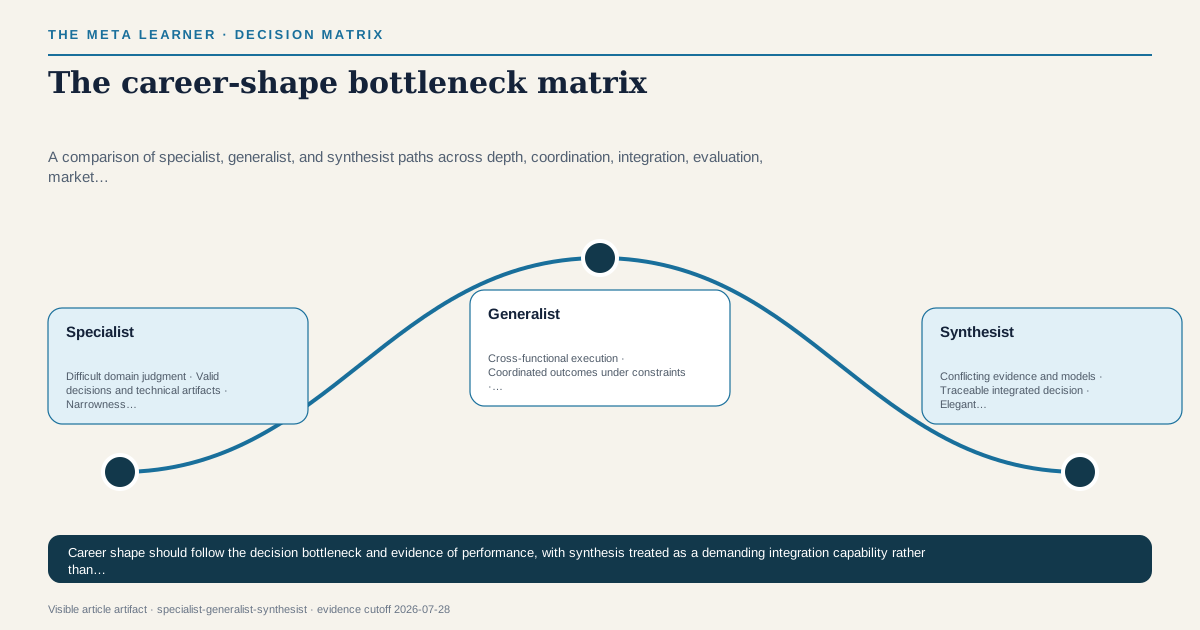
Choose specialist when the bottleneck is deep technical or domain judgment; generalist when it is coordination across functions and changing contexts; and synthesist when it is integrating incompatible evidence and expert perspectives into a decision. AI can widen each person’s reach, but it also makes shallow breadth easier to imitate. Choose the shape whose difficult work you can demonstrate.
Three shapes and three forms of value
The familiar “specialist versus generalist” debate misses a third form: synthesis. A synthesist does not merely know a little about many things. The person reconstructs expert claims, translates methods and vocabulary, preserves disagreement, and produces a decision that no single field can carry alone.
These are emphases, not personality types:
- Specialist: depth, exception recognition, technical standards, and domain accountability.
- Generalist: coordination, prioritization, translation, and movement across functions.
- Synthesist: evidence integration, model comparison, boundary work, and coherent judgment.
Most strong careers combine all three in different proportions.
Adoption case: the career-shape bottleneck matrix
A healthcare technology company needs to evaluate an AI documentation tool.
- A clinical specialist examines workflow, patient safety, and professional standards.
- A generalist product lead coordinates engineering, procurement, users, privacy, and rollout.
- A synthesist integrates clinical evidence, human-factors research, model evaluation, legal constraints, and staff experience into a decision record.
One person may cover more than one role, but the functions remain. AI may assist each; it cannot erase domain authority or the need to integrate consequences.
Compare the work, not the romance
| Shape | Core bottleneck | Strong proof | Characteristic failure | |---|---|---|---| | Specialist | Difficult domain judgment | Valid decisions and technical artifacts | Narrowness outside context | | Generalist | Cross-functional execution | Coordinated outcomes under constraints | Surface understanding | | Synthesist | Conflicting evidence and models | Traceable integrated decision | Elegant but invalid flattening |
AI can draft code, summaries, plans, and comparisons. That may complement a specialist, let a generalist operate across more functions, or help a synthesist organize source material. It does not automatically validate the result.
Official evidence describes jobs as bundles of tasks, knowledge, skills, activities, and context, while OECD analysis emphasizes a broad AI-era skill mix. National Academies guidance treats interdisciplinary integration as demanding specialized and collaborative work. The three career shapes are an editorial model, not a validated labor-market taxonomy.
Claim sources: oecd-skills, nasem-interdisciplinary, onet-content, nber-genai-work
The specialist test
Choose depth when:
- errors require extensive tacit or technical knowledge;
- the domain has strong standards, licensing, or cumulative theory;
- edge cases determine value;
- buyers can recognize expert quality;
- you enjoy sustained formation and accountability.
Do not define specialization by tool mastery alone. A model, platform, or technique can be absorbed into another role. Anchor depth in a consequential domain problem and its standards.
The generalist test
Choose breadth when:
- work repeatedly crosses functions;
- the bottleneck is framing and sequencing;
- multiple stakeholders must coordinate;
- uncertainty requires rapid learning;
- the organization values end-to-end ownership.
The risk is becoming an information router. Strong generalists carry at least one area of depth and can show decisions, not only participation.
The synthesist test
Choose synthesis when:
- the decision depends on several disciplines or evidence forms;
- experts answer different parts of the question;
- vocabulary and scales conflict;
- someone must preserve provenance while building a whole;
- the final product is a defensible view, framework, or decision memo.
The National Academies defines interdisciplinary research through integration that advances understanding beyond a single discipline.nasem-interdisciplinary, oecd-skills, onet-content, nber-genai-work Synthesis is not a license to ignore specialist objections. Its quality depends on representing them accurately.
Use official task structure
O*NET’s model separates occupational tasks, activities, knowledge, skills, abilities, work styles, and context.onet-content Select three target roles and compare their actual task bundles.
Ask:
- Which tasks demand depth?
- Which failures occur at handoffs?
- Which decisions require several evidence traditions?
- Who owns the result?
- What work sample would reveal performance?
The labels should follow this map.
Choose by the bottleneck
- Select three recurring problems in your work.
- Map tasks and failure consequences.
- Identify whether depth, coordination, or integration is the current bottleneck.
- Gather one independent evaluator’s view.
- Choose a twelve-month emphasis.
- Build two work samples that expose the difficult part.
- Reassess from market response and performance, not identity.
OECD argues that thriving with AI requires mixes of foundational, digital, complementary, and advanced capabilities, with impacts differing across contexts.oecd-skills Build the chosen shape in Build a Skill Portfolio for an AI-Shaped Career after using Audit Your Work for Automation, Augmentation, and Human Judgment. Systems Thinking is a useful comparison for synthesis across levels.
Identity labels without capability
- Calling curiosity generalism.
- Calling aggregation synthesis.
- Treating narrow software knowledge as durable specialization.
- Refusing foundational depth because AI can explain terms.
- Pursuing prestige rather than a market or institutional bottleneck.
- Building no artifacts that another person can evaluate.
- Assuming one career shape must last forever.
Ask for evidence at the boundary between shapes. A specialist should explain how adjacent constraints alter a deep recommendation. A generalist should perform one difficult component rather than merely coordinate it. A synthesist should show the translation ledger that connects claims, methods, and decisions across fields. In all three cases, test performance on a representative workflow with real source material and an accountable outcome. The NBER customer-support study is a useful caution: measured effects in one deployed task setting do not establish a universal career shape, but they show why the distribution of gains across workers matters when selecting a development strategy.nber-genai-work
Career shapes overlap
“Synthesist” lacks a standardized labor-market definition, and the framework does not forecast hiring demand. Some careers require credentials or deep specialization regardless of preference. Opportunities depend on geography, industry, organization, network, language, and life constraints. Use local job, project, and buyer evidence before making an expensive transition.
Career shape is not a declaration of who you are. It is a working hypothesis about the difficult contribution for which others will trust you.
Named sources
Evidence and further reading
Published July 29, 2026. No substantive revision has been recorded. Evidence last verified July 28, 2026.