Are You Solving the Right Problem? Symptoms, Constraints, and Decision Questions
Reframe a vague complaint into a decision question by separating symptoms, mechanisms, constraints, stakeholders, and evidence that could change the frame.
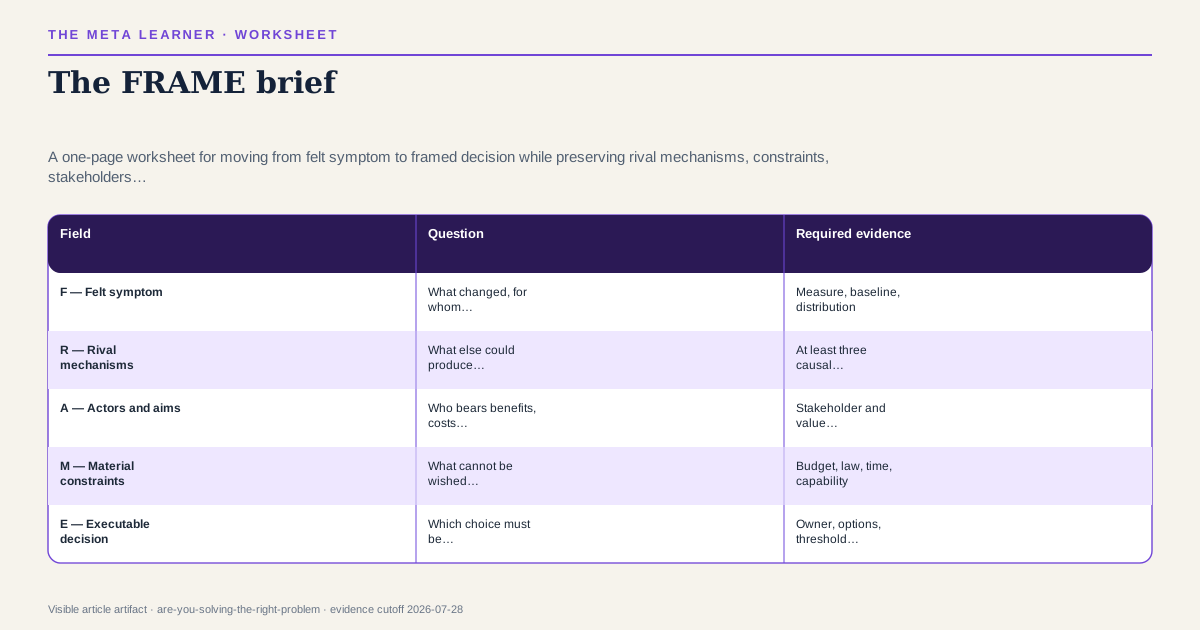
Do not begin with a solution. Record the symptom, identify who experiences it and against which baseline, generate rival mechanisms, expose binding constraints, and turn the result into a choice an owner can actually make. Then write the evidence that would force you to reframe the problem. Reframing cannot compensate for absent data, incompatible values, or an organization that lacks authority to act on the resulting decision.
The symptom is not yet the problem
“Engagement is down.” “Employees resist AI.” “Students forget the material.” These are observations or interpretations, not yet decision questions. Each can be framed as a motivation problem, a design failure, a measurement artifact, a capability gap, or a rational response to incentives. Each frame privileges different evidence and interventions.
Framing is therefore not decorative wording before analysis. It selects the unit of attention, causal story, stakeholders, objective, and feasible action. The danger is not only choosing a bad solution. It is becoming efficient at answering a question that should never have governed the decision.
The FRAME brief: evidence and boundary
Research on decision framing shows that descriptions of a choice can alter preferences even when relevant outcomes are equivalent. Design research treats reframing as a way to connect an unfamiliar problem situation with a useful working principle. OECD systems guidance emphasizes relationships, feedback, multiple actors, and the risk that isolated interventions displace rather than resolve a public problem.
tversky-framing, dorst-frame-innovation, oecd-systemsClaim sources: tversky-framing, dorst-frame-innovation, oecd-systems
Build a FRAME brief
Use five fields before commissioning research or building a solution.
| Field | Question | Required evidence | |---|---|---| | F — Felt symptom | What changed, for whom, compared with what? | Measure, baseline, distribution | | R — Rival mechanisms | What else could produce this pattern? | At least three causal accounts | | A — Actors and aims | Who bears benefits, costs, and authority? | Stakeholder and value map | | M — Material constraints | What cannot be wished away? | Budget, law, time, capability | | E — Executable decision | Which choice must be made now? | Owner, options, threshold, horizon |
Add a sixth line below the table: reframe if. It names the observation that would make the current representation untenable.
A worked frame
A company says, “We need an AI training course because adoption is low.”
The symptom is low recorded use of an approved assistant. Rival mechanisms include insufficient skill, tasks poorly suited to the tool, fear that prompts will expose confidential data, lack of time to redesign workflows, and a managerial incentive that rewards visible busyness rather than improved outcomes. The affected actors include staff, clients, security, managers, and the people whose work might be evaluated by the system.
The original frame asks, “Which course should we buy?” A more decision-ready question is:
For which two recurring tasks can this team test an approved AI workflow over four weeks, under existing privacy rules, and what evidence would justify expanding, redesigning, or stopping it?
Training remains one option. It is no longer smuggled in as the diagnosis.
Use constraints as information
Constraints are not all obstacles. Some reveal the real problem. If no intervention can change the budget this quarter, the decision concerns reallocation. If law prohibits using personal data, the problem is not “how to persuade compliance”; it is how to achieve the outcome with lawful inputs. If the accountable owner cannot alter incentives, a motivation frame may be politically convenient but operationally empty.
Distinguish:
- binding constraints, which currently remove options;
- assumptions, which appear fixed but can be tested;
- preferences, which express values or convenience;
- self-imposed conventions, which may be redesigned.
The distinction prevents “constraint” from becoming a dignified name for habit.
Test a rival frame
For every preferred frame, write a rival that changes both the mechanism and the intervention. If “learners lack discipline” is the preferred account, test “the environment makes the desired action costly and the reward distant.” If “customers need more features” is preferred, test “customers cannot discover or trust the features already present.”
The rival is useful only if it could win. Give it the strongest plausible evidence, not a caricature. Then ask which low-cost observation distinguishes the frames: task logs, interviews about a specific incident, a behavioral measure, a comparison group, or a reversible pilot.
Signals that should suspend the FRAME brief
Keep the current frame when it predicts observations better than rivals, maps to an action the owner can take, survives stakeholder challenge, and does not externalize the problem into an invisible population.
Reverse or widen it when:
- the symptom disappears under a better measure or baseline;
- a rival mechanism explains cases the preferred frame cannot;
- the “solution” improves one metric while worsening the actual objective;
- the people bearing the cost define success differently;
- a supposed constraint is shown to be an untested assumption;
- no authorized actor can execute the stated decision.
Sometimes the narrow frame is still correct. During an outage, restoring the service may precede systems analysis. Reframing has opportunity cost.
Framing failures
- Treating the first requested solution as the problem.
- Naming an abstract condition—“culture,” “mindset,” “innovation”—without an observable outcome.
- Choosing a metric because it is available, then redefining success around it.
- Listing stakeholders without examining who has power or bears downside.
- Generating many frames but refusing to select a decision.
- Letting an AI assistant produce polished causes from sparse observations.
- Calling every difficulty “systemic,” making intervention impossible.
The jurisdiction of the FRAME brief
The FRAME brief improves problem representation; it does not identify causal effects, reconcile incompatible values, or guarantee implementation. Some problems are emergencies with little time for reframing, while others are political conflicts rather than technical puzzles. High-stakes frames require domain expertise and participation from people affected by the decision.
First separate facts, inferences, and judgments. Then test the proposed causal mechanism and match deliberation to decision reversibility.
Named sources
Evidence and further reading
Published July 29, 2026. No substantive revision has been recorded. Evidence last verified July 28, 2026.