Facts, Inferences, and Judgments: The Three Layers Every AI-Assisted Decision Needs
Separate what was observed, what the evidence implies, and what should be done. AI can assist each layer, but it must not silently collapse them.
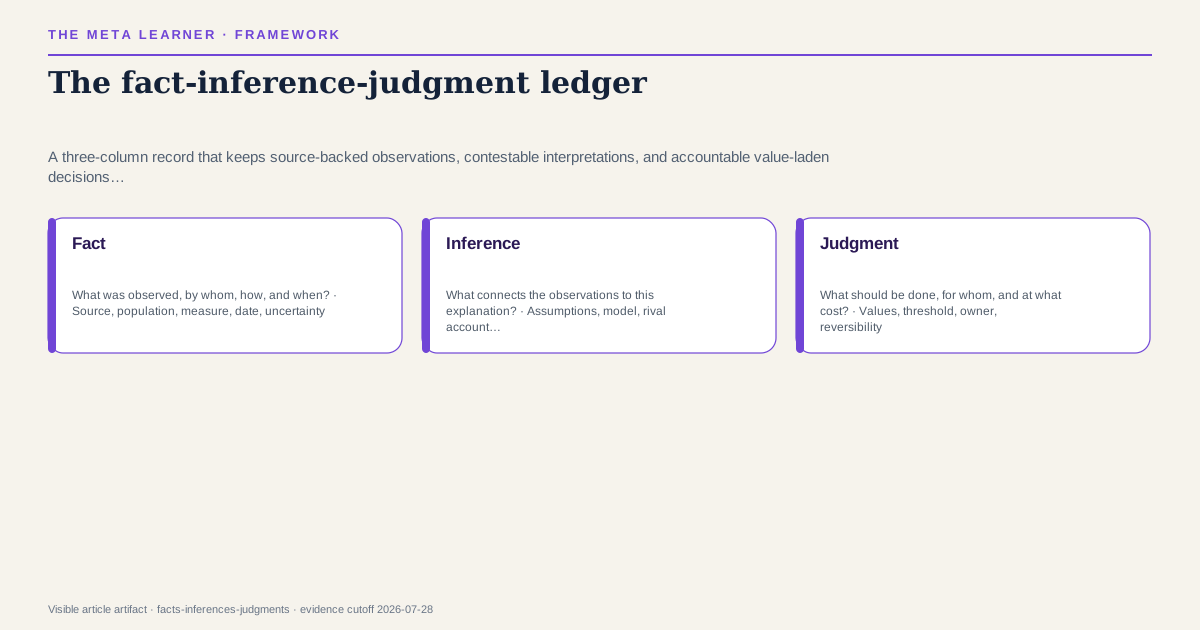
Record AI-assisted decisions in three layers: facts are observations tied to sources and measurement; inferences are interpretations that connect facts through assumptions; judgments choose what to value and do under constraints. Verify each layer differently, expose rival inferences, and assign the final judgment to an accountable human or institution. The three-layer model simplifies iterative reasoning, where new judgments can change what is measured and new observations can reframe the question.
The collapsed-layer problem
An AI answer says:
Customer satisfaction fell after the redesign, showing that the new interface confused users and should be rolled back.
This sentence contains at least three propositions. Satisfaction fell is a descriptive claim. The redesign caused confusion is a causal inference. Rollback is a judgment about action, cost, and values. The first can be correct while the second and third fail.
This guide is for people using AI to synthesize research, business data, or policy evidence. Its goal is not to make reasoning linear. It is to keep different warrants visible.
The fact-inference-judgment ledger: evidence and boundary
NIST’s AI risk framework emphasizes context, documentation, measurement, oversight, and defined accountability. Causal-inference research distinguishes associational observations from intervention and counterfactual claims that require assumptions. The American Statistical Association warns that a statistical result alone does not measure effect importance or justify a substantive conclusion. These distinctions support layered decision records.
nist-ai-rmf, pearl-causal, asa-pvaluesClaim sources: nist-ai-rmf, pearl-causal, asa-pvalues
The fact-inference-judgment ledger
| Layer | Required question | Minimum record | |---|---|---| | Fact | What was observed, by whom, how, and when? | Source, population, measure, date, uncertainty | | Inference | What connects the observations to this explanation? | Assumptions, model, rival account, confidence | | Judgment | What should be done, for whom, and at what cost? | Values, threshold, owner, reversibility |
AI may help extract facts, generate rival explanations, or compare options. It does not erase the need for a source, model, or decision owner.
A worked separation
Observed facts
- Post-redesign survey scores are lower than the previous quarter.
- Response rate also fell.
- A major outage occurred during the survey window.
Inference A
The interface increased task friction and reduced satisfaction.
Rival inference B
The outage and a changed respondent pool explain much of the decline.
Judgment
Run task-level usability tests and restore one reversible navigation element before deciding on a full rollback.
The ledger makes disagreement productive. Teams can ask which observation would separate A from B instead of arguing about the one compressed sentence.
Facts are produced, not found naked
A fact record needs measurement conditions. “Conversion is 4.2 percent” is incomplete without denominator, event definition, window, exclusions, and data quality. A paper’s result needs population, comparator, outcome, and uncertainty.
AI extraction can lose qualifiers while retaining a number. Require the system to quote or locate the relevant table, then open the source. Preserve “not reported” rather than inviting completion by inference.
Inferences carry models
An inference may be deductive, statistical, causal, analogical, or abductive. Each has failure modes. A causal inference needs a credible counterfactual and attention to confounding. An analogy needs structural correspondence and break points. An explanation inferred as “best” needs serious alternatives.
Ask the AI for the strongest rival account and the observation that would distinguish it. Then seek evidence beyond the model’s own generated alternatives.
Judgments contain values
Data do not choose how much risk is acceptable, whose loss matters, or which rights constrain action. Expected outcomes inform a decision; they do not own it. A judgment record should name:
- beneficiary and burden bearer;
- threshold for action;
- cost of delay;
- reversibility;
- accountable owner;
- escalation condition.
This layer should not be disguised as neutral analysis.
Build a three-layer decision record
- Copy the proposed conclusion into a working document.
- Split every clause into fact, inference, or judgment.
- Attach provenance and measurement conditions to each fact.
- Write assumptions underneath each inference.
- Construct one rival inference with comparable seriousness.
- Name the values and constraints behind the judgment.
- Define what evidence would reverse the inference or action.
- Ask an accountable reviewer to inspect the weakest layer.
The output can be brief. Visibility matters more than volume.
Adversarial case and reversal conditions
Imagine the same fact set supports two actions because decision-makers value false positives differently. That is not automatically analytical failure; it may be a genuine value conflict. The ledger should expose it.
Reverse an inference when new evidence better fits a rival mechanism, a key measurement fails, or a stated assumption no longer holds. Reverse a judgment when the decision threshold, affected interests, constraints, or option set changes. Do not demand that one layer’s update mechanically overturn all three.
Layer violations
One useful quality-control exercise is a role reversal. Ask a source auditor to challenge the fact layer, a method specialist to challenge the inference, and an affected stakeholder to challenge the judgment. If each critique can be answered only by borrowing authority from another layer—“the data require this policy” or “the executive chose it, so the cause is established”—the record has collapsed again. Preserve disagreement in the relevant column instead of averaging it into one confidence score.
- Presenting an estimate as a raw observation.
- Treating a correlation as a mechanism.
- Asking AI to “fill in” missing source details.
- Hiding a value choice inside a score.
- Listing token alternatives that receive no evidential test.
- Assigning accountability to the model or “the data.”
- Updating the conclusion without preserving the earlier record.
The jurisdiction of the fact-inference-judgment ledger
Facts, inferences, and judgments interact: concepts determine measurement, and values influence which questions matter. The ledger is an accountability aid, not a complete philosophy of science or automated governance system. High-stakes medical, legal, financial, employment, and public decisions require applicable standards, qualified experts, stakeholder processes, and authority beyond a worksheet.
The discipline is simple to state and difficult to fake: label what the world showed, what your model added, and what an accountable person chose.
Start with critical thinking about claims and evidence, test explanations through correlation, causation, and mechanism, and document reversal with what would change your mind.
Named sources
Evidence and further reading
Published July 29, 2026. No substantive revision has been recorded. Evidence last verified July 28, 2026.