The AI-Era Signpost Ledger: What to Watch Through 2027
A falsifiable ledger of capability, adoption, work, trust, learning, multilingual access, and infrastructure signals—without pretending to forecast.
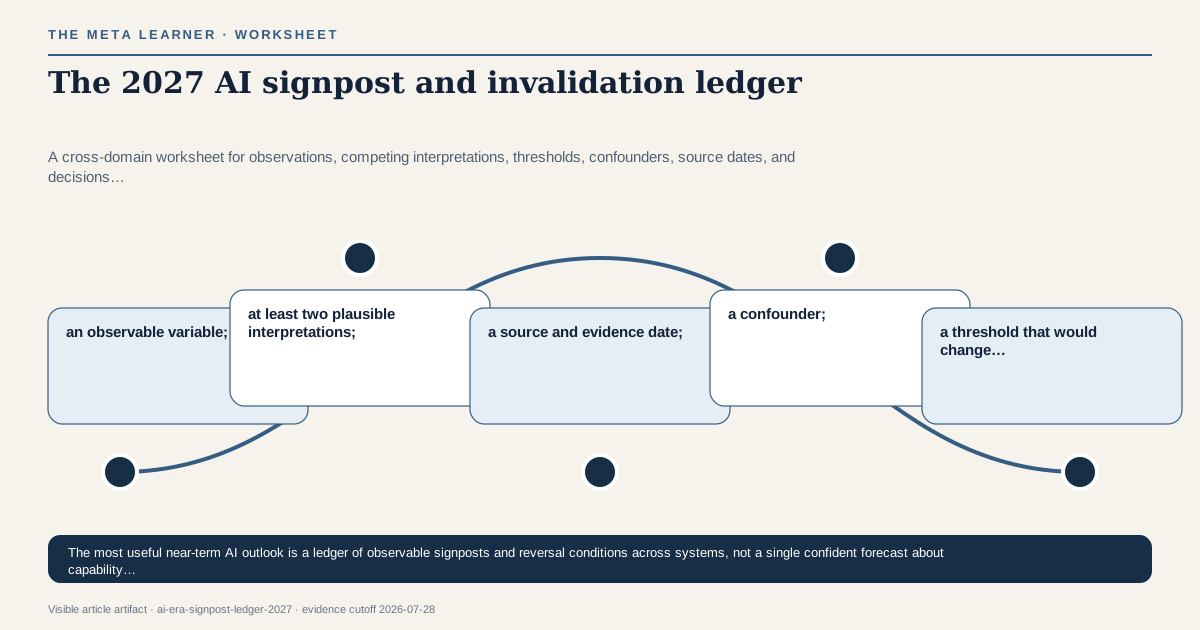
Through 2027, watch paired signposts rather than one headline metric: model capability and failure, AI use and workflow outcomes, task exposure and labor-market movement, synthetic volume and verification capacity, tutoring access and learner performance, translation coverage and language-specific quality, data-center growth and grid constraint. The ledger is not a publication schedule or forecast; it is a way to know what evidence should change a decision.
Evidence at the cutoff
The Stanford AI Index records rapid technical progress, substantial investment, broad use, uneven geographic capacity, and unresolved responsible-AI measurement gaps.stanford-index, oecd-adoption, ilo-empirical, iea-questions, unesco-rights OECD research on firm adoption shows that complementary capabilities shape whether access becomes operational use.oecd-adoption
The ILO’s empirical review reports real but uneven productivity evidence, limited aggregate displacement to date, and concerns involving younger workers, autonomy, coordination, and job quality.ilo-empirical The IEA documents rising data-center demand, efficiency gains, and physical bottlenecks.iea-questions UNESCO frames educational AI around learner rights, privacy, safety, equity, and governance.unesco-rights
The evidence supports fast technical and investment change alongside slower, uneven institutional outcomes and important measurement gaps. It does not justify a single forecast for 2027.
Claim sources: stanford-index, oecd-adoption, ilo-empirical, iea-questions, unesco-rights
Why a ledger beats a headline
An AI forecast often compresses several systems into one claim: better models will produce adoption, adoption will produce productivity, productivity will change jobs, and social institutions will adjust. Each arrow has its own conditions and delay.
A signpost ledger keeps the arrows separate. Every row contains:
- an observable variable;
- at least two plausible interpretations;
- a source and evidence date;
- a confounder;
- a threshold that would change the current view;
- and the decision affected.
The method rewards disconfirmation. A signal matters because it can alter action, not because it confirms a dramatic narrative.
The 2027 scenario ledger and signposts
1. Capability with reliability
Observe: performance on representative multi-step tasks, severe failures, robustness across models and contexts, and evaluation saturation.
Interpretations: systems are becoming dependable; benchmarks are becoming easier or less representative; scaffolding rather than models creates the gain.
Capability reversal signal: replicated end-to-end success on difficult, changing tasks with lower severe-error and review rates.
2. Adoption with absorption
Observe: production deployment by business function, workflow cycle time, review burden, exception rate, and named owners.
Interpretations: broad value creation; shallow experimentation; local automation with displaced work.
Adoption reversal signal: durable outcome gains across representative firms, not login or license counts.
3. Work with distribution
Observe: entry-level openings, wages, hours, job transitions, task bundles, autonomy, internal mobility, and who captures time savings.
Interpretations: augmentation; reorganization; cyclical hiring weakness; unequal displacement.
Work reversal signal: consistent labor-market movement linked to actual deployment and separated from macroeconomic effects.
4. Generation with trust
Observe: unverifiable citation rates, source opening, provenance adoption, correction latency, severe misinformation incidents, and review cost.
Interpretations: verification tax; effective automated checking; retreat into trusted enclaves.
Trust reversal signal: verified knowledge scaling faster than synthetic volume with equitable access.
5. Education with learning
Observe: AI access, unaided retention, transfer, source judgment, assessment redesign, privacy incidents, and learner appeal.
Interpretations: accelerated learning; performance without learning; institutional surveillance response.
Learning reversal signal: longitudinal, independent evidence across populations and subjects, not satisfaction alone.
6. Translation with language agency
Observe: pair-specific quality, dialect coverage, local-language creation, qualified review, community governance, and data provenance.
Interpretations: meaningful inclusion; thin localization; centralized linguistic mediation.
Language reversal signal: sustained convergence in quality and expressive participation for lower-resource languages.
7. Infrastructure with access
Observe: data-center electricity demand, efficiency per workload, grid connection, equipment lead times, compute prices, geographic concentration, and small-firm access.
Interpretations: efficient abundance; physical bottleneck; concentrated capacity.
Infrastructure reversal signal: broad capacity growth without declining reliability, affordability, or regional participation.
Three composite scenarios
Scenario A — absorbed intelligence. Reliability, organizational capacity, trust infrastructure, workforce redesign, and physical supply improve together. Signposts align: lower review cost, better outcomes, protected learning, wider multilingual performance, and manageable infrastructure constraints.
Scenario B — abundant output, scarce trust. Capability and use rise faster than verification, governance, and apprenticeship. Signposts diverge: more output, longer review queues, ambiguous ownership, and weaker source contact.
Scenario C — concentrated systems. Frontier capability and infrastructure cluster while most institutions consume through a few platforms. Signposts include switching costs, dependent local ecosystems, uneven language quality, and premium access to trusted evidence.
These scenarios are not mutually exclusive. Different sectors and regions can occupy different states.
A bounded decision example
A university considers a broad AI-tutor rollout. It does not ask whether “AI will transform education.” It selects signposts tied to the decision: performance in relevant languages, learner-data controls, unaided transfer, instructor review load, accessibility, appeal, total cost, and portability.
The pilot proceeds only within a bounded subject. A threshold for severe factual error and a threshold for transfer deterioration are set before use. The university records which result would expand, redesign, or stop the deployment.
The ledger makes uncertainty operational. It does not promise to predict the sector.
How to read signposts without fooling yourself
Pair every attractive metric with a cost or boundary. Capability with failure. Adoption with depth. Speed with review. Employment with job quality. Translation coverage with pair-specific performance. Energy efficiency with total demand.
Record lag. Hiring may respond later than task change; infrastructure approvals later than investment; learning outcomes later than satisfaction. A missing effect at the wrong time horizon is not evidence of no effect.
Record dependence. Ten reports may rely on one survey or benchmark. More citations do not create more independent observations.
Use From Model Capability to Workflow Adoption for the absorption pair, The Verification Tax for trust, and The Physical Infrastructure Behind Abundant Intelligence for supply.
Invalidation rules for the ledger
The ledger itself fails if its rows never change a decision, if thresholds are written after results, if only confirming signals are recorded, or if definitions drift without a note. Retire a signpost when it no longer distinguishes rival interpretations.
The central interpretation—that multiple systems mediate AI outcomes—would weaken if technical capability alone reliably predicted adoption, work, learning, and distribution. It would strengthen when paired indicators repeatedly diverge.
What this ledger is not
The ledger assigns no probabilities and omits many geopolitical, legal, scientific, environmental, and cultural variables. Metrics may be revised, inaccessible, strategically reported, or incomparable across countries. Correlated signposts do not establish causation. The selected thresholds must be defined for a real decision. This is a dated sensemaking instrument, not investment, employment, education, energy, or legal advice.
The most valuable signpost is the one that can force a confident story to become more precise—or be abandoned.
Named sources
Evidence and further reading
Published July 29, 2026. No substantive revision has been recorded. Evidence last verified July 28, 2026.