The Physical Infrastructure Behind “Abundant Intelligence”
A structural map of the electricity, grids, data centers, chips, capital, and geography concealed by the metaphor of nearly free digital intelligence.
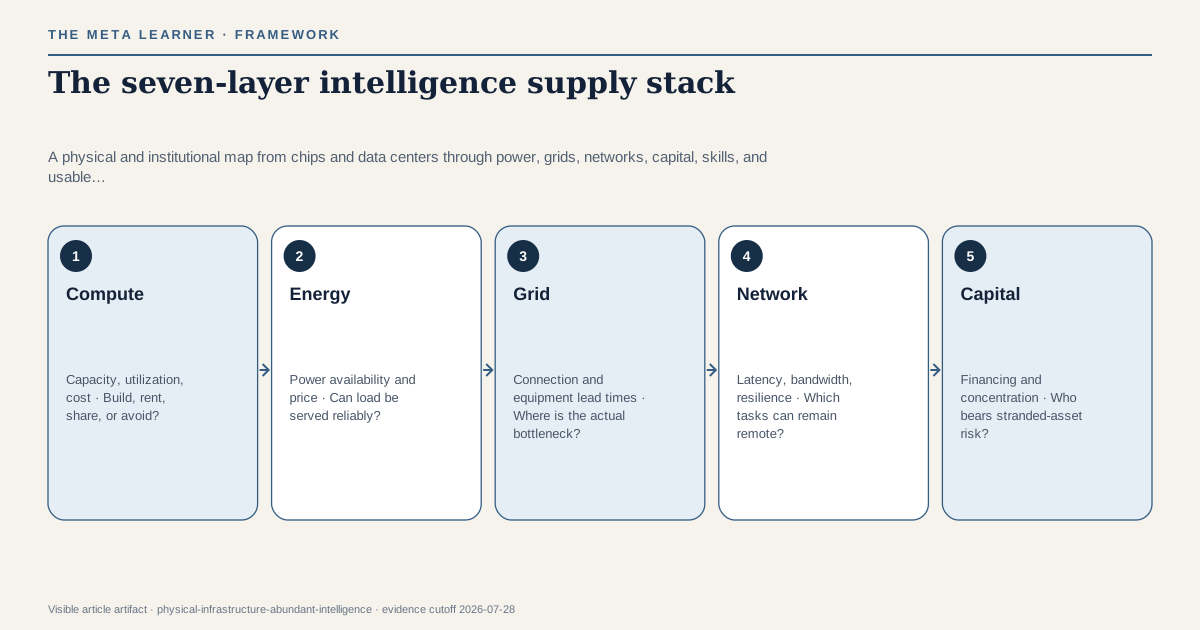
“Abundant intelligence” is a user experience, not a description of the whole supply system. AI depends on chips, data centers, electricity, grids, networks, capital, skilled operators, and institutions able to deploy it. Model efficiency can improve quickly while total demand still grows. The distribution of those physical layers will shape who can build, afford, and reliably use AI.
Observed physical constraints
The IEA’s 2025 Energy and AI report models data-center electricity demand, supply, security, emissions, and the potential use of AI inside energy systems.iea-energy-ai, iea-questions, stanford-index Its 2026 update reports fast demand growth alongside efficiency improvements and bottlenecks involving grids, transformers, turbines, chips, components, planning, and approvals.iea-questions
The Stanford AI Index documents concentrated model development, investment, compute, and data-center geography alongside expanding capability.stanford-index
The evidence supports rapid AI and data-center expansion, improving efficiency, physical bottlenecks, and uneven capacity. Projections remain conditional, and the sources do not establish one inevitable energy or market outcome.
Claim sources: iea-questions, iea-energy-ai, stanford-index
The interface hides a supply stack
A user types a question and receives an answer in seconds. The transaction feels weightless. Beneath it sits a chain:
- advanced chips and fabrication capacity;
- data-center buildings, cooling, and networks;
- electricity generation and storage;
- transmission, distribution, and grid connection;
- land, permits, equipment, and supply chains;
- finance, procurement, operations, and security;
- organizations with data, skills, and workflows capable of using the service.
A constraint at any layer changes economics or geography. More efficient chips may reduce energy per task while lower prices increase use. Available generation may exist far from a constrained grid connection. Compute capacity may exist while local firms lack complementary skills.
Our inference: abundance will be regionally conditional
AI services can be globally accessible through networks, but the ability to train, host, customize, and govern them remains uneven. Regions with reliable electricity, grid capacity, capital, cooling options, and technical ecosystems can capture more of the infrastructure value.
Others may consume intelligence through distant platforms while depending on external pricing, policy, and service continuity. This is not automatically harmful; shared infrastructure can lower entry barriers. It becomes strategically important when dependency limits bargaining power, data governance, or resilience.
“Sovereignty” is not binary self-sufficiency. The practical question is which layers a country or organization must control, diversify, contract, or understand for its use case.
The seven-layer supply audit
For a proposed AI strategy, ask:
| Layer | Signal | Decision question | |---|---|---| | Compute | Capacity, utilization, cost | Build, rent, share, or avoid? | | Energy | Power availability and price | Can load be served reliably? | | Grid | Connection and equipment lead times | Where is the actual bottleneck? | | Network | Latency, bandwidth, resilience | Which tasks can remain remote? | | Capital | Financing and concentration | Who bears stranded-asset risk? | | Capability | Operators, evaluators, integrators | Can the system be absorbed? | | Governance | Data, security, accountability | Which dependencies are acceptable? |
The audit prevents a compute announcement from standing in for an operating system.
Bounded case: a regional education platform
A public education program considers hosting a large tutoring system locally. The political appeal is control. The operational comparison includes expected load, language-specific performance, connectivity, privacy, staff, model updates, electricity reliability, and total lifecycle cost.
The decision may be a hybrid: locally governed learner data and retrieval, smaller models for common tasks, and contracted external capacity for burst demand. The design preserves an exit path and measures educational outcomes rather than equating local hardware with learning value.
This is not an infrastructure recommendation. It shows how physical and pedagogical constraints belong in the same decision.
Efficiency is not the same as lower total demand
Two observations can be true: energy per AI task falls, and aggregate electricity use rises because models, modalities, agent steps, users, and applications expand. The net outcome depends on efficiency, price, demand elasticity, workload mix, and system boundaries.
Avoid simple claims that one query has a stable universal footprint. Hardware, model, batch size, location, electricity mix, and allocation method matter. At the same time, uncertainty is not a reason to ignore infrastructure. Measure what the decision can control: workload, provider disclosure, location, timing, and alternatives.
Infrastructure scenarios and signposts
Efficiency-led diffusion. Cost per useful task falls faster than physical constraints grow. Signposts: lower energy per workload, broader access, stable reliability, and measured productivity gains.
Bottlenecked expansion. Demand outruns grids and supply chains in specific regions. Signposts: connection delays, equipment shortages, rising local price pressure, and projects migrating to available capacity.
Concentrated abundance. A small number of firms and regions control crucial layers. Signposts: capital concentration, proprietary stacks, dependence on a few fabrication and cloud providers, and policy focus on sovereign capacity.
Flexible integration. Data centers coordinate with power systems and locate around available low-carbon or flexible supply. Signposts: demand response, storage, temporal workload shifting, transparent reporting, and grid investment.
Economic and organizational signposts
Physical supply alone does not create value. Watch whether firms outside the infrastructure sector gain measurable workflow outcomes, whether small organizations can access capability, and whether skills and data gaps narrow. From Model Capability to Workflow Adoption tracks the absorption side.
For the cost story, The Cost of Intelligence Is Falling separates service price from verification and responsibility.
Invalidation signals for the seven-layer intelligence supply stack
The scarcity thesis would weaken if compute, energy, grid, and supply capacity expanded so rapidly and diffusely that location, capital, and infrastructure ceased to constrain meaningful AI use. It would also weaken if most value came from highly efficient local systems with minimal dependence on large infrastructure.
Conversely, persistent bottlenecks, rising concentration, or widening regional access gaps would strengthen it. The AI-Era Signpost Ledger keeps those observations separate from forecasts.
What the stack cannot forecast
Energy and compute data are incomplete, fast-moving, and method-sensitive. Projections depend on adoption, efficiency, model architecture, regulation, economic demand, and energy-system choices. The article does not estimate the footprint of a particular query, provider, or product and does not offer investment advice. Its structural interpretation uses evidence available through July 28, 2026.
Abundance at the interface is real. So is the physical world that makes the interface possible.
Named sources
Evidence and further reading
Published July 29, 2026. No substantive revision has been recorded. Evidence last verified July 28, 2026.