The Cost of Intelligence Is Falling. The Cost of Judgment Is Not
Why cheaper generation can move cost into verification, choice, accountability, and correction—and how to distinguish abundance from value.
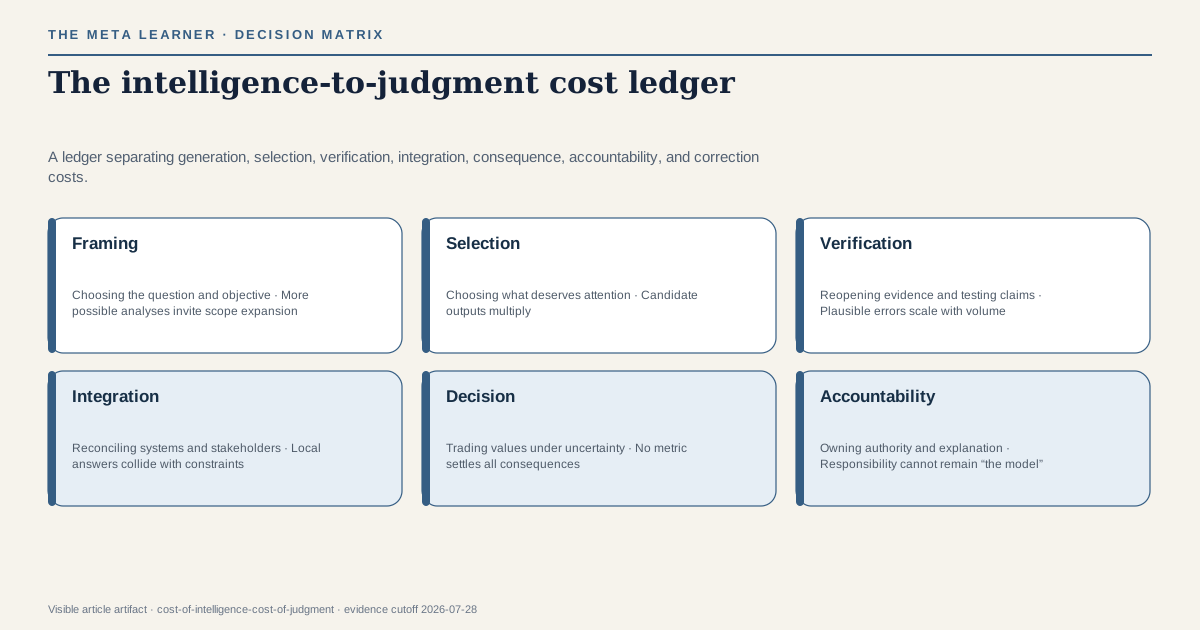
AI is making many forms of draft intelligence—summaries, alternatives, explanations, code, and analysis—cheaper and more abundant. Judgment is a different economic object. It includes selecting the right problem, distinguishing plausible from supported, weighing consequences, obtaining authority, and correcting decisions. Those costs may fall in well-bounded tasks, but abundance can also raise them by multiplying what must be evaluated.
What is observed
The Stanford AI Index documents substantial improvements on demanding technical evaluations and growing economic use of generative AI.stanford-technical, stanford-economy, automation-use, nist-rmf These measures support a direction: more capable output is available to more people. They do not show that every output is reliable, relevant, or worth acting on.
Research on automation use and misuse predates current generative systems but remains structurally relevant: people can misuse automation by relying when they should not, or disuse it when it would help.automation-use NIST’s framework therefore treats measurement, governance, context, and risk management as part of the system lifecycle.nist-rmf
Evidence supports falling access and production barriers alongside persistent reliability and human–automation problems. The claim that judgment remains costly is an interpretation about the resulting workflow, not a direct price estimate.
Claim sources: stanford-technical, stanford-economy, automation-use, nist-rmf
The cost stack that a token price misses
Calling generation “intelligence” can conceal several different costs:
| Cost | The work performed | Why abundance may raise it | |---|---|---| | Framing | Choosing the question and objective | More possible analyses invite scope expansion | | Selection | Choosing what deserves attention | Candidate outputs multiply | | Verification | Reopening evidence and testing claims | Plausible errors scale with volume | | Integration | Reconciling systems and stakeholders | Local answers collide with constraints | | Decision | Trading values under uncertainty | No metric settles all consequences | | Accountability | Owning authority and explanation | Responsibility cannot remain “the model” | | Correction | Detecting harm and reversing course | Faster production can propagate farther |
Some costs are computational; others are institutional and moral. A faster model does not automatically create a trusted source, a legitimate decision right, or the willingness to say no.
Our inference: judgment is the new queue
When a team can generate ten options where it once produced two, option production stops being the bottleneck. Comparative evaluation becomes the queue. If it generates a source-rich report in minutes, source identity, relevance, and scope become the queue. If an agent can act, authorization and incident recovery become the queue.
This does not make human judgment mystical or immune to automation. Structured rubrics, retrieval systems, calibrated models, and better interfaces can reduce its cost. The inference is narrower: advances at the generation layer do not guarantee equal advances at the decision layer, and can increase demand placed upon it.
The useful comparison is total decision cost, not unit generation cost.
Bounded case: an investment memo
An analyst asks AI to generate five market-entry options. The system produces coherent cases, financial assumptions, and citations quickly. The cheap part is now the first-pass memo.
Judgment costs include verifying market data, identifying dependent sources, checking legal constraints, testing whether demand evidence fits the customer segment, and deciding how much downside the firm can accept. The committee must also know who owns the recommendation. A sixth polished option may reduce clarity rather than add value.
The team limits generation to three genuinely different strategies, requires a claim ledger, and predefines a reversal condition. It uses The Judgment Bottleneck to locate scarce review, then builds Decision-Grade AI-Assisted Work around it. This case is a design example, not evidence that all investment processes should use AI.
Rival interpretation: judgment is falling too
A strong rival view says models increasingly evaluate, rank, critique, retrieve evidence, and simulate outcomes. Human judgment may therefore become cheaper alongside generation.
That is plausible in domains with clear objectives, representative data, fast feedback, low-cost reversal, and measurable errors. In such settings, the same systems can help perform parts of verification and selection.
The boundary is consequence and observability. If an error is cheap, quickly detected, and reversible, machine-assisted judgment can compress the stack. If objectives conflict, affected parties lack voice, evidence is incomplete, or failure appears late, the remaining judgment may become more—not less—valuable.
Scenario ledger and signposts
Compression scenario. Evaluation tools improve with generation. Signposts: lower severe-error rates, calibrated confidence, independent replication, and declining review time on representative tasks.
Verification bottleneck scenario. Output volume rises faster than trust infrastructure. Signposts: longer approval queues, more source audits, duplicated analysis, and growing demand for provenance.
Accountability premium scenario. Production is commoditized while clients pay for defensible responsibility. Signposts: contracts organized around outcomes, stronger audit rights, explicit correction duties, and price separation between generic output and accountable advice.
The Verification Tax tracks the second scenario at the information-system level.
What would invalidate the thesis
The thesis would be invalidated if consequential organizations consistently achieved lower total decision cost, equal or better outcomes, and no displaced review or correction burden as generation scaled. It would also weaken if autonomous evaluation became reliable across changing, adversarial, value-laden environments without corresponding governance.
The strongest evidence would be longitudinal and end-to-end: not benchmark scores alone, but errors, appeals, review time, reversals, distributional effects, and responsibility.
Boundaries of the interpretation
“Intelligence” and “judgment” are broad terms, and no common accounting standard separates their costs. The cited evidence covers technical performance, adoption, human–automation interaction, and governance rather than one causal experiment. Cheap generation can be highly valuable, especially in reversible tasks. The ledger is an editorial model with an evidence cutoff of July 28, 2026.
The strategic error is not believing that intelligence becomes cheaper. It is assuming that every downstream cost falls at the same rate.
Named sources
Evidence and further reading
Published July 29, 2026. No substantive revision has been recorded. Evidence last verified July 28, 2026.