The Judgment Bottleneck: Why Faster Output Does Not Mean Better Work
Diagnose when AI accelerates production but leaves framing, evaluation, trade-offs, and accountable decisions as the real constraints on value.
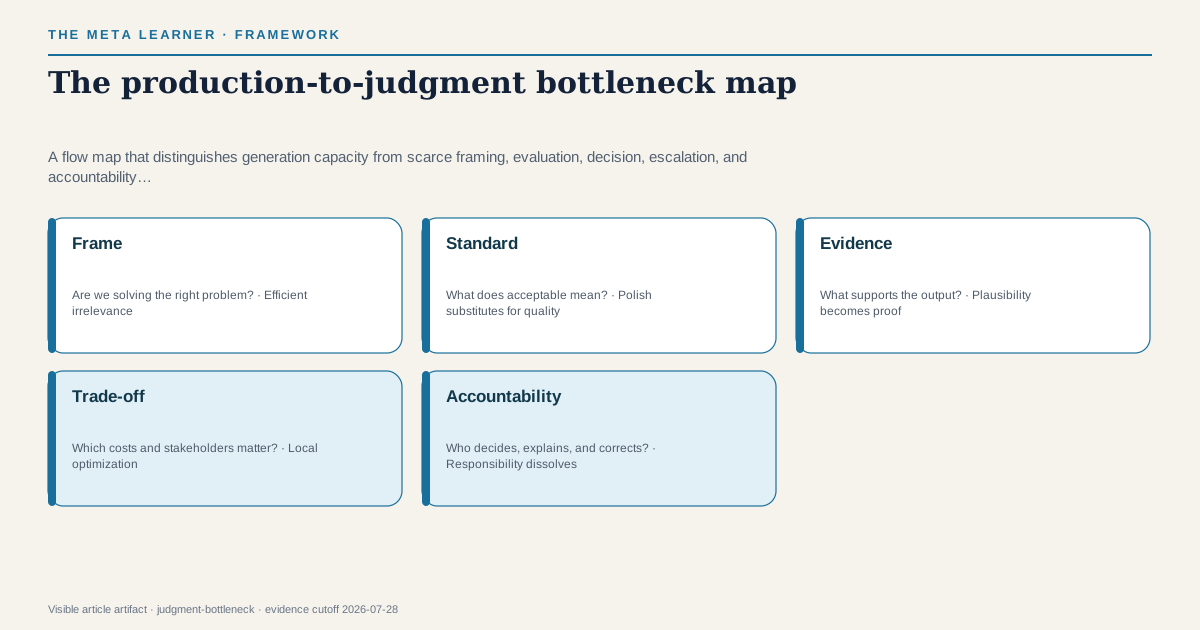
Faster output does not mean better work when the scarce step is judgment: choosing the problem, defining quality, detecting anomalies, resolving trade-offs, or owning the decision. AI can increase the volume arriving at those gates and make fluent errors harder to notice. Improve the system by limiting output, designing independent checks, routing exceptions, and allocating real time and authority to judgment.
Output abundance moves the constraint
If a team can generate ten proposals instead of two, someone must still decide which problem matters, whether assumptions are valid, what evidence is missing, and which proposal deserves resources. Production capacity rises; decision capacity may not.
This is the judgment bottleneck. It appears when an upstream tool increases output faster than downstream evaluation, coordination, or accountability can scale.
O*NET recognizes decision impact, freedom, accuracy, work context, and problem solving as distinct features of work.onet-decisions, automation-use, nist-human-ai A task inventory that counts only deliverables misses these constraints.
The five judgment gates
| Gate | Core question | Failure if rushed | |---|---|---| | Frame | Are we solving the right problem? | Efficient irrelevance | | Standard | What does acceptable mean? | Polish substitutes for quality | | Evidence | What supports the output? | Plausibility becomes proof | | Trade-off | Which costs and stakeholders matter? | Local optimization | | Accountability | Who decides, explains, and corrects? | Responsibility dissolves |
Map how many AI outputs arrive at each gate and how much qualified review capacity exists. Queue length is a warning signal.
Human-factors research distinguishes appropriate use, misuse, disuse, and abuse of automation, while NIST emphasizes explicit human roles and contextual limits. These sources support designing reliance rather than assuming human presence guarantees safety.
Claim sources: automation-use, nist-human-ai, onet-decisions
Separate output quality from decision quality
A draft can be accurate and still support a poor decision because:
- the question was wrong;
- relevant stakeholders were omitted;
- opportunity cost was ignored;
- the recommendation exceeds evidence;
- implementation cannot reproduce the conditions;
- accountability is unclear.
Score the artifact and the decision separately. If the system produces better text but worse prioritization, the work has not necessarily improved.
Design independent judgment
Showing AI output first can anchor the reviewer. For material decisions:
- ask the human to state a provisional view before seeing the output;
- require source inspection for load-bearing claims;
- seed errors to test detection;
- separate generator and approver roles where feasible;
- cap the number of alternatives;
- escalate low-confidence or high-consequence cases;
- measure reviewer workload and detection.
Parasuraman and Riley’s human-factors framework treats automation use as a relationship in which misuse and disuse can both occur.automation-use The goal is calibrated reliance, not maximum or minimum use.
Protect authority and time
A reviewer cannot own a decision if:
- deadlines permit only a glance;
- rejecting AI output creates political cost;
- relevant sources are unavailable;
- performance metrics reward throughput alone;
- the person lacks domain competence;
- no escalation route exists.
NIST’s human-AI guidance calls for differentiated roles and responsibilities and attention to limits of human-AI interaction.nist-human-ai Organizational design must make those roles real.
Decomposing a case with the production-to-judgment bottleneck map
An investment committee uses AI to generate twenty market scenarios instead of four.
The initial meeting becomes worse: members debate narratives without inspecting assumptions. The redesign limits output to six distinct scenarios, requires a common evidence template, records disconfirming indicators, and assigns one member to challenge the base rate before seeing the model’s ranking.
AI remains useful for exploring combinations. The scarce resource—committee judgment—is protected from unstructured abundance. This case does not authorize financial decisions or imply one committee design fits all.
Map the five judgment gates
- Choose one AI-assisted workflow.
- count outputs arriving at each gate.
- identify the person, standard, time, and authority.
- note which failures are hardest to detect.
- create an independent check for the highest-consequence gate.
- limit or batch upstream output.
- measure decision outcomes and review burden.
- stop if judgment becomes ceremonial.
Use Audit Your Work for Automation, Augmentation, and Human Judgment to map the system, Verify AI Explanations and Sources at the evidence gate, and How to Make Decisions Under Uncertainty at the trade-off gate.
Human review that exists only on paper
- Reviewer sees only the generated conclusion.
- Throughput targets make rejection impossible.
- No one defines acceptable quality.
- The least experienced person reviews the hardest cases.
- Confidence labels replace evidence.
- Every output receives nominal approval.
- Failures are corrected but not logged or learned from.
Capability and adoption create different judgment bottlenecks. A model may demonstrate strong output on a benchmark while a real deployment places it inside noisy data, fragmented authority, rushed review, and incentives to agree. Conversely, limited capability can still create risk when the organization treats confident text as settled analysis. Audit the deployed workflow: what information reaches the reviewer, whether judgment is formed before the recommendation appears, how dissent is recorded, and who can stop the process. The bottleneck is not “the human” in the abstract. It is the specific decision gate whose evidence, expertise, time, or authority is insufficient for the consequence it controls.
Measure that gate with realistic cases, including correct recommendations, subtle errors, missing context, and situations in which escalation is the only defensible decision.
Not every task needs the same oversight
Some bounded, low-consequence automation can operate without item-level human review, while high-impact systems may require much stronger controls than this article describes. Human judgment is also biased and fallible. Appropriate design depends on law, domain, reversibility, affected people, system performance, and organizational capacity.
When machines make output cheap, restraint, standards, and accountable choice become part of production—not overhead added after it.
Named sources
Evidence and further reading
Published July 29, 2026. No substantive revision has been recorded. Evidence last verified July 28, 2026.