What Makes AI-Assisted Work Decision-Grade? Evidence, Traceability, and Escalation
Make AI-assisted work decision-grade with source evidence, transformation logs, explicit uncertainty, independent review, escalation, and accountable approval.
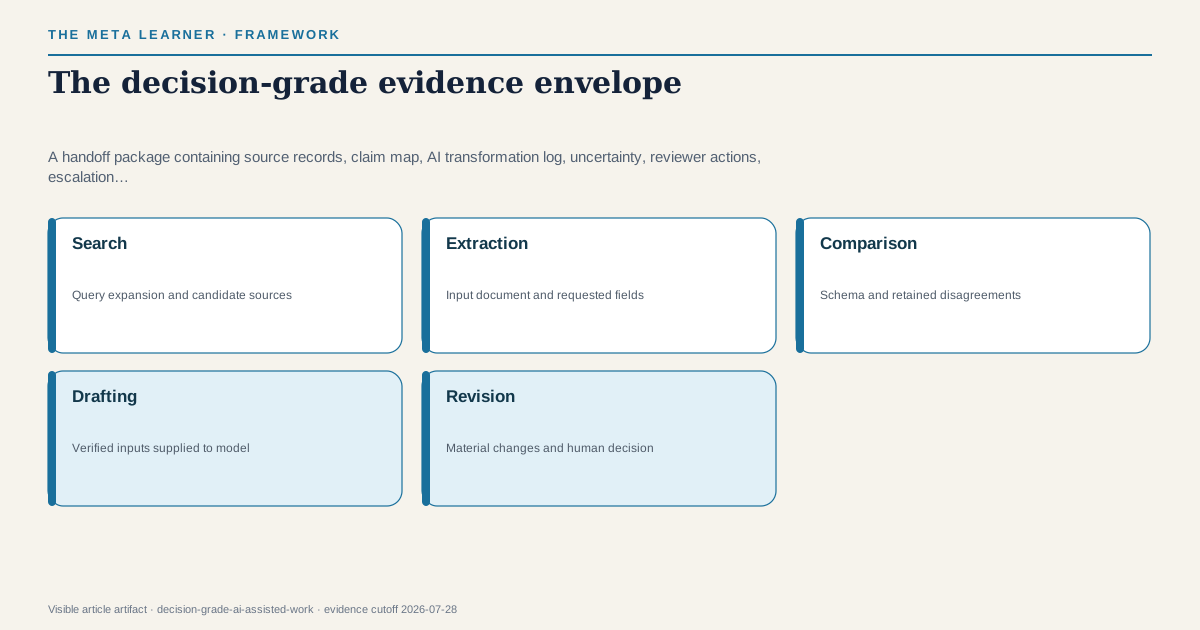
AI-assisted work is decision-grade when an accountable reviewer can trace every material claim to evidence, see what the AI transformed, distinguish observation from inference, inspect uncertainty and counterevidence, reproduce key checks, and know where unresolved cases escalate. The final approver—not the model or prompt author—must own the decision and correction path.
Fluency is not a decision record
A polished briefing can conceal a weak evidence chain. The citations may exist but not support the claims. Model output may have been rewritten until its provenance vanished. The reviewer may see only the final recommendation and have no way to challenge its construction.
Decision-grade is a property of the work system, not the prose style. It asks whether the artifact can carry a consequential choice under scrutiny.
Adoption case: the decision-grade evidence envelope
An executive team requests an AI-assisted supplier-risk brief.
The analyst uses AI to classify public sources and draft comparison tables. The envelope shows:
- supplier and date scope;
- opened filings and official records;
- claims separated from scenarios;
- AI roles and corrected errors;
- gaps in privately held suppliers;
- escalation for sanctions, safety, or legal questions;
- named procurement owner approving action.
The output informs which suppliers require deeper due diligence. It does not certify supplier safety or replace legal review.
The evidence envelope
Attach seven parts:
- Decision frame: owner, audience, question, scope, and consequence.
- Source record: opened sources, access dates, roles, and limitations.
- Claim map: observations, sourced conclusions, inferences, and recommendations.
- Transformation log: where AI searched, extracted, compared, drafted, or revised.
- Evaluation: test cases, known failures, and reviewer corrections.
- Uncertainty: gaps, counterevidence, and assumptions.
- Escalation and approval: triggers, route, final authority, and correction record.
The envelope can be concise. Its purpose is to preserve intellectual and operational custody.
NIST and GAO frameworks converge on governance, mapping context, data, performance, monitoring, documentation, and accountable roles. They are general frameworks rather than certification that one artifact is safe or fit for a domain.
Claim sources: nist-rmf, nist-genai, gao-accountability, nber-genai-work
Trace claims to opened evidence
For each material sentence:
- source ID;
- exact support;
- evidence type;
- population and time;
- inference or transformation;
- limitation;
- verification status.
AI-suggested citations remain unverified until resolved and inspected. NIST’s Generative AI Profile identifies confabulation and information-integrity risks, among others.nist-genai, nist-rmf, gao-accountability, nber-genai-work A valid URL is not yet a valid warrant.
Preserve the AI transformation
Record the role, not every conversational token:
| Stage | Record | |---|---| | Search | Query expansion and candidate sources | | Extraction | Input document and requested fields | | Comparison | Schema and retained disagreements | | Drafting | Verified inputs supplied to model | | Revision | Material changes and human decision |
Note model and date where behavior matters. Preserve sensitive prompts only in approved systems.
Make uncertainty operational
An uncertainty statement should change action:
- uninspected source: cannot support final claim;
- conflicting evidence: present range or branch;
- unknown applicability: restrict scope or pilot;
- high-consequence error: independent specialist review;
- changing fact: verify at decision time;
- missing authority: escalate.
The NIST AI RMF’s govern, map, measure, and manage functions emphasize lifecycle context and risk management.nist-rmf Documentation without a changed decision is archive, not control.
Design escalation
Specify:
- trigger;
- person or role;
- information transferred;
- response time;
- default if no response;
- authority to stop;
- affected-person route where relevant.
“Ask a human” is inadequate if no human has the competence, time, or power to intervene.
Assemble the evidence envelope
- Name the decision and owner.
- build the claim-source map.
- label AI transformations.
- run representative failure tests.
- add counterevidence and material gaps.
- define escalation triggers and stop rules.
- require an independent reviewer for load-bearing claims.
- archive the approval and correction path.
Start with Verify AI Explanations and Sources, map responsibility through Audit Your Work for Automation, Augmentation, and Human Judgment, and test warrants through Critical Thinking: A Practical System for Claims and Evidence.
GAO organizes its AI accountability framework around governance, data, performance, and monitoring and provides questions for entities and assessors.gao-accountability Use its full framework where relevant rather than treating this envelope as equivalent.
Documentation that preserves no accountability
- Saving prompts without source evidence.
- Listing citations no one opened.
- Recording model version but not human corrections.
- using a confidence score without calibration.
- hiding disagreement in a merged summary.
- naming a reviewer who lacked authority.
- retaining logs while providing no correction route.
Decision-grade work begins with a task-level workflow trace. Record the question received, source boundary, model transformation, checks performed, material corrections, unresolved uncertainty, decision owner, and downstream action. Keep model capability separate from organizational adoption: a system can produce an impressive analysis and still be unsuitable for deployment because evidence access, privacy, escalation, or reviewer capacity is missing. The NBER field study demonstrates why context matters: observed effects came from a particular tool, workforce, and operating environment, not from “AI” as a free-standing cause applicable everywhere.nber-genai-work The evidence envelope should make that local boundary impossible to overlook.
If a reviewer cannot reconstruct why the recommendation survived its strongest objection, the envelope documents activity rather than decision quality.
Decision-grade is domain-specific
The evidence envelope does not establish compliance, safety, fairness, security, privacy, financial suitability, legal privilege, or scientific validity. Different sectors require different validation, audit, records, and approval. Some AI use may be prohibited regardless of documentation. Apply current domain rules and accountable expertise.
Decision-grade work is not work that cannot be challenged. It is work designed so challenge can reach the evidence, the judgment, and the person responsible.
Named sources
Evidence and further reading
Published July 29, 2026. No substantive revision has been recorded. Evidence last verified July 28, 2026.