The Verification Tax: Why Cheap Generation Makes Trusted Knowledge More Expensive
A structural analysis of how abundant plausible content can shift cost toward source identity, provenance, appraisal, synthesis, and accountable correction.
The verification tax is the extra work required to turn abundant plausible content into trusted knowledge: resolve source identity, recover provenance, split claims, inspect the underlying evidence, preserve disagreement, and assign correction responsibility. AI can also reduce parts of this work, so the tax is not inevitable—but generation can scale faster than trust infrastructure.
Observed changes in the trust environment
NIST’s synthetic-content report surveys provenance, watermarking, detection, authentication, testing, and auditing, while warning that transparency mechanisms do not guarantee trustworthiness or correct context.nist-synthetic, acrl-framework, stanford-lateral, c2pa-spec C2PA provides a specification for recording an asset’s origin and modification history.c2pa-spec Together, they show that provenance has become an infrastructure problem, not merely an individual reading habit.
The ACRL framework treats authority as constructed and contextual, research as inquiry, and information creation as a process.acrl-framework Stanford research on lateral reading shows the value of leaving a page to investigate its source and context rather than evaluating appearance in isolation.stanford-lateral
The sources support the need for origin, context, source evaluation, and information-process awareness. The “verification tax” is an economic metaphor and structural inference, not a measured universal surcharge.
Claim sources: nist-synthetic, acrl-framework, stanford-lateral, c2pa-spec
Why the tax appears
Before cheap generation, producing a polished report required enough effort that format carried a weak signal of investment. It never guaranteed truth. Now the visual and rhetorical costs can approach zero while evidentiary quality varies widely.
A single generated paragraph can contain:
- a real source attached to the wrong claim;
- a secondary report presented as original evidence;
- a correct statistic with a missing denominator;
- two dependent sources counted as confirmation;
- an inference phrased as an observed fact;
- a true statement outside its temporal or geographic scope.
The reader must decompose fluency back into inspectable units. That reversal is the tax.
The seven-layer ledger
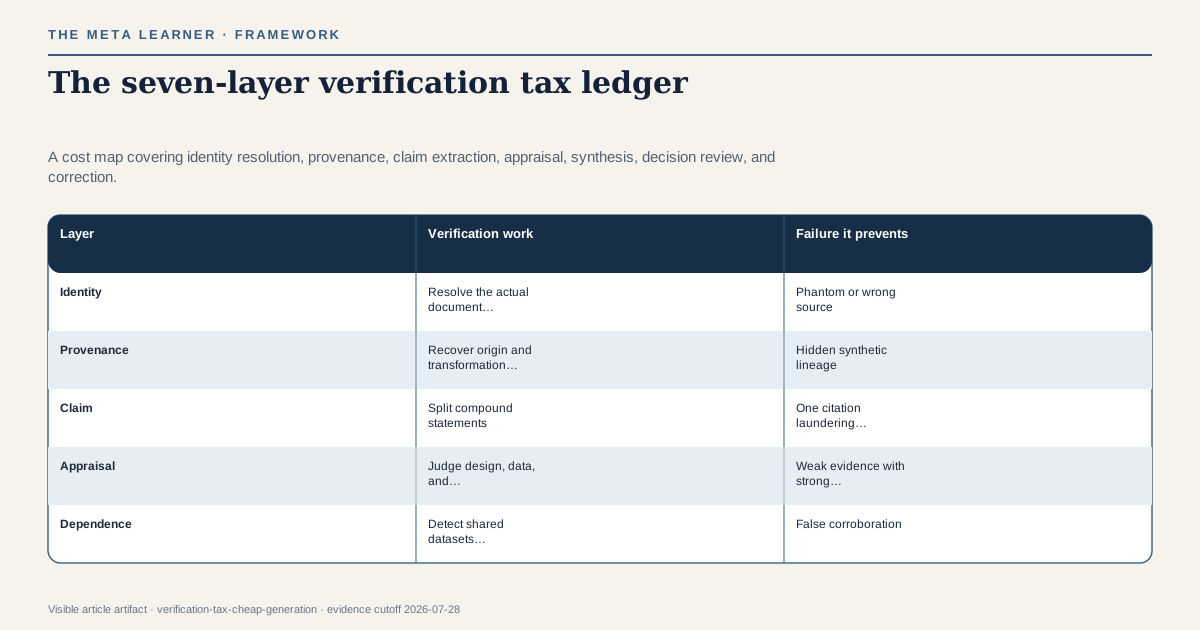
| Layer | Verification work | Failure it prevents | |---|---|---| | Identity | Resolve the actual document, author, and version | Phantom or wrong source | | Provenance | Recover origin and transformation history | Hidden synthetic lineage | | Claim | Split compound statements | One citation laundering many claims | | Appraisal | Judge design, data, and relevance | Weak evidence with strong polish | | Dependence | Detect shared datasets and citation chains | False corroboration | | Synthesis | Preserve scope and disagreement | Averaged-away uncertainty | | Correction | Name owner, record, and route | Persistent known error |
Technical provenance helps mainly at the second layer. A valid credential can show who signed an asset and how it changed; it cannot prove that the interpretation is sound.
Our inference: trusted knowledge becomes a premium system
If generation increases supply faster than verification capacity, organizations will ration trust. They may rely on approved sources, pay for expert review, demand claim-level provenance, or retreat into closed collections. Trusted knowledge becomes more expensive relative to generic content even if total research cost falls.
This can produce inequality. Wealthy organizations can afford databases, specialists, legal review, and audits. Others receive abundant low-cost answers with weaker routes to challenge them. Verification therefore has an access dimension, not only a quality dimension.
AI itself can reduce the tax by resolving identifiers, comparing passages, checking calculations, and flagging missing support. But its checks need evaluation and provenance too. A verifier that cites the same corrupted chain adds speed without independence.
Bounded case: a health-policy briefing
A team receives a generated briefing with twenty references. It does not ask whether the prose “looks AI-written.” It extracts ten material claims, resolves each DOI or official record, distinguishes research from commentary, groups publications reporting the same study, and records the evidence cutoff.
Three references do not support the attached claim. Two report the same dataset. One official source has been superseded. The final briefing is shorter, narrower, and more useful.
This is a knowledge-control example, not medical advice. How to Detect Citation Laundering provides the chain audit, and The Evidence Map makes the revised argument challengeable.
Scenarios and verification signposts
Tax spiral. Synthetic volume grows faster than verification. Signposts: rising correction queues, unverifiable citations, repeated false claims, and more content than reviewers can sample.
Verification automation. Machine-assisted provenance and appraisal lower total review cost. Signposts: reliable identifier resolution, calibrated claim checking, lower severe-error rates, and independent replication of gains.
Trust enclaves. Institutions depend on curated collections and authenticated channels. Signposts: premium evidence products, closed source environments, credential requirements, and widening access gaps.
Open trust infrastructure. Public standards, transparent ledgers, and shared verification tools distribute capacity. Signposts: interoperable provenance, public correction records, and inexpensive source-resolution services.
The scenarios can combine: authenticated origin may grow while appraisal remains costly.
Operational signposts
Measure claims per reviewer, unresolved source rate, time to first authoritative source, percentage of claims tied to exact evidence, severe errors after publication, correction latency, and access cost. Do not celebrate a higher number of citations if dependence and relevance are unknown.
The Cost of Intelligence Is Falling places these measures in the total decision-cost ledger.
Invalidation signals for the seven-layer verification tax ledger
The tax thesis would weaken if verified, source-resolved knowledge scaled at least as quickly as generated content while severe-error rates and access disparities fell. It would also weaken if provenance plus automated appraisal became reliably sufficient across domains.
For a particular workflow, the thesis should reverse when generation and verification are jointly automated, independently evaluated, cheaper than the baseline, and no material burden is displaced to downstream users.
What the tax metaphor cannot show
There is no standardized “verification tax” measure. Costs vary by domain, stakes, language, source access, regulation, and existing quality systems. Some pre-AI knowledge markets already produced abundant misinformation, while AI can improve verification access. Provenance standards are neither universal nor complete. The scenario analysis uses evidence available through July 28, 2026.
Cheap generation does not make trusted knowledge impossible. It makes the architecture of trust impossible to ignore.
Named sources
Evidence and further reading
Published July 29, 2026. No substantive revision has been recorded. Evidence last verified July 28, 2026.