From Model Capability to Workflow Adoption: The Gap That Will Define the Next Phase
A structural map of why rapid AI capability gains do not automatically become reliable organizational performance, and which adoption signposts matter.
AI capability is advancing faster than most organizations can convert it into dependable work. The binding constraint is increasingly an absorption system: task fit, usable data, redesigned handoffs, evaluation, authority, security, worker learning, and accountability. A model demonstration shows what a system can sometimes produce; adoption is the repeated ability of a real workflow to deliver a bounded outcome without hiding cost or risk.
Observed facts
The Stanford AI Index records rapid gains across technical benchmarks, including agentic tasks, while also emphasizing that agents still fail on structured evaluations.stanford-technical, stanford-economy, oecd-adoption, nist-rmf Its economy chapter reports high organization-level AI use in surveyed firms but agent deployment in the single digits across almost all business functions.stanford-economy These are not contradictory observations. “Uses AI somewhere” and “delegates a multi-step workflow reliably” are different states.
The OECD’s firm-adoption study identifies skills, data, finance, organizational capacity, complementary assets, and management as conditions shaping diffusion.oecd-adoption NIST’s risk framework likewise treats trustworthy deployment as a lifecycle and governance problem, not a one-time model choice.nist-rmf
The evidence supports a gap between measured model capability, reported tool use, and accountable deployment. It does not provide a single cross-industry conversion rate, because benchmarks, surveys, task definitions, and risk thresholds are not directly comparable.
Claim sources: stanford-technical, stanford-economy, oecd-adoption, nist-rmf
Our inference: absorption becomes the scarce layer
When access to capable models broadens, competitive difference moves outward. The organization must know which task is worth changing, provide the right context, connect the system to tools, and decide where uncertain output stops. It must also make correction economically possible.
This is an inference from several evidence streams, not an observed universal law. In low-stakes, self-contained work, adoption may follow capability quickly. In high-consequence or institutionally fragmented work, the surrounding system can dominate.
The important unit is not the model or even the task alone. It is the task inside a workflow, with upstream inputs, downstream users, exceptions, incentives, and a named owner.
Absorption also has a political economy. A technically viable redesign may stall because one team bears the review burden while another receives the saving, because workers lack permission to expose failure, or because a vendor controls the evidence needed to evaluate its system. These are not “soft” obstacles outside the technology. They determine whether capability can enter ordinary work without transferring hidden cost. A serious adoption measure should therefore identify the beneficiary, burden bearer, decision right, and evidence owner for every material change. When those four positions do not align, apparent resistance may be rational information about the proposed workflow.
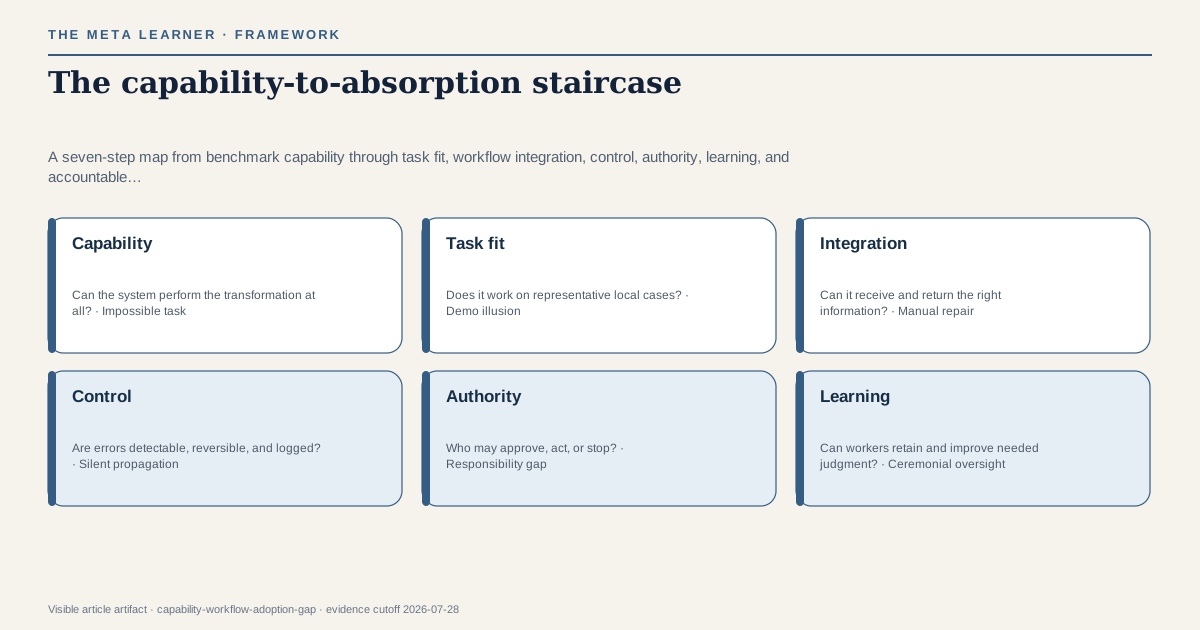
The capability-to-absorption staircase
| Step | Question | Failure if skipped | |---|---|---| | Capability | Can the system perform the transformation at all? | Impossible task | | Task fit | Does it work on representative local cases? | Demo illusion | | Integration | Can it receive and return the right information? | Manual repair | | Control | Are errors detectable, reversible, and logged? | Silent propagation | | Authority | Who may approve, act, or stop? | Responsibility gap | | Learning | Can workers retain and improve needed judgment? | Ceremonial oversight | | Outcome | Does the whole workflow improve? | Local speed, global loss |
Organizations often climb the first two steps and announce transformation. Yet integration can move labor into data cleanup; control can make review more expensive than generation; and unclear authority can turn a technically good recommendation into an unusable one.
Use From Task Automation to Workflow Redesign to expose those movements. Apply How to Measure Whether AI Actually Improves Your Work before treating use as value, then specify ownership with The Manager’s Human-Checkpoint Map.
A bounded case: policy research
A policy team tests an agent that can search a document collection, extract provisions, and draft a comparison. On curated examples, the output is faster and often accurate.
Adoption still fails if document versions are ambiguous, citations point to superseded language, the system cannot distinguish binding rules from guidance, or analysts lack time to reopen sources. The redesigned workflow therefore assigns ingestion, version control, claim verification, legal interpretation, and approval to different gates. The agent drafts a traceable table; a qualified analyst owns the conclusion.
The case establishes a design logic, not a performance claim about a product. A team should measure its own representative cases, severe-error rate, review time, and decision outcome.
Scenarios and signposts
Scenario 1 — diffusion without redesign. AI use becomes nearly universal, but most value remains personal and informal. Signposts include high account activity, weak process data, duplicate subscriptions, and unchanged cycle times.
Scenario 2 — selective absorption. Organizations redesign a few high-volume workflows with clear ownership. Signposts include task-specific baselines, documented escalation, measured review cost, and worker participation in design.
Scenario 3 — agentic reorganization. Some firms rebuild operations around delegated multi-step systems. Signposts include agent identities, least-privilege access, durable audit trails, incident exercises, and new roles for exception handling and evaluation.
The scenarios can coexist across functions inside one organization. Finance may remain tightly bounded while internal communications move quickly.
Invalidation signals for the capability-to-absorption staircase
This interpretation would be weakened if broad, independently measured agent deployment began producing durable workflow gains without complementary organizational change. It would also be weakened if model reliability improved enough that integration, review, authority, and learning costs became negligible across consequential contexts.
Evidence that would change the conclusion includes longitudinal firm data connecting deployment to outcomes, review burden, error severity, workforce effects, and governance maturity—not adoption counts alone.
Limits of this window
The article compares heterogeneous benchmark, survey, case, and governance evidence. Reported organizational adoption can reflect anything from occasional chat use to production integration. Firms that measure and publish results may not represent smaller or less digitized organizations. The staircase is an editorial synthesis, not a validated maturity model, and the evidence cutoff is July 28, 2026.
The near-term question is therefore not merely “How capable is the next model?” It is “What must become true around the model before this organization can trust the work?”
Named sources
Evidence and further reading
Published July 29, 2026. No substantive revision has been recorded. Evidence last verified July 28, 2026.