From Task Automation to Workflow Redesign: Where AI Creates Real Value
Find AI value by redesigning the whole workflow around inputs, decisions, verification, exceptions, learning, and accountability—not one faster task.
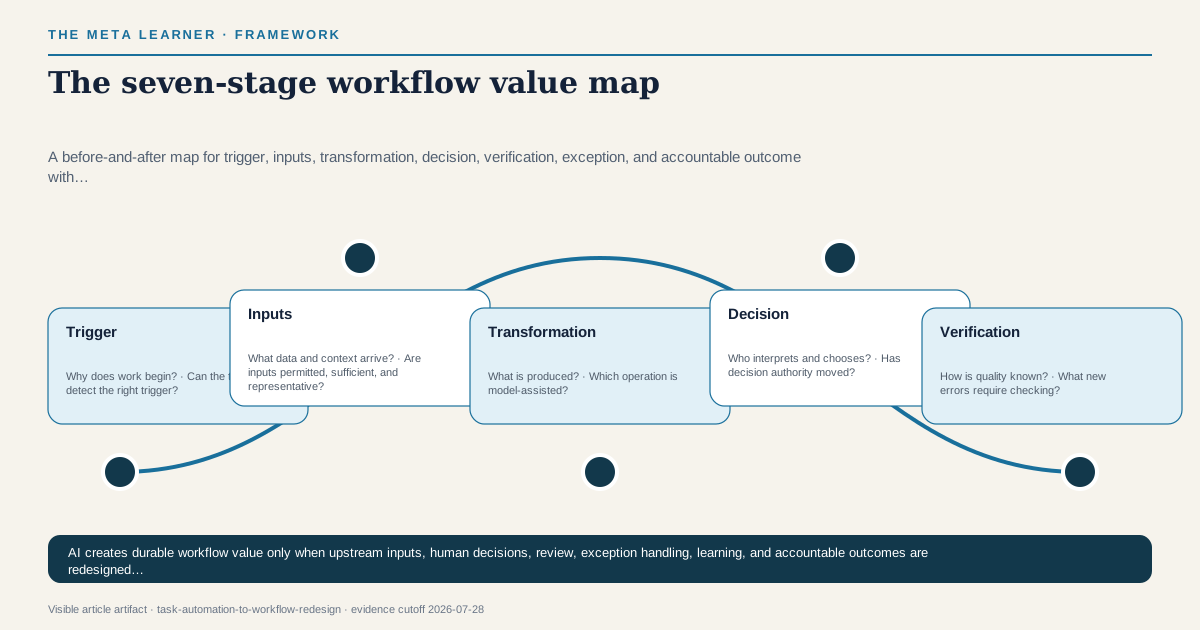
Move from task automation to workflow redesign by mapping seven stages: trigger, inputs, transformation, decision, verification, exception, and accountable outcome. Compare the current and AI-assisted versions on total time, error, downstream rework, learning, risk, and user value. Automate only where the redesigned system is better end to end—not where a model produces one step quickly.
The task-speed illusion
An AI system writes a draft in thirty seconds, so a thirty-minute task appears automated. Then someone assembles context, removes confidential material, checks citations, repairs tone, resolves exceptions, and explains the result. The generation step is faster; the workflow may not be.
This is why capability and adoption must remain separate. ILO research estimates task exposure using occupational data and expert assessment; it does not predict that every exposed task will be automated in every workplace.ilo-exposure, oecd-ai-work, nist-rmf, nber-genai-work
Workflow value is the change in the whole system.
Pilot the seven-stage map
| Stage | Current questions | AI-assisted questions | |---|---|---| | Trigger | Why does work begin? | Can the tool detect the right trigger? | | Inputs | What data and context arrive? | Are inputs permitted, sufficient, and representative? | | Transformation | What is produced? | Which operation is model-assisted? | | Decision | Who interprets and chooses? | Has decision authority moved? | | Verification | How is quality known? | What new errors require checking? | | Exception | Where do unusual cases go? | Can people recognize and escalate them? | | Outcome | Who receives value and owns harm? | Is the final result measurably better? |
Add waiting, handoff, and learning time between stages. Invisible work often lives there.
Official evidence supports task-level analysis, attention to job quality and organizational choice, and lifecycle governance of AI risk. It does not establish value for a particular tool or workflow without local evaluation.
Claim sources: ilo-exposure, oecd-ai-work, nist-rmf, nber-genai-work
Measure the baseline before the demo
Collect representative cases and record:
- total elapsed and active time;
- corrections and rework;
- output quality;
- exception frequency;
- downstream complaints or failures;
- sensitive data involved;
- who makes and owns decisions;
- what capability the task develops.
Do not compare a polished AI demo with an undocumented current process. The baseline may reveal that waiting, not drafting, is the bottleneck.
Redesign decision and review
NIST’s AI RMF uses govern, map, measure, and manage to structure risk work and emphasizes defined roles and context.nist-rmf Translate that into operational questions:
- Which outputs may proceed automatically?
- Which require independent evidence?
- Does the reviewer see the model answer before forming a judgment?
- Which errors are difficult to detect?
- Who can stop the workflow?
- What is logged?
- Who handles affected users and correction?
“Human in the loop” is not a control unless the human has time, competence, authority, and useful information.
Reinvest the gain
If time is saved, decide where it goes:
- deeper source verification;
- customer contact;
- exception analysis;
- capability development;
- shorter turnaround;
- lower workload;
- more output.
OECD evidence on AI and job quality shows that workplace effects are shaped by use and organizational choices, not technology alone.oecd-ai-work A value case should therefore name who gains, who performs new work, and who bears failure.
Evidence-bounded case: the seven-stage workflow value map
A procurement team uses AI to extract clauses from standard low-risk contracts.
Current workflow: analyst reads every document, records clauses, flags deviations, and sends a summary to counsel.
Pilot redesign:
- approved documents enter a controlled environment;
- AI extracts against a fixed schema;
- analyst independently checks high-consequence clauses and a sample of others;
- deviations route to counsel;
- all changes are logged;
- contracts outside the standard class are excluded.
Measures include total time, missed clauses, false flags, escalation, and reviewer workload. The pilot does not authorize contract approval or replace counsel.
Draw the seven-stage value map
- Choose one bounded workflow.
- save representative ordinary and exception cases.
- map the current seven stages.
- define the outcome and baseline.
- draw the proposed system with decision rights.
- seed known errors to test review.
- compare total cost and quality.
- decide expand, redesign, restrict, or stop.
Begin with Audit Your Work for Automation, Augmentation, and Human Judgment, inspect Build Your First Useful AI Workflow, and preserve the redesign as a work sample in Build a Skill Portfolio for an AI-Shaped Career.
Local automation that damages the whole
- Optimizing generation time while review expands.
- Automating a task whose inputs are the real bottleneck.
- moving errors downstream where they cost more.
- hiding exception work in another role.
- removing developmental tasks without replacement.
- measuring adoption rather than outcome.
- assigning accountability after the workflow is built.
Compare the redesigned workflow against the baseline on a complete case, not a favorable step. The NBER customer-support study measured deployment in a particular organization and task environment; it is evidence that real use can affect performance, not a transferable estimate for every workflow.nber-genai-work Track elapsed time, queue movement, corrections, review burden, exception handling, user outcome, and who absorbed the saved effort. If drafting accelerates but verification becomes the new queue, move capacity and authority there. If workers quietly repair weak outputs outside the instrumented path, the apparent gain is an accounting artifact.
Record those invisible repairs through observation and interviews, because a dashboard built only from system events will systematically miss them.
A pilot is not organizational proof
Local pilots can miss rare harms, long-term deskilling, labor displacement, surveillance, accessibility, security, environmental cost, and distributional effects. Tool use may be constrained by law, contract, policy, data rights, or worker representation. An accountable organization must evaluate those issues beyond the workflow map.
AI creates real value when the whole workflow becomes more useful, trustworthy, and learnable—not when one box in a diagram becomes dramatically faster.
Named sources
Evidence and further reading
Published July 29, 2026. No substantive revision has been recorded. Evidence last verified July 28, 2026.