The Manager’s Human-Checkpoint Map: Review, Escalation, and Accountability
Place human checkpoints according to consequence, detectability, reversibility, uncertainty, and decision authority rather than reviewing everything.
Place human checkpoints where an AI-supported decision is consequential, difficult to reverse, hard to detect when wrong, uncertain, or reserved to human authority. Give the reviewer the evidence, rubric, time, competence, and power to reject or escalate. Use sampling and monitoring for lower-risk cases; do not require nominal review of everything and then starve reviewers of attention.
Human review is a scarce control
Review every output and review becomes cursory. Review nothing and failures can travel to users. The managerial problem is allocation: where does human attention most reduce risk or improve judgment?
Begin with actual work. O*NET distinguishes decision frequency, decision impact, freedom, accuracy, work activities, and context within occupations.onet-content, nist-core, nist-human-ai, nber-genai-work Those dimensions are more useful than a blanket rule tied to job title.
Scenario: the consequence-detectability checkpoint map under organizational constraints
A support team uses AI to draft replies.
- routine informational questions receive sampled review;
- refunds above a threshold require agent approval;
- account access, discrimination, threats, health, and legal issues route immediately to trained specialists;
- every source-backed policy answer links to the current approved policy;
- supervisors monitor correction patterns and reviewer workload.
AI never closes a high-consequence case. The design reflects this team’s authority and policies, not a universal customer-service rule.
Score the decision boundary
For each stage, assess:
- consequence: cost if wrong;
- detectability: likelihood an error is noticed before harm;
- reversibility: ability to undo the action;
- uncertainty: evidence quality and system confidence;
- authority: whether a human must legally or professionally decide;
- learning value: whether review develops needed capability.
Use qualitative ratings with reasons. A precise number can hide weak assumptions.
The checkpoint matrix
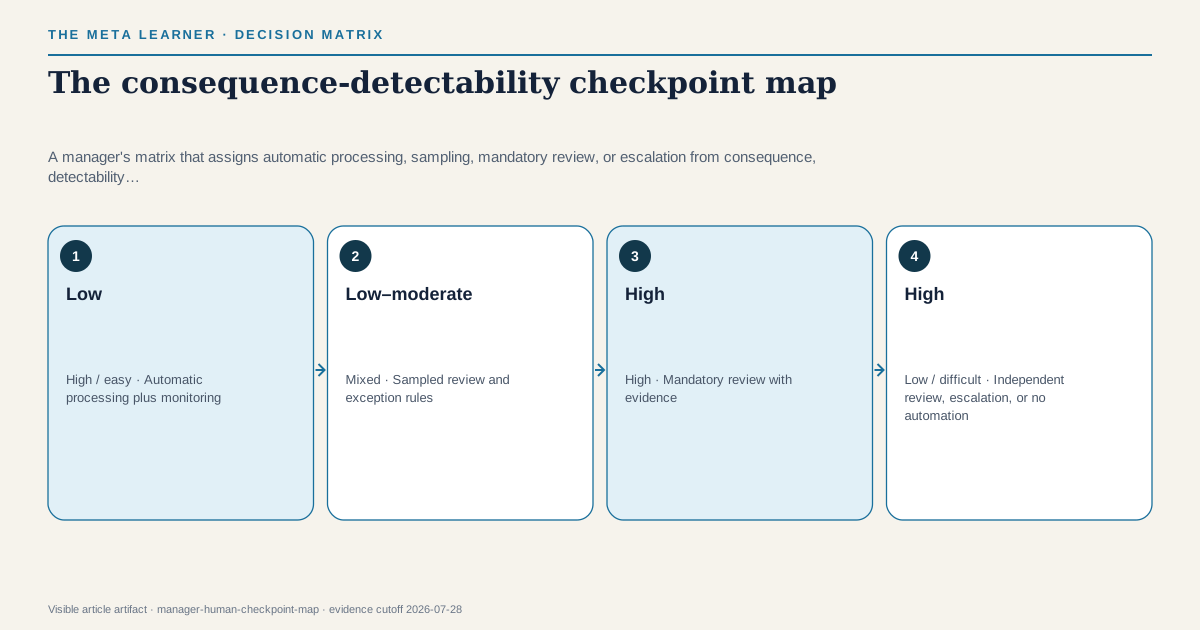
| Consequence | Detectability / reversibility | Design | |---|---|---| | Low | High / easy | Automatic processing plus monitoring | | Low–moderate | Mixed | Sampled review and exception rules | | High | High | Mandatory review with evidence | | High | Low / difficult | Independent review, escalation, or no automation |
Add a pre-output checkpoint when the framing or input choice is more consequential than the generated text. Add a post-use monitor when harm may emerge later.
NIST frames governance as cross-cutting and calls for clear human roles and responsibilities in context. O*NET supplies task and decision descriptors. The matrix is a managerial translation and does not prescribe oversight for a regulated use.
Claim sources: nist-core, nist-human-ai, onet-content, nber-genai-work
Specify the reviewer contract
Every checkpoint needs:
- reviewer role and competence;
- evidence visible;
- question to decide;
- rubric and forbidden outcomes;
- time allocation;
- authority to reject;
- escalation destination;
- action when unavailable;
- log and correction process.
“Manager approval” is not enough. A manager may lack technical or domain expertise. Split checkpoints across source verification, domain standard, risk, and final authority where necessary.
Preserve independence
If the reviewer sees a confident recommendation first, anchoring can weaken the check. Options:
- form a provisional judgment before AI output;
- compare source evidence directly;
- hide model confidence;
- use a second reviewer for high consequence;
- seed known failure cases;
- rotate cases to prevent automation complacency.
NIST’s human-AI appendix notes the importance of clearly differentiating human roles and understanding limits in human-AI interaction.nist-human-ai
Design escalation as a route
Define triggers such as:
- missing source;
- conflicting records;
- protected data;
- out-of-scope case;
- material model disagreement;
- affected-user objection;
- reviewer uncertainty;
- high-impact decision.
For each, name the receiving role and default. If escalation is slow, specify whether the workflow pauses or falls back to a manual process.
Draw the checkpoint map
- Map the workflow and decisions.
- score six dimensions with reasons.
- assign automatic, sampled, mandatory, or escalated handling.
- write the reviewer contract.
- test detection with seeded errors.
- measure backlog and decision quality.
- adjust upstream output to available review capacity.
- document who owns correction.
Start with Audit Your Work for Automation, Augmentation, and Human Judgment, inspect Build Your First Useful AI Workflow, and use How to Make Decisions Under Uncertainty for escalation thresholds.
NIST’s core organizes AI risk work through govern, map, measure, and manage and treats governance as continuing across the lifecycle.nist-core A checkpoint should therefore connect to monitoring and correction, not end at approval.
Checkpoints that create only signatures
- Reviewing every output with no prioritization.
- giving reviewers no source evidence.
- assigning approval to people without rejection power.
- measuring review completion instead of error detection.
- hiding model changes from reviewers.
- escalating to an unnamed “expert.”
- letting throughput targets punish careful review.
Calibrate checkpoints with seeded cases before trusting the map. Include an ordinary correct output, a subtle factual error, a boundary case that requires escalation, and a persuasive recommendation that conflicts with independent evidence. Measure detection, decision time, disagreement, and whether the reviewer can obtain missing context. A field study such as NBER’s customer-support deployment can establish effects inside its setting, but it cannot set the checkpoint design for a different task or consequence.nber-genai-work The manager’s map must therefore be tested where it will operate and revised when reviewers either rubber-stamp or block harmless work.
Report both missed harmful cases and unnecessary intervention, because excessive checkpoints can create delay, fatigue, and a misleading appearance of control.
Oversight obligations are contextual
This map is not legal advice, a safety case, or a substitute for domain standards. Some decisions may not be delegated to AI at all; others may use automated controls without item-level human review. Human reviewers can also be biased, tired, or conflicted. Apply current law, policy, worker protections, accessibility, and sector assurance.
The purpose of a checkpoint is not to prove a human was present. It is to place competent, empowered judgment where it can still change the outcome.
Named sources
Evidence and further reading
Published July 29, 2026. No substantive revision has been recorded. Evidence last verified July 28, 2026.