Who Owns the Learning Record? AI Tutors, Personal Data, and Portability
A rights-and-infrastructure map for the records AI tutors create: source data, inferred profiles, achievements, corrections, export, deletion, and control.
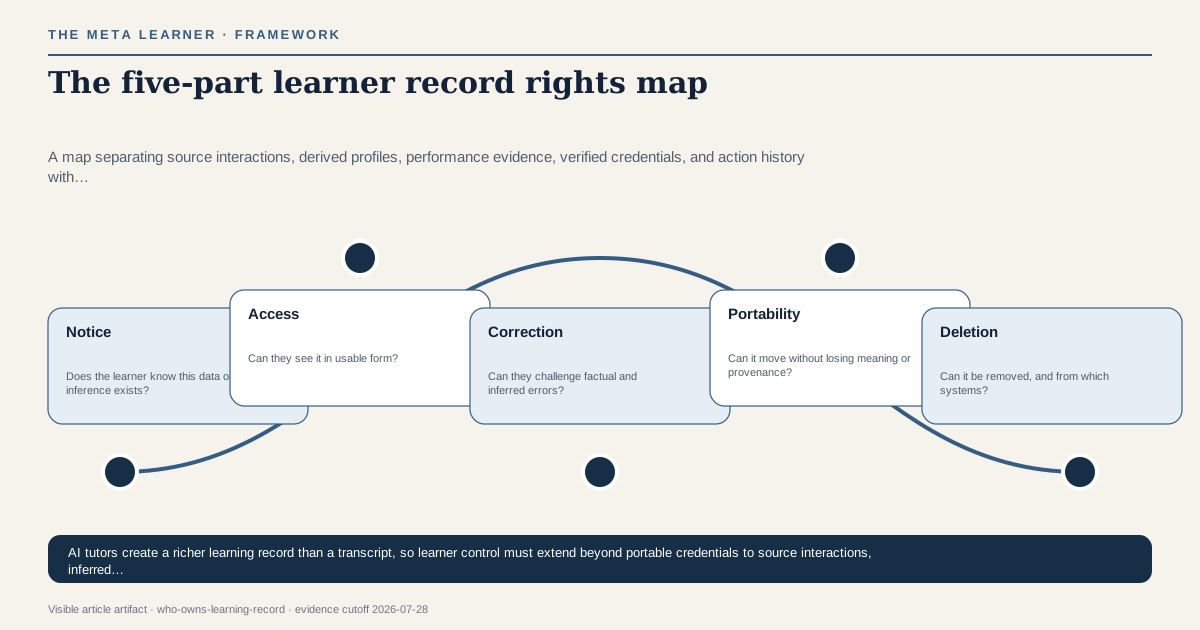
An AI tutor can create more than a grade or transcript. It may retain conversations, misconceptions, preferences, confidence estimates, language patterns, interventions, and predictions. A learner-controlled record should make source data and inferences inspectable, correctable, portable where meaningful, and deletable where required—not merely export a list of achievements. Ownership, access, deletion, and portability rights depend on contract, jurisdiction, age, institution, and system architecture.
What current systems make visible
Observed facts at the evidence cutoff are limited but clear: current policy work treats learner rights and privacy as material, while interoperable standards already exist for verified achievement records but not for every inference an AI tutor may retain.
UNESCO’s report on learner rights frames educational AI around privacy, safety, equity, governance, and human-centered use.unesco-rights, clr-standard, nist-privacy, unesco-genai-education Its generative-AI guidance likewise treats data protection and pedagogical validation as central.unesco-genai-education
The 1EdTech Comprehensive Learner Record standard supports secure, verifiable, portable records of achievements and is designed for learner control across systems.clr-standard The NIST Privacy Framework supplies a risk-management approach for identifying and managing privacy consequences.nist-privacy
The sources establish rights, privacy, and interoperability concerns plus a mature standard for portable achievement records. They do not establish a universal standard for exporting every conversational or inferred AI-tutor memory.
Claim sources: unesco-rights, clr-standard, nist-privacy, unesco-genai-education
The learning record is splitting into five parts
Traditional records emphasize courses, grades, credentials, and attendance. An AI tutor can create a more intimate and operational profile:
- Source interactions: prompts, answers, submissions, clicks, speech, and files.
- Derived profile: inferred misconceptions, preferences, proficiency, risk, or motivation.
- Performance evidence: attempts, feedback, corrections, and transfer tasks.
- Verified achievement: institutionally issued credentials and milestones.
- Action history: recommendations, adaptations, alerts, or decisions made from the profile.
These parts have different evidentiary value. A credential may be verified by an issuer. A model’s inference that a learner is “low confidence” is a probabilistic claim that may be wrong, culturally biased, or outdated.
Our inference: the most consequential record may be invisible
Portability debates often focus on the transcript a learner can see. Yet future instruction may be shaped by a derived profile the learner cannot inspect. If that profile cannot move, be corrected, or be forgotten, it becomes both a switching cost and a hidden curriculum.
The record tells the next system what the learner is “like.” A false inference can become self-reinforcing: easier material produces lower opportunity, which appears to confirm the original profile.
Learner control must therefore include provenance. Which interaction produced the inference? Which model and rule transformed it? How confident is it? Who has used it? What evidence would change it?
The five-part rights map
For each record layer, consider:
| Control | Question | |---|---| | Notice | Does the learner know this data or inference exists? | | Access | Can they see it in usable form? | | Correction | Can they challenge factual and inferred errors? | | Portability | Can it move without losing meaning or provenance? | | Deletion | Can it be removed, and from which systems? | | Restriction | Can it be excluded from a decision or new purpose? | | Accountability | Who explains harm and corrects downstream use? |
Not every record should move. Sensitive raw conversations may create more risk when exported. Portability must be selective and secure, not synonymous with copying everything.
Bounded case: an adult language learner
A learner uses an AI tutor for two years. The system has speech recordings, correction history, vocabulary estimates, preferred topics, and an inferred anxiety profile. The learner wants to change platforms.
A meaningful export contains verified milestones, learner-selected work samples, vocabulary and pronunciation evidence with dates, source language and assessment conditions, and a transparent list of preferences. It excludes sensitive recordings unless the learner deliberately includes them. Inferences are labeled as inferences and can be rejected.
The new platform should not treat a confidence estimate from another model as fact. The case shows why portability must carry semantics and limitations, not just data.
The Rise of Personal AI Workspaces explains the context lock-in; A Personal Knowledge Base That Survives Tool Changes supplies an exit test.
Institution, vendor, learner, and community
“Who owns it?” may have several answers: the learner has rights and interests; an institution has recordkeeping duties; a vendor operates the system; an issuer controls a credential signature; and a language community may have claims over collective data practices.
The solution is not a slogan of absolute ownership. It is a rights and responsibility matrix that resolves access, purpose, retention, correction, portability, and downstream use for each layer.
For multilingual learners, records should also distinguish content performance from language proficiency and retain the language and modality of assessment. The Multilingual Intelligence Shift adds the community-data boundary.
Ownership scenarios and signposts
Learner-controlled record layer. Credentials and selected evidence move between systems under learner control. Signposts: open standards, verifiable provenance, granular consent, and practical export.
Platform profile enclosure. Derived memory drives personalization but cannot leave or be inspected. Signposts: opaque recommendations, weak deletion, raw export without semantics, and high switching cost.
Institutional federation. Schools, employers, and platforms exchange records. Signposts: interoperability agreements, purpose limits, identity assurance, and stronger consequences if inferences spread.
Minimal-data tutoring. Systems retain less and personalize ephemerally. Signposts: local processing, short retention, explicit memory modes, and user-selected continuity.
Invalidation signals for the five-part learner record rights map
The hidden-record thesis would weaken if AI tutors retained no consequential derived profiles or if all such profiles became transparent, correctable, selectively portable, and reliably deletable by default. It would also weaken if personalization showed no meaningful persistence or downstream effect.
For a deployment, stop using a derived profile when its provenance is missing, it cannot be challenged, it crosses an unauthorized purpose, or its validity has decayed.
Legal and evidentiary limits
This article is not legal advice. Data protection, education records, children’s rights, consumer protection, and contractual rights vary across jurisdictions. CLR is an achievement-record standard, not a complete AI-memory standard. Portability can create security and privacy risk, and deletion may conflict with legitimate recordkeeping duties. The interpretation is current through July 28, 2026.
A learning record should help a person continue learning. It should not become a hidden theory of the person that they cannot leave.
Named sources
Evidence and further reading
Published July 29, 2026. No substantive revision has been recorded. Evidence last verified July 28, 2026.