The Multilingual Intelligence Shift: Who Gains When Translation Becomes Ambient?
A scenario analysis of how ambient translation can expand access while redistributing power through language quality, cultural fit, data, and verification.
Ambient translation can give more people immediate access to information, markets, and conversations across languages. The gains will not be automatic or equal. High-resource languages, institutions with verification capacity, and platforms controlling data may benefit first. The decisive questions are quality by language pair, cultural meaning, community agency, and who can detect consequential errors.
Observed facts across languages
UNESCO’s global roadmap treats multilingual technology as an inclusion, standards, data-sovereignty, research, and community-participation challenge—not merely a model feature.unesco-roadmap, unesco-assessment, oecd-productivity-divide, unesco-languages Its multilingual education guidance argues for learning in languages people understand and for policies that recognize multilingualism as an educational resource.unesco-languages
UNESCO and UNICEF guidance on classroom assessment emphasizes language choices and methods that accurately document multilingual learners’ capabilities.unesco-assessment OECD analysis of the global productivity divide identifies infrastructure, skills, finance, and institutional capacity as barriers to realizing AI gains, with cross-country heterogeneity.oecd-productivity-divide
The evidence supports uneven digital language representation and the importance of infrastructure, assessment, community participation, and data governance. It does not quantify the future distribution of ambient-translation gains.
Claim sources: unesco-roadmap, unesco-assessment, oecd-productivity-divide, unesco-languages
What “ambient” changes
Translation becomes ambient when it is embedded into browsers, meetings, messaging, tutoring, search, public services, and work systems rather than invoked as a separate professional act. The user experiences meaning as if it arrived directly.
This can remove friction. A student can compare sources, a migrant can navigate a form, a small firm can contact customers, and colleagues can collaborate across languages.
It can also hide mediation. Users may not know which language served as the pivot, whether a culturally specific term was normalized, which dialect was assumed, or whether uncertainty was discarded. The smoother the interface, the easier it is to forget that a language model made choices.
Our inference: translation redistributes intelligence
Ambient translation changes who can enter a conversation, but also who defines its default concepts. If technical knowledge is generated mainly in dominant languages and translated outward, access widens while intellectual agenda-setting remains centralized.
If communities create, govern, and evaluate data in their own languages, translation can support two-way knowledge flows. Local concepts can enter global research and services rather than appearing only as approximations of an external vocabulary.
The shift therefore has at least three levels:
- Access: Can a person receive information?
- Expression: Can they contribute without flattening their meaning?
- Authority: Can their language community shape data, standards, and correction?
Translation succeeds differently at each level.
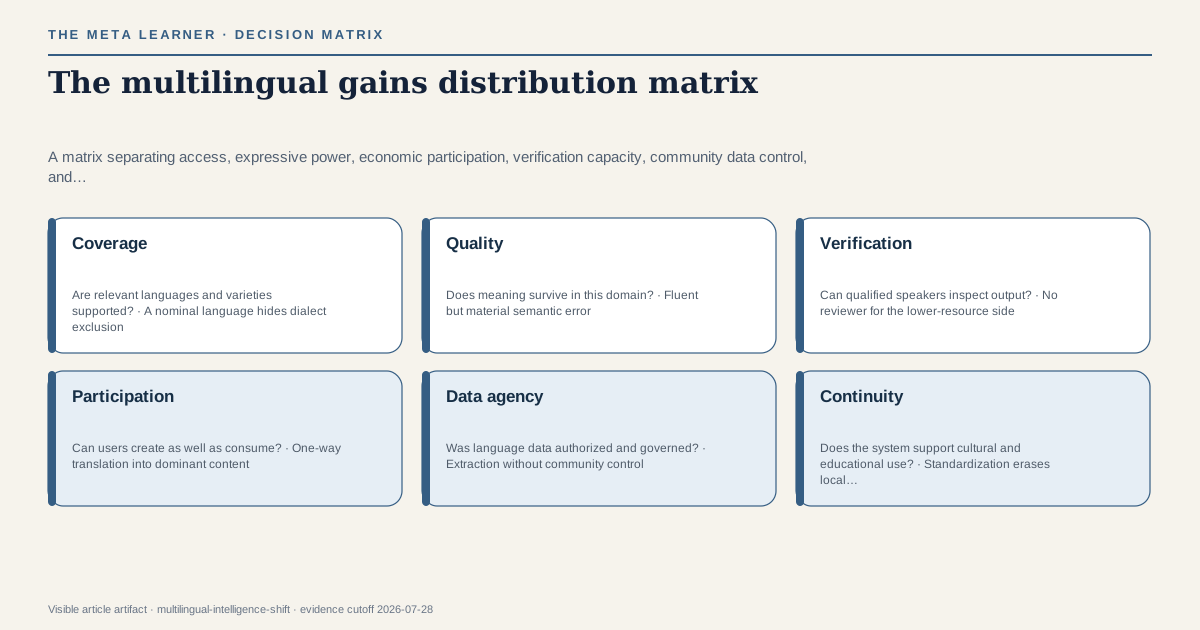
The multilingual gains distribution matrix
Evaluate a deployment across six dimensions:
| Dimension | Gain question | Failure signal | |---|---|---| | Coverage | Are relevant languages and varieties supported? | A nominal language hides dialect exclusion | | Quality | Does meaning survive in this domain? | Fluent but material semantic error | | Verification | Can qualified speakers inspect output? | No reviewer for the lower-resource side | | Participation | Can users create as well as consume? | One-way translation into dominant content | | Data agency | Was language data authorized and governed? | Extraction without community control | | Continuity | Does the system support cultural and educational use? | Standardization erases local forms |
A deployment that performs well for travel phrases may fail in consent, assessment, law, health, or heritage.
Bounded case: a multilingual training program
A company translates a safety course from English into six workforce languages. Machine translation cuts initial production time. The organization does not assume equivalence. It recruits qualified reviewers for each language, tests comprehension with scenarios rather than word matching, records disputed terminology, and maintains a route for workers to report ambiguity.
One language lacks an accepted equivalent for a technical term, so the course keeps the original term, a local explanation, and a visual example. The result is not merely a translated artifact; it is a language-specific learning design.
This case illustrates a control structure, not proof of safety. First-Language Transfer explains why language-specific structures matter, while The AI Evaluation Divide asks who has the standing to challenge failure.
Does language learning become unnecessary?
Ambient translation reduces the need for some transactional proficiency. It does not reproduce every benefit of knowing a language: direct relationship, humor, identity, cultural reference, participation without mediation, or the ability to notice when translation has failed.
The rational learning target may change. Some people will rely on tools for broad access and learn enough language for verification and relationship. Others will pursue deep proficiency because the human and professional value lies precisely in unmediated meaning. There is no universal replacement threshold.
Scenarios and multilingual signposts
Broad inclusion. Quality and coverage improve across language communities. Signposts: community-led datasets, transparent pair-specific evaluation, local-language creation, and accessible correction.
Thin universality. Platforms claim many languages but deliver uneven depth. Signposts: interface localization without domain competence, heavy pivot-language dependence, and weak dialect support.
Language enclosure. A few platforms mediate cross-language knowledge and control memory, data, and ranking. Signposts: proprietary evaluation, limited export, disappearing source text, and centralized terminology.
Plural intelligence. Translation supports knowledge moving in several directions. Signposts: cited local sources, multilingual research discovery, community governance, and institutions that publish in more than one language.
Assessment signposts
Track performance by language pair, domain, modality, dialect, and consequence—not a single multilingual score. Observe whether errors cluster around culturally specific concepts, code-switching, names, negation, or power-sensitive speech. In education, compare content knowledge separately from proficiency in the assessment language.
Education After the Take-Home Essay extends that distinction: when polished language becomes easier to produce, assessment must reveal provenance, reasoning, and transferable performance rather than treating surface fluency as sufficient evidence.
Invalidation signals for the multilingual gains distribution matrix
The distribution thesis would weaken if robust, independently evaluated translation quality converged across languages and dialects while data agency, verification access, and expressive participation also equalized. It would also weaken if users consistently recognized and corrected mediation failures without language-specific expertise.
For a local deployment, stop or narrow use when qualified review is unavailable for a consequential language pair, user comprehension worsens, or the system cannot preserve an essential term.
Limits of the ambient-translation frame
Language coverage and performance change rapidly, and public evaluations rarely represent every dialect, register, domain, disability, or cultural context. “Community” is not a single voice, and data governance can involve internal disagreement. The article does not compare products or predict language loss. Its scenarios are bounded by evidence available on July 28, 2026.
The multilingual shift will be judged not by how many languages an interface lists, but by how many people can think, contribute, verify, and refuse through it.
Named sources
Evidence and further reading
Published July 29, 2026. No substantive revision has been recorded. Evidence last verified July 28, 2026.