The Rise of Personal AI Workspaces: Memory, Context, and Dependency
A structural analysis of persistent AI workspaces as cognitive infrastructure: their leverage, memory risks, portability boundaries, and dependency tests.
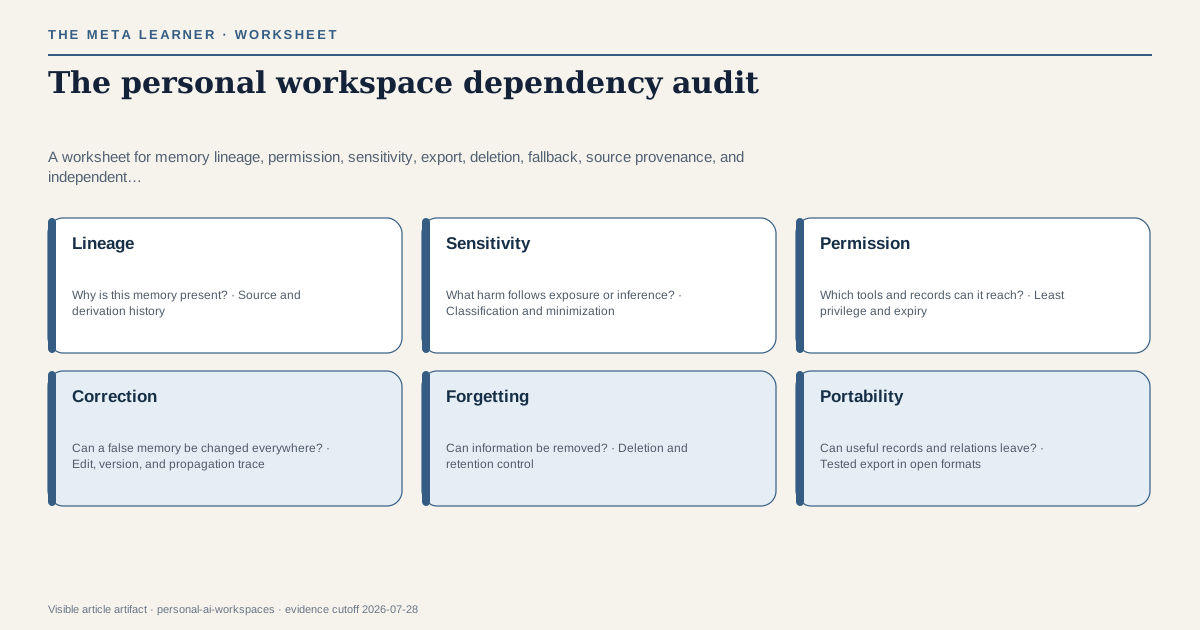
A personal AI workspace is more than a chatbot when it retains memory, accesses files and tools, and carries context across projects. It can reduce setup cost and extend cognition, but it also concentrates sensitive history and creates dependency. A trustworthy workspace needs visible memory lineage, bounded permissions, export and deletion, source provenance, and a tested fallback when the system is absent or wrong.
What is becoming observable
Observed facts at this stage concern enabling components rather than one settled product category: persistent context, tool access, agent standards work, privacy risk management, and longstanding human use of external cognitive aids.
NIST’s agent standards initiative focuses on secure identity, interoperability, and trusted action as AI systems gain tool access.nist-agent-initiative, nist-privacy, nist-rmf, cognitive-offloading The NIST Privacy Framework offers a risk-management approach for identifying and managing privacy consequences in systems and organizations.nist-privacy The AI RMF adds lifecycle governance and measurement.nist-rmf
Research on cognitive offloading describes how people use external actions and tools to reduce internal cognitive demand.cognitive-offloading External memory is not inherently a loss of capability; notebooks, calendars, and search are foundational cognitive infrastructure. Persistent AI changes the degree because it can select, summarize, infer, and act on the stored context.
The sources support privacy and risk management for AI-enabled systems and the broader legitimacy of cognitive offloading. Long-term evidence on personal AI workspaces as a distinct category remains limited.
Claim sources: nist-agent-initiative, nist-privacy, nist-rmf, cognitive-offloading
From archive to active context
A traditional archive waits for retrieval. A personal AI workspace may decide which past note matters, infer a preference, combine projects, draft from earlier work, or act through connected services.
That creates three kinds of memory:
- source memory: files, messages, records, and links supplied by the user;
- derived memory: summaries, inferred preferences, profiles, and relationships;
- action memory: prior tool calls, outcomes, corrections, and permissions.
Users need to know which kind shaped an answer. A false derived memory can persist and influence many later tasks; a sensitive source memory can be exposed through an overbroad permission; an action memory can normalize a bad precedent.
Our inference: context becomes a switching cost
The more useful the workspace becomes, the harder it is to leave. The platform has accumulated vocabulary, projects, corrections, preferences, and workflow integrations. Exporting raw files may not export the relationships or derived memory that produced the value.
This creates a new form of lock-in: not only data possession, but cognitive continuity. A user may tolerate price, policy, or quality changes because rebuilding context feels like rebuilding a working self.
The opposite is also possible. Open formats, interoperable agent protocols, and local or user-controlled memory could make context portable. The strategic question is who owns the transformation from records into working memory.
The dependency audit
For each workspace, record:
| Dimension | Question | Minimum control | |---|---|---| | Lineage | Why is this memory present? | Source and derivation history | | Sensitivity | What harm follows exposure or inference? | Classification and minimization | | Permission | Which tools and records can it reach? | Least privilege and expiry | | Correction | Can a false memory be changed everywhere? | Edit, version, and propagation trace | | Forgetting | Can information be removed? | Deletion and retention control | | Portability | Can useful records and relations leave? | Tested export in open formats | | Fallback | What happens without the workspace? | Independent procedure and backup |
Do not wait for migration to run the export test. How to Build a Personal Knowledge Base That Survives Tool Changes supplies the portable core.
Bounded case: a researcher’s workspace
A researcher connects papers, notes, interview records, and a calendar to an assistant. It remembers terminology, suggests related sources, and drafts weekly briefs. The leverage is real.
The researcher separates public sources from sensitive notes, keeps stable IDs in exportable files, requires citations for material claims, disables autonomous external messaging, and audits derived memories monthly. A second workflow can reconstruct one project from the export. Sensitive interview data remain in an approved system rather than the general workspace.
The case is not a product recommendation or a security guarantee. It shows how value and dependency can be measured together.
Human capability is part of resilience
If the workspace frames every question, retrieves every source, and writes every synthesis, the user may lose visibility into their own process. Dependence matters most when an error is hard to recognize or the tool becomes unavailable.
Use paired performance: complete one representative task with normal support and another with restricted memory or a seeded false context. Assess problem framing, source recovery, anomaly detection, and correction—not recall for its own sake.
Train a Team to Use AI Without Creating Hidden Dependence adapts this logic to collective work.
Workspace scenarios and signposts
User-controlled cognitive layer. Memory is portable, inspectable, permissioned, and reversible. Signposts: open export, source-level lineage, granular deletion, local options, and interoperable tools.
Platform enclosure. Context becomes proprietary and difficult to migrate. Signposts: incomplete exports, opaque derived profiles, bundled services, and rising switching cost.
Agentic workspace. Memory drives autonomous actions across services. Signposts: agent identity, delegated authority, action logs, approval policies, and incident recovery.
Memory backlash. Privacy or security failures lead users to prefer ephemeral systems. Signposts: memory-off modes, local processing, shorter retention, and regulatory scrutiny.
Enterprise agent controls in Are Organizations Ready to Absorb AI Agents? provide a stricter comparison.
Invalidation signals for the personal workspace dependency audit
The dependency thesis would weaken if useful context became fully portable across systems, derived memory remained transparent and correctable, and users could switch without meaningful loss. It would also weaken if persistent workspaces showed no effect on privacy exposure or independent capability.
For an individual, leave or narrow the workspace when memory lineage is unavailable, sensitive aggregation exceeds permission, deletion cannot be verified, or the system becomes necessary for tasks whose failure consequences exceed its controls.
Limits of the workspace lens
This article does not audit any product, contract, privacy policy, encryption scheme, or legal right. NIST frameworks are voluntary risk-management resources, not proof of compliance. Cognitive offloading research is broader than current AI workspaces, and long-term dependency effects are not settled. Accessibility tools can increase independence and should not be stigmatized as harmful offloading. Evidence is current to July 28, 2026.
The best personal workspace should remember enough to help—and remain transparent enough that the user still owns the continuity.
Named sources
Evidence and further reading
Published July 29, 2026. No substantive revision has been recorded. Evidence last verified July 28, 2026.