How to Train a Team to Use AI Without Creating Hidden Dependence
Train teams through task literacy, source verification, independent baselines, failure drills, transfer checks, and explicit fallback capability.
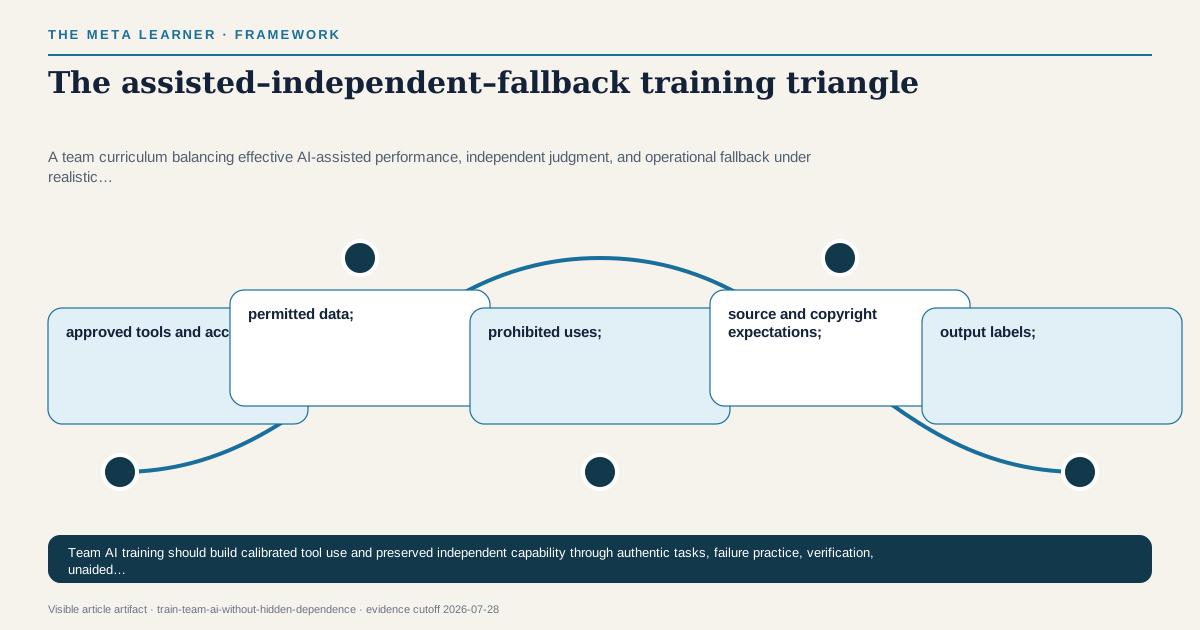
Train a team in three modes: assisted performance, independent judgment, and fallback. Use real approved tasks, teach source and data boundaries, practise known failure modes, require people to explain and verify outputs, and periodically test the capabilities they still need without AI. Dependence is hidden when the workflow works only while the tool is available and no one can recognize when it is wrong.
Tool fluency can conceal capability loss
A team can become faster at prompting while becoming weaker at framing, checking, or explaining. The output still looks strong because the tool supplies missing structure. Dependence becomes visible only when an unfamiliar case appears, a model fails, or a reviewer must defend the decision.
This is not an argument against cognitive offloading. Humans routinely use writing, calculators, checklists, and collaborators. Research on cognitive offloading studies how external action reduces cognitive demands and depends on metacognitive judgments.cognitive-offloading, oecd-ai-skills, nasem-learning The managerial question is which internal capability remains necessary for safe and valuable use.
Define required independent capability
For each workflow, ask:
- What must a person know to frame the task?
- Which anomalies must be recognized before search?
- What requires source verification?
- Which decision cannot be delegated?
- What must continue during outage or access loss?
- Which capability develops future reviewers?
Do not test people on everything the tool can retrieve. Test what they must independently judge or perform.
The training triangle
Assisted: use AI effectively within approved boundaries.
Independent: perform or judge the critical components without seeing AI output.
Fallback: continue safely, pause, or escalate when the system is unavailable or unreliable.
Each training unit needs one task in all three modes.
OECD evidence emphasizes a wide mix of foundational, digital, managerial, and human capabilities in the AI age. Learning science supports active performance, feedback, and transfer. Cognitive-offloading research explains external support but does not yield a universal anti-dependence training schedule.
Claim sources: oecd-ai-skills, nasem-learning, cognitive-offloading
Teach the workflow boundary
Employees need to know:
- approved tools and accounts;
- permitted data;
- prohibited uses;
- source and copyright expectations;
- output labels;
- review thresholds;
- escalation;
- incident reporting;
- accountability.
Policy knowledge should be applied to cases, not delivered only as slides. Present ambiguous examples and ask people to decide whether to proceed, restrict, or escalate.
Practise failure, not only success
Build examples with:
- invented citation;
- outdated policy;
- subtle numerical inconsistency;
- prompt injection in source text;
- sensitive data;
- confident answer outside scope;
- biased or inaccessible output;
- tool outage.
Ask trainees to identify the cue, explain consequence, and take the correct next action. Measure detection, not their confidence.
Preserve learning tasks
How People Learn II emphasizes prior knowledge, metacognition, feedback, and context.nasem-learning New staff may need to perform some work manually before they can evaluate automation.
Use:
- manual baseline cases;
- blind judgment before AI output;
- error classification;
- rotation through exceptions;
- paired review;
- explanation from evidence;
- later transfer cases.
The point is not ritual deprivation. It is to build the mental model required for oversight.
Decomposing a case with the assisted–independent–fallback training triangle
A research team trains analysts to use AI for source triage.
- Assisted mode: AI clusters search results and extracts candidate metadata.
- Independent mode: analysts evaluate authority, study design, claim support, and contradiction from opened sources.
- Fallback mode: a documented manual search and screening process activates if the tool fails or data cannot be shared.
Training includes fabricated and misattached citations. Analysts must trace them, not merely flag that AI “may hallucinate.” The use remains triage; AI does not decide final inclusion.
Measure team capability
Use four measures:
- assisted task quality and total time;
- independent detection of seeded errors;
- transfer to an unfamiliar case;
- correct fallback or escalation.
Track variation across roles. Averages can hide a reviewer group whose capability is inadequate for the responsibility assigned.
OECD’s report argues that most workers need broader digital and complementary capability rather than advanced AI development skill.oecd-ai-skills Training should begin with work and responsibility, not technical spectacle.
Build the training triangle
- Select one permitted workflow.
- define required independent capabilities.
- create assisted, independent, and fallback cases.
- teach boundaries and evidence routines.
- include realistic failures.
- assess against a frozen rubric.
- remediate the error pattern.
- authorize only the tested scope.
Start with AI Literacy for Adult Learners, require Verify AI Explanations and Sources, and use Build Your First Useful AI Workflow as a bounded practice environment.
AI training that teaches compliance theater
- A prompt library with no task model.
- policy slides with no cases.
- successful demos with no failure drills.
- measuring attendance instead of performance.
- assessing output polish without source verification.
- removing novice practice without replacement.
- testing people on trivia the tool should retrieve.
Use paired assessments to make dependence visible. Give the team one representative case with approved AI support and a second, varied case in which the relevant support is unavailable or deliberately unreliable. Score not only the final answer but problem framing, evidence selection, anomaly detection, escalation, and correction. A performance drop is not automatically failure—external tools are legitimate cognitive resources—but it reveals which fallback capability, redundancy, or operating limit the workflow needs. Publish the boundary internally so speed under normal conditions is not confused with resilience under degraded ones.
Dependence is task-specific
Unaided tests can be unnecessary or exclusionary when external aids are legitimate accommodations or standard professional tools. Teams differ in required fallback, and some automated systems may not need item-level human judgment. Training cannot authorize prohibited use or solve poor workload, incentives, governance, or tool design.
The capable team is not the one that can work as if AI never existed. It is the one that knows what to delegate, what to retain, and what to do when the boundary fails.
Named sources
Evidence and further reading
Published July 29, 2026. No substantive revision has been recorded. Evidence last verified July 28, 2026.