AI Agents Are Improving. Are Organizations Ready to Absorb Them?
A readiness test for agentic AI that separates technical progress from identity, authorization, data, observability, evaluation, and incident capacity.
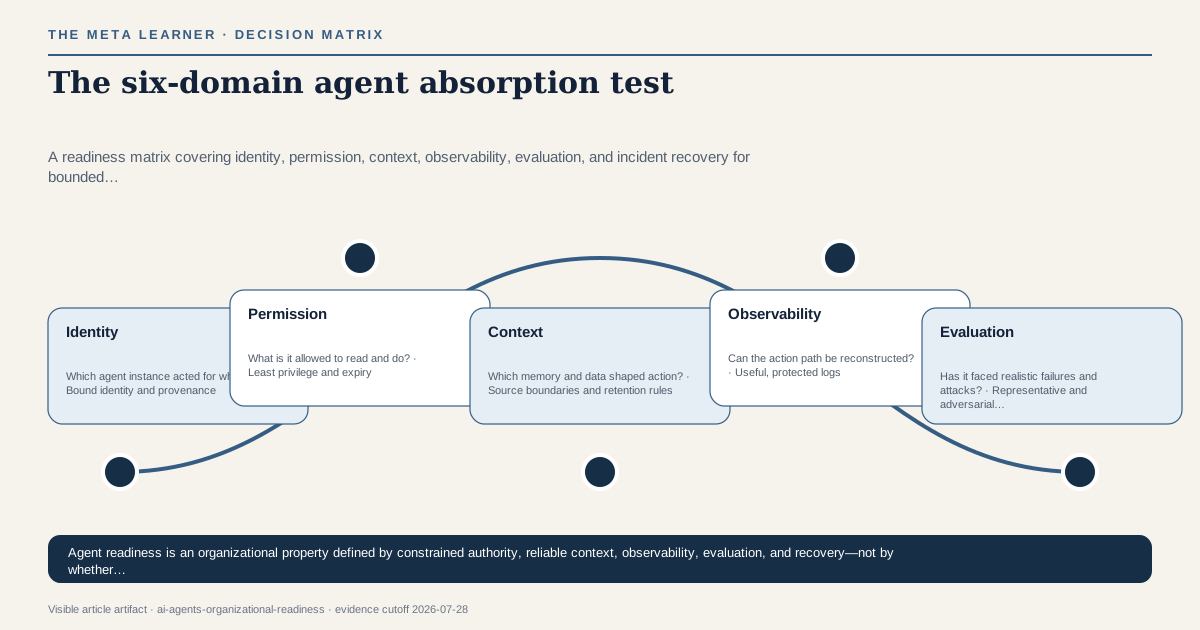
Organizations are ready for AI agents only when they can define the agent’s identity, limit its authority, govern its context and memory, observe actions, evaluate representative failures, and recover from mistakes. Better task completion is necessary but insufficient. The readiness test is whether the surrounding institution can safely absorb delegated action.
The evidence now visible
Observed facts at the evidence cutoff are narrower than the surrounding hype: agent benchmarks improved, reported production use remained early, and public standards work was still addressing identity, interoperability, authorization, and security.
The 2026 Stanford AI Index describes continuing progress on agentic evaluations while noting meaningful failure rates on structured tasks.stanford-technical, stanford-economy, nist-agent-initiative, nist-agent-security Its economic evidence reports that agent use remained early even amid broad organization-level AI adoption.stanford-economy Technical possibility and deployed prevalence are moving at different speeds.
NIST launched an AI Agent Standards Initiative around security, identity, interoperability, and trusted adoption.nist-agent-initiative Its analysis of public responses on agent security reports agreement that agent systems introduce security concerns that impede adoption and require adaptations to established cybersecurity practices.nist-agent-security
Current evidence supports improving agent capability, early deployment, and unresolved security and standardization needs. It does not support a claim that all agents are unsafe or that one control set fits every organization.
Claim sources: stanford-technical, stanford-economy, nist-agent-initiative, nist-agent-security
The shift from answer risk to action risk
A chatbot can produce a wrong sentence. An agent can turn a wrong intermediate belief into a sequence of tool calls. The system may read a message, update a record, send a file, book a service, or change code before a human sees the chain.
The relevant risk therefore includes:
- what the agent believes its goal to be;
- which sources count as instructions rather than untrusted data;
- which identity it presents to other systems;
- which data and tools it may access;
- how permissions change with context;
- whether actions and intent are reconstructable;
- what can be reversed, by whom, and how quickly.
This does not mean every action requires approval. It means autonomy should be engineered as a bounded grant rather than inferred from technical capability.
Our inference: readiness is a property of the host
The same agent can be tolerable in a sandbox and reckless in production. The difference is not only the model. It is the environment, authority, observability, and consequence.
An organization with clean identity systems, explicit process owners, reliable data, representative evaluation cases, and rehearsed response may absorb a moderately capable agent responsibly. Another organization may fail with a stronger one because permissions are inherited, exceptions are undocumented, and nobody can reconstruct what happened.
This interpretation treats organizational readiness as a form of infrastructure.
The six-domain absorption test
| Domain | Minimum question | Evidence of readiness | |---|---|---| | Identity | Which agent instance acted for whom? | Bound identity and provenance | | Permission | What is it allowed to read and do? | Least privilege and expiry | | Context | Which memory and data shaped action? | Source boundaries and retention rules | | Observability | Can the action path be reconstructed? | Useful, protected logs | | Evaluation | Has it faced realistic failures and attacks? | Representative and adversarial cases | | Recovery | Can harm be stopped and reversed? | Kill path, rollback, owner, rehearsal |
A seventh domain sits across all six: worker and user voice. People who perform exceptions or bear consequences often see failure paths absent from architecture diagrams.
Before deployment, pair this test with The Manager’s Human-Checkpoint Map and How Teams Can Adopt AI Without Losing Accountability.
Bounded case: a procurement agent
An organization wants an agent to collect vendor information, compare offers, and draft purchase requests. A demonstration shows it can navigate websites and complete forms.
A readiness review separates three authority levels. The agent may search public sources and prepare a comparison. It may enter a draft into an internal system with its sources and uncertainty. It may not accept contractual terms, disclose protected information, choose the winning vendor, or submit payment.
Representative tests include a malicious instruction embedded in a vendor page, inconsistent price units, expired quotations, and a request that exceeds budget authority. Logs must show which source triggered each action. The procurement owner controls submission.
This is not proof that the design is secure. It shows how agent capability becomes a narrower, inspectable delegation.
Three readiness scenarios
Contained assistants. Most organizations keep agents inside research, drafting, coding sandboxes, or reversible internal steps. Signposts: narrow permissions, frequent checkpoints, and limited external action.
Controlled process agents. Mature organizations delegate multi-step workflows with identity, policy enforcement, monitoring, and rollback. Signposts: agent-specific credentials, incident exercises, audited tool scopes, and measured exception rates.
Premature autonomy and retreat. Competitive pressure drives broad permissions before controls mature; incidents cause reversals. Signposts: shared credentials, missing provenance, post-hoc ownership disputes, and sudden access restrictions.
These scenarios may arrive in that order, coexist, or reverse. Sector rules and failure costs matter more than a universal timeline.
Signposts inside the organization
Track the share of agent actions that are reversible; privileged tool calls; overrides; seeded-attack detection; unresolved identity events; review time; exception load; and time to stop or restore a workflow. Also track whether workers retain the independent capability needed to recognize a bad trajectory.
For personal systems, The Rise of Personal AI Workspaces explores the related problem of persistent memory without enterprise controls.
Invalidation and reversal
The readiness thesis would weaken if reliable agents could safely operate across changing tools and adversarial inputs without explicit identity, permission, observability, or recovery. It would also change if standardized infrastructure made these controls automatic, cheap, and consistently effective.
For a specific deployment, reverse or narrow authority when severe actions escape the boundary, audit trails cannot explain them, permissions expand unexpectedly, review capacity is overwhelmed, or independent evaluation materially deteriorates.
What remains uncertain
Agent definitions, benchmarks, architectures, and standards are changing. NIST’s initiative and security work describe an emerging field rather than a complete certification regime. Public incidents are selectively reported, and vendor demonstrations may not represent local environments. The six-domain test is an editorial synthesis with an evidence cutoff of July 28, 2026.
Agent progress makes the readiness question more urgent. It does not answer it.
Named sources
Evidence and further reading
Published July 29, 2026. No substantive revision has been recorded. Evidence last verified July 28, 2026.