How Teams Can Adopt AI Without Losing Accountability
Adopt AI through named decision owners, approved uses, representative tests, worker participation, documented controls, escalation, and correction.
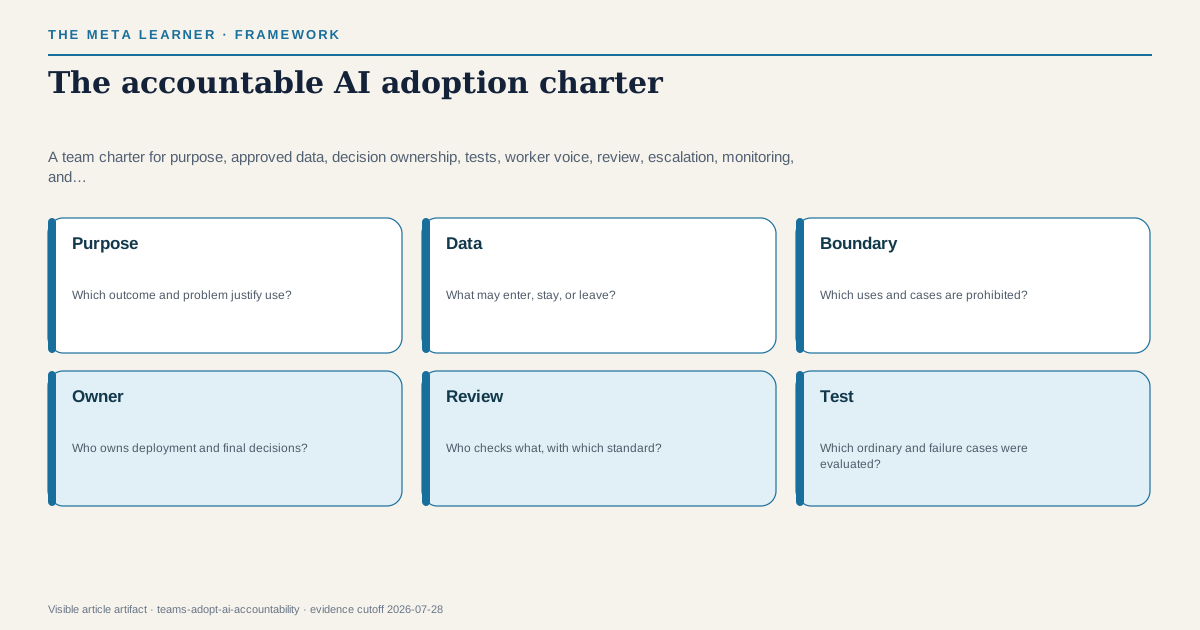
Teams can adopt AI without losing accountability by writing a use charter before scaling: name the purpose, approved data, prohibited uses, decision owner, reviewer, test set, escalation route, monitoring signals, worker participation, and correction process. AI may generate or recommend; an authorized person must still own the decision, explain it, and have power to stop the system.
Adoption can diffuse responsibility
When AI arrives through individual experimentation, responsibility becomes ambiguous. The employee chose the tool; procurement owns the contract; security owns data policy; a manager approves the output; the vendor designed the model. When harm appears, every party can point elsewhere.
Accountability is not blame assigned after failure. It is a design that lets people know who can authorize, challenge, stop, correct, and answer for a decision before the workflow runs.
Start with one use, not “AI”
Define:
- task and outcome;
- user and affected people;
- inputs and their sensitivity;
- AI operation;
- decision consequence;
- realistic alternative;
- excluded cases.
“Use a chatbot for productivity” is ungovernable. “Draft non-confidential internal meeting summaries for human correction” is testable.
The accountable adoption charter
| Element | Required decision | |---|---| | Purpose | Which outcome and problem justify use? | | Data | What may enter, stay, or leave? | | Boundary | Which uses and cases are prohibited? | | Owner | Who owns deployment and final decisions? | | Review | Who checks what, with which standard? | | Test | Which ordinary and failure cases were evaluated? | | Voice | Which workers and affected groups were involved? | | Escalation | What trigger goes to whom? | | Monitor | Which quality, risk, and workload signals continue? | | Correct | How are outputs, users, and process corrected? |
NIST’s AI RMF places governance across the lifecycle and organizes work through govern, map, measure, and manage.nist-rmf, gao-accountability, oecd-job-quality, nber-genai-work
NIST and GAO frameworks support named governance, data, performance, monitoring, and risk practices. OECD evidence emphasizes that workplace outcomes depend on organizational choices and job-quality effects. The charter is a practical synthesis, not a compliance certification.
Claim sources: nist-rmf, gao-accountability, oecd-job-quality, nber-genai-work
Include the people whose work changes
AI adoption can shift review burden, autonomy, monitoring, skill formation, and exposure to error. Invite the people who perform the work—not only executives and tool enthusiasts—to map exceptions and failure consequences.
OECD analysis of AI and job quality discusses how outcomes vary with workplace use, consultation, training, and organizational context.oecd-job-quality Participation does not mean every preference prevails; it means the design uses operational knowledge and makes distribution visible.
Test accountability, not only accuracy
Run scenarios:
- reviewer disagrees with AI;
- source evidence is missing;
- personal data appears;
- tool is unavailable;
- output harms a user;
- employee reports a concern;
- model behavior changes;
- vendor access or terms change.
Observe whether the named person can actually stop, escalate, and correct. A role in a document without time or authority is not a control.
Monitor three systems
Technical: quality, error, drift, availability, security.
Workflow: review time, exceptions, handoffs, rework, backlog.
Human: workload, autonomy, learning, speaking up, distribution of benefit and harm.
GAO’s accountability framework is organized around governance, data, performance, and monitoring, with assessment questions for organizations and auditors.gao-accountability Consult the full framework where applicable.
Evidence-bounded case: the accountable AI adoption charter
A communications team pilots AI for internal summaries.
The charter allows only approved, non-sensitive meetings; participants are informed; a named employee reviews accuracy and omissions; decisions and quotations are checked against the recording or notes; sensitive meetings are excluded; corrections update the distributed summary; workload and missed commitments are measured.
AI never sends automatically. The department head owns the pilot, while information-security and privacy owners retain their authorities. The case is low consequence relative to many deployments and should not be generalized to personnel or customer decisions.
Write the accountable adoption charter
- Choose one bounded use.
- map task, data, decision, and affected people.
- involve workers who know exceptions.
- assign owner, reviewer, and escalation.
- create representative and failure cases.
- freeze approval and stop thresholds.
- pilot with logs.
- review technical, workflow, and human outcomes.
Use Audit Your Work for Automation, Augmentation, and Human Judgment, inspect Build Your First Useful AI Workflow, and require Verify AI Explanations and Sources where claims enter work.
Team AI rules that govern nothing
- “Use responsibly.”
- “Always have a human in the loop.”
- “Do not share sensitive data” without a data classification.
- approving a tool but not a use case.
- assigning risk to the most junior reviewer.
- measuring licenses activated rather than outcomes.
- allowing exceptions through private messages.
- retaining logs no one reviews.
Stress-test the charter with an incident rehearsal. Seed a plausible but consequential error into a representative workflow, then observe who notices, who can pause use, what evidence survives, how affected people are informed, and where correction authority sits. Include a routine case too, because controls that work only during a staged crisis may collapse under volume. The NBER study of a deployed assistant offers bounded evidence that real workplace effects can differ across workers; it does not show that adoption is accountable by default.nber-genai-work A charter is credible when ordinary behavior—not its vocabulary—routes capability through explicit ownership.
Repeat the rehearsal after a model, policy, staffing, or workflow change; the authorization boundary may have moved even when the charter text did not.
A charter is not authorization
Organizations may need legal, privacy, security, procurement, records, accessibility, worker-representation, sector, and affected-community processes beyond this charter. Some uses should not proceed. Monitoring can itself become surveillance. Accountability varies by jurisdiction and cannot be delegated to this general framework.
Adoption becomes responsible when a team can answer not only “What can the tool do?” but “Who has the duty and power to decide what happens next?”
Named sources
Evidence and further reading
Published July 29, 2026. No substantive revision has been recorded. Evidence last verified July 28, 2026.