From Search to Synthesis: What Changes When Answers Arrive First
How answer-first interfaces reorder inquiry, source discovery, appraisal, and synthesis—and how to preserve intellectual agency without rejecting assistance.
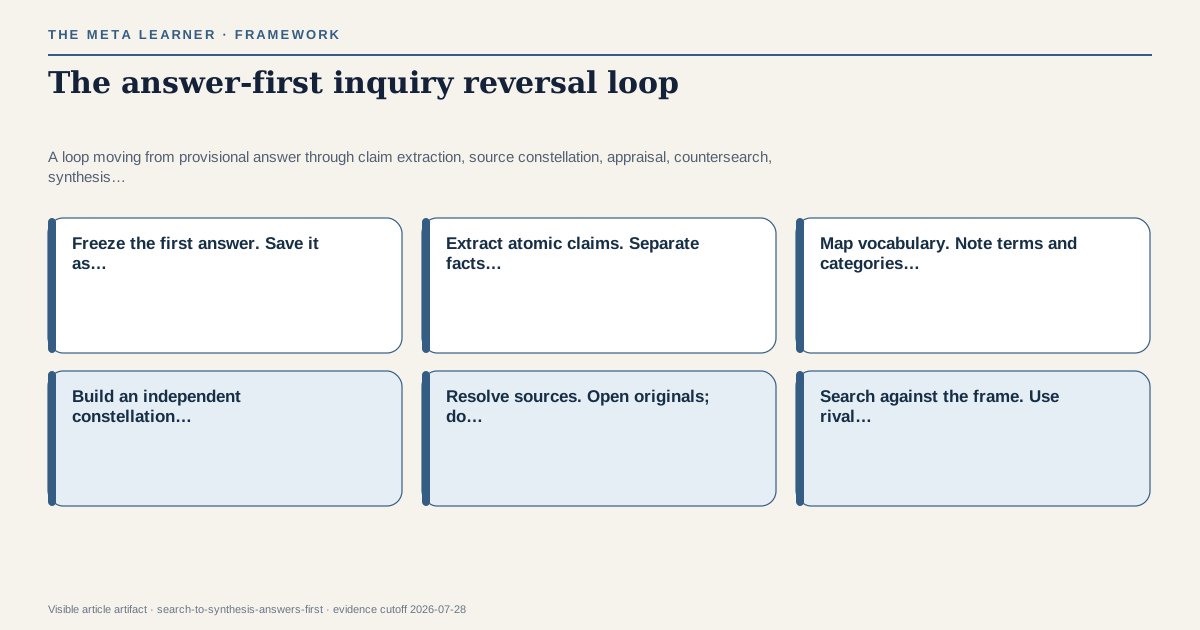
When answers arrive first, inquiry begins with a generated synthesis rather than a results page. This can accelerate vocabulary, framing, and source discovery, but it can also anchor the question before the researcher sees the field. Treat the answer as a provisional claim map: extract its assertions, build an independent source constellation, seek disagreement, and rewrite only after opening the evidence.
What is observed in answer-first inquiry
The ACRL framework presents research as inquiry, authority as contextual, and information creation as a process.acrl-framework, stanford-lateral, cochrane-synthesis, nist-synthetic These principles matter more when an interface hides the creation process behind one fluent response.
Stanford’s lateral-reading research shows why evaluating a source often requires leaving it to investigate who is behind it and what other sources say.stanford-lateral Cochrane guidance on non-meta-analytic synthesis emphasizes transparent methods rather than informal vote counting.cochrane-synthesis NIST’s synthetic-content review distinguishes provenance and transparency from guaranteed truth.nist-synthetic
The sources support inquiry, lateral verification, transparent synthesis, and provenance awareness. The claim that answer-first interfaces reorder inquiry is an interpretive description, not a measured universal cognitive effect.
Claim sources: acrl-framework, stanford-lateral, cochrane-synthesis, nist-synthetic
The old and new sequence
A simplified search-first sequence looked like this:
question → query → results → source selection → reading → comparison → synthesis.
An answer-first sequence often looks like:
question → synthesis-shaped answer → cited or uncited sources → selective checking.
The new sequence is not inherently worse. It can give a non-specialist vocabulary, reveal subquestions, translate technical language, and expose potential sources. The risk is asymmetry: the generated frame determines which checks feel necessary. A claim omitted from the answer may never enter the search.
The researcher must therefore reverse the answer back into inquiry.
Our inference: framing becomes the hidden retrieval system
Every synthesis includes a selection model: what counts as the question, which concepts matter, whose evidence is relevant, and where disagreement sits. In a traditional review, the researcher gradually constructs that model. In an answer-first interface, a model presents one immediately.
That convenience can become epistemic enclosure. Search terms, clicked sources, and counterarguments all inherit the initial vocabulary. The interface need not fabricate anything to narrow the field; it only needs to offer a coherent first frame.
The new foundational skill is not refusing the answer. It is making its selection model visible.
The answer-first inquiry reversal loop
- Freeze the first answer. Save it as a dated artifact rather than allowing silent regeneration.
- Extract atomic claims. Separate facts, interpretations, recommendations, and uncertainties.
- Map vocabulary. Note terms and categories the answer introduced.
- Build an independent constellation. Identify official, research, professional, critical, and affected-party sources.
- Resolve sources. Open originals; do not trust citation strings.
- Search against the frame. Use rival terms, excluded groups, and reversal questions.
- Appraise and cluster. Track methods, scope, dependence, and study families.
- Resynthesize. State what changed from the first answer and why.
The output is not merely a better answer. It is an inspectable history of inquiry.
Bounded case: a workplace policy question
A manager asks whether remote work reduces productivity. An AI answer provides a balanced summary and several citations. The team extracts claims about output, collaboration, creativity, retention, and well-being.
It then notices the answer treats “remote work” as one intervention and “productivity” as one outcome. Independent search adds hybrid arrangements, task interdependence, selection effects, worker disability, household conditions, and different measurement periods. Some cited articles report the same dataset.
The final synthesis becomes conditional: which tasks, teams, coordination systems, workers, and outcomes? The first answer was useful as a question generator, not as the final evidence model.
How to Find the Best Sources on an Unfamiliar Topic builds the constellation; How to Synthesize 20 Sources reconstructs the point of view.
What changes for search providers and publishers
When answers occupy the top layer, publishers may receive less direct attention while their information is transformed into a response. Source visibility, attribution, correction, and economic sustainability become system-design questions.
Users need source-level controls: open the exact passage, distinguish quotation from synthesis, see publication and evidence dates, identify which claims lack support, and report an error. Publishers need stable identifiers and machine-readable provenance without surrendering human-readable context.
The research interface should make uncertainty navigable, not merely append a citation list.
Inquiry scenarios and signposts
Evidence-aware synthesis. Answers expose claim-source mappings and counterevidence. Signposts: exact passages, source diversity, version dates, uncertainty, and easy source opening.
Answer enclosure. Users remain inside generated synthesis. Signposts: falling source clicks, circular citations, repeated frames, weak correction visibility, and lost disagreement.
Hybrid research workspace. AI assists orientation, search, appraisal, and mapping while the researcher controls selection criteria. Signposts: saved protocols, source ledgers, independent search, and change records.
Verification bifurcation. Casual users accept answers while specialists purchase deeper evidence. Signposts: premium provenance, closed databases, and unequal access to source appraisal.
Practical signposts
Measure how often users open sources, whether cited passages support claims, diversity and independence of sources, rate of unresolved identifiers, changes after countersearch, and correction latency. The Evidence Map provides a structure for recording the result.
Do not treat a higher citation count as success if the answer still controls which questions can be asked.
Invalidation signals for the answer-first inquiry reversal loop
The anchoring thesis would weaken if answer-first systems consistently broadened source discovery, surfaced rival frames, increased original-source reading, and improved synthesis accuracy without a deliberate reversal loop. It would also weaken if users naturally treated first answers as provisional across contexts.
For a workflow, skip the full loop when the task is low-stakes, the answer is easily verified, and no consequential decision follows. Increase it when claims are novel, contested, time-sensitive, or difficult to reverse.
Limits of the reversal loop
This article does not compare search products or establish causal effects on reading behavior. Traditional search also ranks, frames, and commercializes attention. Independent search can reproduce the same bias, and comprehensive discovery may require specialist databases or librarians. The loop is not a systematic-review protocol and is current to July 28, 2026.
When answers arrive first, intellectual agency begins by asking what had to disappear for the answer to look complete.
Named sources
Evidence and further reading
Published July 29, 2026. No substantive revision has been recorded. Evidence last verified July 28, 2026.