How to Find the Best Sources on an Unfamiliar Topic
Find authoritative sources in a new field by mapping its institutions, evidence types, vocabulary, landmark work, and current disputes.
To find the best sources on an unfamiliar topic, first map the field: its official institutions, scholarly databases, professional bodies, evidence types, technical vocabulary, landmark works, and current disputes. Search each source role separately, follow citations in both directions, and verify unfamiliar publishers and authors laterally. Do not let the first page of a general search define the field for you.
Why unfamiliar fields distort search
Search rewards vocabulary you already possess. In a new domain, you often query with popular terms while specialists publish under different constructs. Ranking systems then return accessible, optimized, or frequently linked pages—not a balanced model of the field.
The novice’s first task is therefore not “find all the sources.” It is source reconnaissance: learn where knowledge is produced, reviewed, contested, implemented, and corrected. This guide provides a two-hour protocol for a bounded question. It is not a systematic-review method and should not be represented as one.
Draw the source constellation
Put the question at the center and add six nodes:
- Official: regulators, statistical agencies, standards bodies, courts, or intergovernmental organizations.
- Scholarly: databases, journals, conferences, research institutes, and review organizations.
- Professional: associations, technical handbooks, practice guidelines, and certification bodies.
- Operational: datasets, repositories, protocols, manuals, and implementation reports.
- Critical: dissenting scholars, watchdogs, replication efforts, correction systems, and affected communities.
- Explanatory: textbooks, encyclopedias, university guides, and high-quality journalism.
These nodes have different jobs. A regulator can state a rule but may not supply independent evaluation. A company can document its product but not settle comparative effectiveness. A meta-analysis can estimate an effect while missing operational constraints. Authority is contextual, not a universal badge.acrl-search, cochrane-search, stanford-lateral
Search by concept blocks
Rewrite the question as two to four concept blocks. For each block, list:
- everyday language;
- specialist synonyms;
- broader and narrower terms;
- acronyms and prior names;
- relevant populations, settings, outcomes, and methods.
Combine synonyms with OR and distinct concepts with AND where the database supports Boolean logic. Cochrane’s search guidance emphasizes both controlled vocabulary and free text, sensitivity within concepts, documentation, multiple sources, and checks against known relevant studies.cochrane-search Those requirements belong to systematic reviews, but the principles expose why one casual query is fragile.
Do not search every feature of the question at once. Over-specific queries can exclude useful records because titles and abstracts do not mention every outcome or comparator.
Strong discovery requires deliberate query design, more than one source environment, and evaluation outside the page being judged. Formal review standards are stricter than this guide, but they demonstrate how database choice, vocabulary, selection, and documentation influence what evidence becomes visible.
Claim sources: cochrane-search, acrl-search, stanford-lateral
Locate anchors, then branch
Find three anchor types:
- one recent authoritative synthesis or handbook;
- one landmark source that shaped the field;
- one current source that challenges, updates, or narrows the landmark.
Mine their reference lists backward and citation trails forward. Track recurring authors, institutions, measures, and disputes. When a term appears repeatedly, add it to the query map. When one source dominates every path, actively search for independent traditions or counterevidence.
Citation count is a clue to influence, not proof of correctness. Older papers have had more time to accumulate citations; controversial or flawed work can be highly cited; entire communities can share assumptions.
Evaluate laterally
Do not judge an unfamiliar website only by its design or “About” page. Open new tabs to investigate who funds it, how experts describe it, whether its work is indexed or cited, what corrections exist, and whether other credible institutions rely on it. Stanford’s civic online reasoning research develops this practice as lateral reading: leaving an unfamiliar page to learn about the source from elsewhere.stanford-lateral
For each candidate, record:
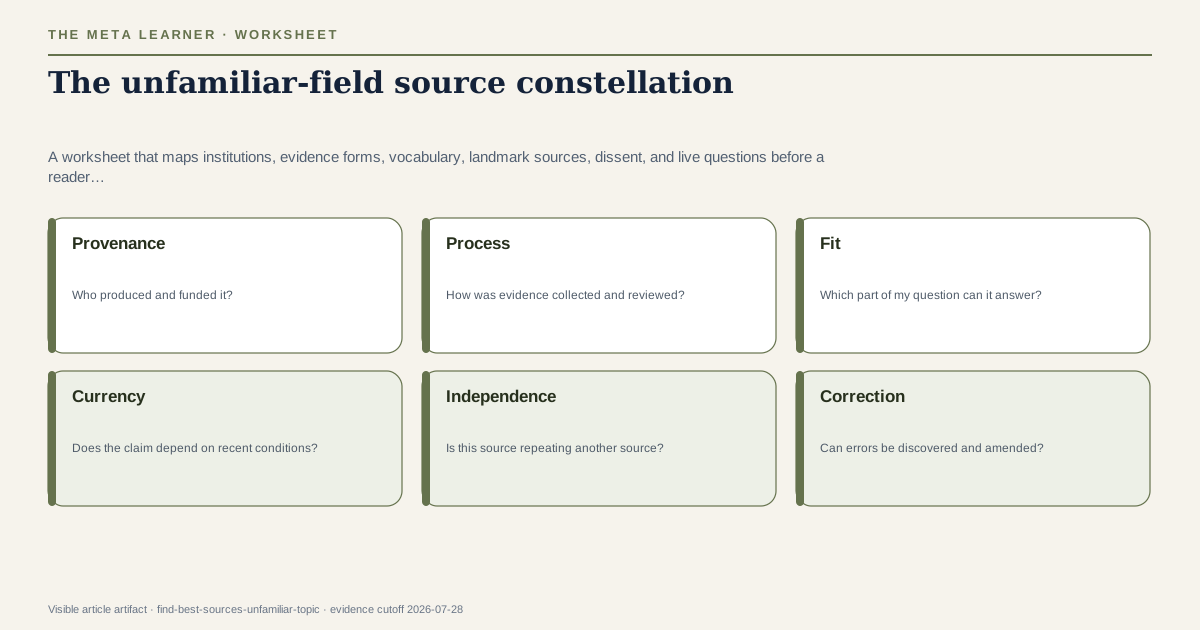
| Field | Question | |---|---| | Provenance | Who produced and funded it? | | Process | How was evidence collected and reviewed? | | Fit | Which part of my question can it answer? | | Currency | Does the claim depend on recent conditions? | | Independence | Is this source repeating another source? | | Correction | Can errors be discovered and amended? |
A worked reconnaissance
Suppose you need to understand “AI and entry-level work.” A generic search produces forecasts, vendor posts, and alarming headlines.
The constellation changes the search:
- labour institutions for occupational and task exposure;
- official occupational databases for task structure;
- organizational research for learning and job design;
- current field studies for measured workplace effects;
- worker organizations for distribution and power;
- vendor documentation only for claimed product capability;
- critics for automation bias, deskilling, and measurement problems.
Your vocabulary expands from “AI job loss” to task exposure, augmentation, job quality, occupational mobility, skill formation, work design, and human oversight. The question becomes better before the answer becomes longer.
Run a two-hour source reconnaissance
- Minutes 0–20: Define one decision and build concept blocks.
- Minutes 20–45: Identify official, scholarly, professional, operational, critical, and explanatory nodes.
- Minutes 45–75: Find the three anchors and mine vocabulary.
- Minutes 75–100: Follow backward and forward citations; search one dissenting frame.
- Minutes 100–115: Laterally verify the ten strongest candidates.
- Minutes 115–120: Select a reading order and document what may still be missing.
Store the result inside Build a Personal Learning System. Use Critical Thinking: A Practical System for Claims and Evidence to appraise it, then How to Read a Difficult Book for the foundational texts.
Discovery traps that feel efficient
- Searching the solution before defining the decision.
- Treating the most visible source as the field’s center.
- Using only one database, language, or disciplinary vocabulary.
- Collecting documents before setting selection criteria.
- Equating official with independent or peer-reviewed with correct.
- Following citations only backward and missing corrections or later evidence.
- Using AI-generated references without resolving and opening them.
- Saving everything and ranking nothing.
Reconnaissance ends with original-source reading, not a list of promising links. Open the primary source or underlying source behind each anchor, reconstruct its main argument, and record which claim the document can actually support. A source constellation is useful only when its nodes resolve to inspectable evidence rather than inherited descriptions.
What reconnaissance will miss
A two-hour map is a starting model, not proof of comprehensive coverage. It may miss non-English research, local records, unpublished studies, proprietary databases, indigenous knowledge, practitioner experience, and evidence described with unfamiliar terms. Formal systematic, legal, safety, or due-diligence work requires a documented protocol, appropriate databases, qualified information specialists, and domain-specific appraisal.
The quality of a research answer is constrained by the world of sources the researcher learned to see. Map that world before collecting its fragments.
Named sources
Evidence and further reading
Published July 29, 2026. No substantive revision has been recorded. Evidence last verified July 28, 2026.